Silvetia compressa
A foundational brown alga of the California intertidal zone.

Silvetia compressa, commonly called golden rockweed, is a species of brown algae that serves as a foundational species in the mid to upper intertidal zone of the California coast. It is notable for creating a dense canopy that slows water, provides shade, and retains moisture, making the habitat habitable for a variety of marine life.
Quick Facts
- Taxon
- Silvetia compressa
Facts from the source article.
Lore & Background
Golden rockweed is a clump-forming species that roots onto rocks using a thick, conical holdfast. Its fronds are golden-brown to olive green, thick, leathery, and bifurcate every 3–5 cm. The blades lack a midrib and are flattened, not gas-filled, giving the species its name compressa. Individuals often form thick mats, though isolated clumps occur in declining populations. It resembles dwarf rockweed (Pelvetiopsis limitata) but is taller with a longer stipe and grows higher up the shoreline.
The species occurs in the Eastern Pacific from Northern California to Baja California, most commonly in Southern California, on rocks in the upper to mid intertidal in protected areas. It is a perennial species; adults can live for eight years, and mortality decreases over the first year of life. Golden rockweed uses diplontic sexual reproduction and is monoecious, producing sperm and eggs at the ends of fertile fronds. Gametes are released during calm low tides, and most offspring settle within 1 m of the parent.
Golden rockweed is in decline throughout its range, with average percent cover decreasing steadily since 2000. Threats include oil spills, trampling, desiccation from Santa Ana wind events (intensifying due to climate change), and increased sea surface temperature during El Niño events. Restoration efforts have involved transplanting full-grown adults affixed to rocks with marine epoxy; one plot at Little Corona del Mar Beach increased from fewer than 70 adults in 2010 to over 1000 mature individuals in 2022.
Reader's Guide
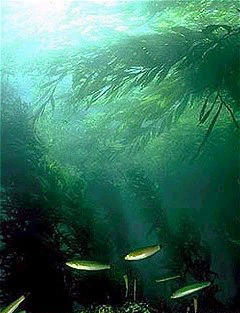
Golden rockweed is considered a foundational or keystone species in the intertidal zone, analogous to forest-forming kelp farther offshore. By forming a dense canopy, it profoundly alters the environment, slowing water, providing shade, and retaining moisture, which makes the mid to upper intertidal habitable for many species. A study in southern California observed 45 species of seaweeds thriving in its subcanopy, including Chamberlainium tumidum, Corallina berteroi, Corallina vancouveriensis, and Pseudolithoderma nigrum. Common animal denizens include sandcastle worms, California mussels, aggregating anemones, Hartweg's chiton, periwinkles, and limpets. The epiphyte Spongonema tomentosum also grows on it. Golden rockweed is a food source for grazers such as Tegula funebralis. Its local disappearance can cause cascading ecosystem effects, leading to declines of numerous animal and algae species. Restoration efforts have focused on transplanting fertile adults to create microhabitats for recruitment, with variable success; further techniques such as lab cultivation could address the limitation of needing nearby healthy donor populations.
Did You Know?
- Golden rockweed can live up to eight years.
- Most offspring settle within 1 meter of the parent plant.
- The species has two subspecies: Silvetia compressa compressa (mainland) and Silvetia compressa deliquescens (island).
More in Brown Macroalgae and Kelp, Part 2 1-24
Spotted an error? Know more?
Reader corrections go straight into our review queue. Suggest an edit · How this site is sourced