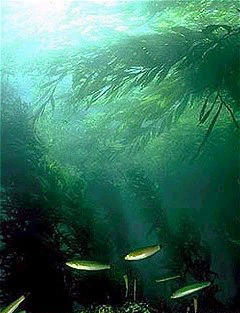
Saccharina latissima
A brown kelp used as kombu and a key coastal habitat.

Saccharina latissima is a brown alga (class Phaeophyceae) of the family Laminariaceae, known by the common names sugar kelp, sea belt, and Devil's apron. It is one of the species known to Japanese cuisine as kombu and is notable for its ecological role as a primary producer and habitat-forming species in coastal waters of the North Atlantic, Arctic, and North Pacific Oceans.
Quick Facts
- Genus
- Saccharina
- Species
- latissima
Facts from the source article.
Lore & Background
Saccharina latissima is a yellowish brown alga with a long, narrow, undivided blade that can grow to 5 metres long and 20 centimetres wide. Its central band is dimpled while the margins are smoother with a wavy edge, a feature that causes greater water movement around the blades to aid in gas exchange. The frond is attached to rock by stout rhizoids about 5 mm in diameter in the intertidal and sublittoral zones, by a claw-like holdfast and a short, pliable, cylindrical stipe.
It is found in the North Atlantic Ocean, Arctic Ocean, and North Pacific Ocean. It is common along the coast of Northern Europe as far south as Galicia, Spain. In North America, it occurs on the East Coast down to Long Island (historically extending to New Jersey) and on the West Coast down to the state of Washington. On the coast of Asia, it is found south to Korea and Japan.
Ecologically, Saccharina latissima is an important primary producer, delivering plant material to the coastal food web. Its three-dimensional forests serve as a habitat for animals, resulting in high biodiversity, with fish, shellfish, and other animals finding food and hiding places within them. It can be infected by the pathogenic fungus Phycomelaina laminariae.
Reader's Guide
Saccharina latissima holds significance as both a food source and an ecologically foundational species. It is used as a food in many places where it grows, one of many species often called kombu. Sugar kelp can be used as a vegetable in salads but is most frequently used in soups and stocks, where it provides savory flavors and is especially highly valued in vegetarian cooking. Kombu is a key component of miso soup. The savory flavor comes from free amino acids like glutamate; monosodium glutamate was first isolated from Saccharina. The kelp gets its name from containing the sugar alcohol mannitol, which is extracted to be used as a sugar substitute, especially for chewing gum. The Isle of Harris distillery on Lewis used the kelp as a flavouring in its gin.
Ecologically, it is a primary producer that delivers plant material to the coastal food web and creates three-dimensional forests that serve as habitat for animals, resulting in high biodiversity. However, in 2004, scientists reported a loss in sugar kelp of up to 80% at Skagerrak and 40% at the west coast of Norway. The reasons for this loss are not fully understood, but the increase in ocean temperature, high levels of nutrients, and the reduction in animal species feeding off filamentous algae are suggested as the most likely reasons.
Did You Know?
- The kelp contains the sugar alcohol mannitol, which is extracted for use as a sugar substitute, especially in chewing gum.
- In 2004, scientists reported a loss of up to 80% of sugar kelp at Skagerrak and 40% at the west coast of Norway.
More in Brown Macroalgae and Kelp, Part 2 1-24
Spotted an error? Know more?
Reader corrections go straight into our review queue. Suggest an edit · How this site is sourced