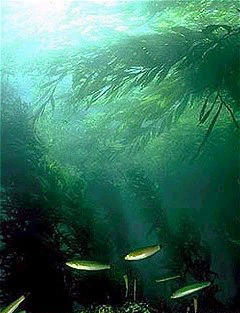
Saccharina japonica
A cultivated brown kelp widely eaten in East Asia.

Saccharina japonica is a brown alga, a type of kelp, commonly known as sweet kelp. It is widely farmed using rope cultivation—a straightforward technique where the seaweed is attached to floating ropes in the ocean—primarily in the seas around China, Japan, and Korea. This species is a major food item in East Asia and goes by the names ma-konbu in Japanese, dasima in Korean, and hǎidài in Chinese. Beyond Asia, it is also cultivated in Russia and France. In China and Japan, it is one of the two most commonly consumed kelps. China alone produces up to ten thousand tons of alginates from this seaweed each year.
The kelp contains very high levels of iodine. Eating 15 grams per day—which provides 35 milligrams of iodine—can suppress thyroid function, though thyroid hormone levels usually stay within normal ranges.
In terms of classification, the species was moved to the genus Saccharina in 2006. Its older names include Laminaria japonica, Laminaria japonica var. ochotensis, and Laminaria ochotensis. A 2026 study suggested that Saccharina diabolicha and Saccharina religiosa are the same species.
Most Japanese kombu—over 90%—is grown in Hokkaidō. Thanks to advances in farming, it is now produced as far south as the Seto Inland Sea.
In Chinese cooking, sliced kelp is a common appetizer, often eaten with alcohol. In Korean cuisine, dasima is used to make broth, deep-fried as bugak or twigak, pickled in soy sauce as jangajji, or eaten raw as a wrap. It is also brewed into dasima-cha (kelp tea). Cheonsa-chae, or kelp noodles, are made from the alginic acid in dasima. Nongshim’s Korean version of Neoguri instant noodles includes one large piece of dasima per package, and Ottogi’s Odongtong Myon has contained two pieces since 2020.
Quick Facts
- Genus
- Saccharina
- Species
- japonica
Facts from the source article.
Lore & Background
The species was transferred to Saccharina in 2006. Three synonyms for this species name are Laminaria japonica (J. E. Areschoug 1851), its variety Laminaria japonica var. ochotensis (Miyabe & Okamura 1936) and Laminaria ochotensis (Miyabe 1902). In addition, a 2026 study considered that S. diabolicha and S. religiosa are also synonymous. Over 90% of Japanese kombu is cultivated in Hokkaidō, and with the development of cultivation technology, production can also be found as far as south of the Seto Inland Sea.
Reader's Guide
Saccharina japonica is notable as one of the two most consumed species of kelp in China and Japan. It is used for the production of alginates, with China producing up to ten thousand tons of the product each year. In Chinese cuisine, sliced kelp is a common hors d'oeuvre often consumed with alcohol. In Korean cuisine, dasima is used to make broth, deep-fried into bugak or twigak, pickled in soy sauce as jangajji, and eaten raw as a sea vegetable for ssam (wraps). It is also used to make dasima-cha (kelp tea). Cheonsa-chae (kelp noodles) is made from the alginic acid from dasima. One of Nongshim's instant noodles, the Korean original versions of Neoguri, contains one big piece of dasima in every package; Ottogi's copy, Odongtong Myon, also has a big piece, and since 2020 Ottogi uses two dasimas per package. The species contains very high amounts of iodine; excessive consumption (15 g/day, containing 35 mg iodine) suppresses thyroid function, though thyroid hormone levels remain within normal limits.
More in Brown Macroalgae and Kelp, Part 2 1-24
Spotted an error? Know more?
Reader corrections go straight into our review queue. Suggest an edit · How this site is sourced