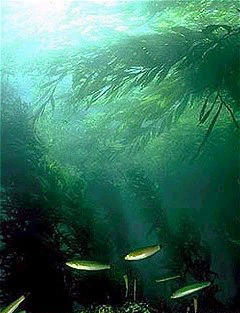
Saccharina dentigera
A dominant brown kelp of the northeastern Pacific shallow subtidal zone.

Saccharina dentigera is a species of brown algae in the family Laminariaceae, native to shallow waters of the northeastern Pacific Ocean from the Gulf of Alaska to Baja California. It is notable as one of the most abundant kelps in the southern Kodiak Islands and the dominant seaweed in the shallow subtidal zone at many sites.
Quick Facts
- Genus
- Saccharina
- Species
- dentigera
Facts from the source article.
Lore & Background
This seaweed was first described in 1889 by the Swedish botanist Frans Reinhold Kjellman as Laminaria dentigera, with the type location being Bering Island, where it was said to be fairly abundant, scattered across the sublittoral zone. In a revision of the genus Laminaria by C.E. Lane, C. Mayes, Druehl and G.W. Saunders in 2005, the species was transferred to the genus Saccharina, becoming Saccharina dentigera.
Saccharina dentigera is a large brown seaweed growing to a length of 1.5 m. The thallus is dark brown, thick and leathery, often appearing palmate because of being split into broad lobes to within 10 cm of its base. Younger thalli are entire with ovate blades. The thallus is supported on a robust, semi-rigid stipe, which has mucilage ducts on its surface near the upper end. The stipe is attached to a rock surface by a branched holdfast up to 8 cm high. Each holdfast only bears one thallus, but new blades sometimes start to grow before the old ones are shed.
The species is found in the northeastern Pacific Ocean, its range extending from the western Gulf of Alaska to the Bering Sea and the Aleutian Islands off the coast of Alaska, and southwards to Ensenada, Baja California. It occurs on rocky substrates in the lower intertidal zone and the shallow subtidal zone.
Reader's Guide
Saccharina dentigera is one of the most abundant kelps in the southern Kodiak Islands, and is the dominant seaweed at most sites in the shallow subtidal zone. The kelp forests it forms provide shelter and substrate for many species of marine organisms. In May, it is found at these sites with reproductive structures. The limpet Lottia instabilis is a specialist feeder on S. dentigera to the extent that it is essentially a parasite of the kelp. Its significance lies in its ecological role as a foundation species in nearshore habitats, supporting biodiversity through its physical structure and serving as a food source for a specialized grazer. The species' transfer from Laminaria to Saccharina in 2005 reflects ongoing taxonomic refinement within the Laminariaceae.
Did You Know?
- Saccharina dentigera was first described in 1889 as Laminaria dentigera by Swedish botanist Frans Reinhold Kjellman.
- The type location for this species is Bering Island, where it was said to be fairly abundant in the sublittoral zone.
- The limpet Lottia instabilis is a specialist feeder on Saccharina dentigera, essentially acting as a parasite.
- Each holdfast of Saccharina dentigera bears only one thallus, but new blades sometimes start growing before old ones are shed.
More in Brown Macroalgae and Kelp, Part 2 1-24
Spotted an error? Know more?
Reader corrections go straight into our review queue. Suggest an edit · How this site is sourced