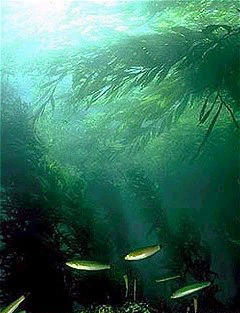
Macrocystis pyrifera
The largest brown alga, forming vast kelp forests worldwide.

Macrocystis pyrifera is the sole species in the monospecific genus Macrocystis, commonly known as giant kelp or bladder kelp. It is the largest of all brown algae (Phaeophyceae), with individual sporophytes capable of growing over 45 meters long at rates of up to 60 cm per day. Despite its plant-like appearance, it is a stramenopile, not a plant.
Quick Facts
- Genus
- Macrocystis
- Species
- pyrifera
Facts from the source article.
Lore & Background
Macrocystis pyrifera is a monospecific genus; all species now synonymous with Macrocystis pyrifera. The macroscopic sporophyte is perennial, with stipes arising from a holdfast and branching three or four times near the base. Blades develop at irregular intervals along the stipe, each with a single pneumatocyst (gas bladder) at its base. The smaller morph formerly identified as Macrocystis integrifolia has deep brown color on flattened, dichotomously branched rhizomes and grows to only 6 m long, found on intertidal or shallow subtidal rocks along the Pacific coast of North America and South America. The life cycle alternates between a macroscopic sporophyte and microscopic dioecious gametophytes. Sporophylls near the holdfast bear sori that release haploid spores, which grow into gametophytes. Female gametophytes release eggs along with the pheromone lamoxirene, which triggers sperm release from males; fertilization produces a zygote that grows mitotically. The species is found widely in subtropical, temperate, and sub-Antarctic oceans of the Southern Hemisphere and in the northeast Pacific, from Baja California to southeast Alaska, and also near South America, South Africa, Australia, New Zealand, and Tristan da Cunha.
Reader's Guide
Macrocystis pyrifera is a major component of temperate kelp forests, forming dense stands known as kelp beds with large floating canopies on rocky substrata. These forests provide habitat and food for many marine animals. The species is one of the fastest-growing organisms on Earth, with growth occurring through stipe lengthening and blade splitting. Translocation of nutrients, including carbon-rich photosynthate and amino acids, occurs through sieve elements resembling phloem, moving material from mature to actively growing regions and downward to sporophylls. Recent research indicates that Arctic kelp forests can increase pH levels by 0.15 units over 10 days during extended daylight, helping mitigate ocean acidification. The primary commercial product from giant kelp is alginate, and it is also harvested on a limited basis for direct food use, being rich in iodine, potassium, and other minerals. It can be used in cooking similarly to other sea vegetables and adds flavor to bean dishes. The species has been studied as a plant fertilizer, increasing bean yields up to 24%, with chemical studies indicating presence of phytohormone-like substances.
Did You Know?
- Macrocystis pyrifera is the largest of all brown algae, with individuals growing over 45 m long.
- It can grow at a rate of up to 60 cm per day.
- The species releases the pheromone lamoxirene to trigger sperm release during reproduction.
- Giant kelp is not a plant but a stramenopile.
More in Brown Macroalgae and Kelp, Part 2 1-24
Spotted an error? Know more?
Reader corrections go straight into our review queue. Suggest an edit · How this site is sourced