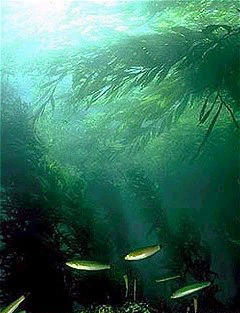
Lessonia corrugata
A poorly studied Tasmanian kelp vulnerable to ocean warming.

Lessonia corrugata, also called strapweed, common crapweed, or Tasmanian kombu, is a brown kelp native to Tasmania and southern Victoria, Australia. It lives in subtidal zones and is the least studied of the region’s three Laminarian kelp species. Arthur Henry Shakespeare Lucas first described it in 1931. Its closest relative is the New Zealand species Lessonia variegata. Though it dominates some Tasmanian kelp forests, scientists still know little about it. Researchers are now exploring its use in aquaculture for food, animal feed, kelp biomass, and environmental cleanup at integrated multi-trophic aquaculture (IMTA) finfish farms. However, the species is highly vulnerable to ocean warming.
This large brown alga averages 1.5 meters in length. Its blades have distinct lengthwise corrugations, which give the kelp its name. The blades emerge from the holdfast through basal splitting and become long and linear as they grow. They lack pneumatocysts, so the kelp is negatively buoyant and grows prostrate, lying flat on the seafloor. Like all Laminarian kelps, its life cycle alternates between microscopic gametophytes and macroscopic sporophytes. It reproduces via linear sori of sporangia and paraphyses located within the grooves of the corrugations.
The kelp thrives in moderate to strong water movement, typically at depths of 1 to 4 meters, though it has been recorded as deep as 18 to 20 meters at some sites. It generally grows in shallower, more exposed spots than other dominant canopy-forming seaweeds in the area, such as Ecklonia radiata and Phyllospora comosa. Its narrow temperature range makes it especially sensitive to rising sea surface temperatures. Juveniles have a thermal optimum around 16°C and an upper limit of 23°C. Gametophytes grow and develop sexually best between 15.7 and 17.9°C. Because of this thermal sensitivity and its small geographic range, recruitment and long-term survival may suffer, with peak summer sea surface temperatures projected to regularly exceed its thermal limit by 2050.
Lessonia corrugata is being developed for aquaculture, but major gaps remain in understanding its basic biology and cultivation needs. Still, new nursery techniques that increase water motion may improve juvenile sporophyte growth and boost biomass production at sea.
Quick Facts
- Genus
- Lessonia (alga)
- Species
- corrugata
Facts from the source article.
Lore & Background
Lessonia corrugata was first described by Arthur Henry Shakespeare Lucas in 1931. It is characterized by distinct longitudinal corrugations on its blades that give the kelp its name. These blades arise from the holdfast via basal splitting and become long and linear as they grow. The blades lack pneumatocysts, meaning that the kelp is negatively buoyant and displays a prostrate growth form, lying flat across the substrate. Like all Laminarian kelps, the life cycle of L. corrugata is a heteromorphic alteration of generations between microscopic gametophyte and macroscopic sporophyte life stages. L. corrugata reproduces from linear sori of sporangia and paraphyses located within the concavities of the corrugations on the blades.
Ecologically, Lessonia corrugata grows in areas of moderate to strong water movement, typically at depths of 1–4 m, but has been recorded as deep as 18–20 m at some sites. It generally occurs in shallower and more exposed locations than other dominant canopy-forming seaweed species in the region, namely Ecklonia radiata and Phyllospora comosa. The species is restricted to a narrow temperature range, making it particularly sensitive to threats such as rising sea surface temperatures. Juveniles have a thermal optimum of ~16°C and an upper thermal limit of 23°C, while the optimal temperature range for growth and sexual development of gametophytes is between 15.7 and 17.9°C. Coupled with its small geographic range, this thermal sensitivity may impact recruitment and long-term survival, with peak summer sea surface temperatures projected to regularly exceed L. corrugata's thermal limit by 2050.
Reader's Guide
Lessonia corrugata is notable as the least studied of the only three Laminarian kelps in the region of Tasmania and southern Victoria, Australia. Despite being a dominant species in some Tasmanian kelp forests, knowledge gaps remain about its fundamental biology and cultivation needs. Its development for aquaculture is ongoing, with novel cultivation techniques that use increased water motion in the nursery potentially improving juvenile sporophyte growth and increasing biomass production at sea. Trials have found spring to be the best season for out-planting L. corrugata, and that growth is best at a depth of 3–5 m. The species is being explored for producing food, feed, kelp biomass, and for environmental remediation in IMTA finfish farms. However, its vulnerability to ocean warming may ultimately limit its viability for seaweed farming. The species' narrow thermal tolerance and small geographic range make it particularly sensitive to rising sea surface temperatures, with projections indicating that peak summer temperatures may regularly exceed its thermal limit by 2050, potentially affecting recruitment and long-term survival. This combination of ecological importance, aquaculture potential, and climate vulnerability underscores the need for further research and conservation attention.
Did You Know?
- Lessonia corrugata is commonly known as strapweed, common crapweed, or Tasmanian kombu.
- The species lacks pneumatocysts, making it negatively buoyant with a prostrate growth form.
- Juveniles have an upper thermal limit of 23°C, with peak summer temperatures projected to regularly exceed this by 2050.
More in Brown Macroalgae and Kelp, Part 2 1-24
Spotted an error? Know more?
Reader corrections go straight into our review queue. Suggest an edit · How this site is sourced