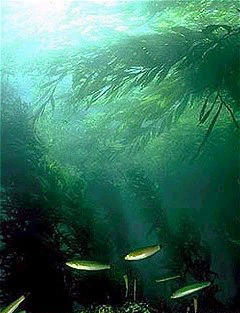
Laminaria sinclairii
A perennial kelp that survives seasonal sand burial in the intertidal zone.

Laminaria sinclairii is a dark brown, perennial kelp belonging to the brown algae class Phaeophyceae and the family Laminariaceae, often simply called seaweed. It grows from a creeping, branching rhizome that sends up ribbon-like thalli at intervals. These thalli reach about 1 meter in length and 3 centimeters in width, with smooth surfaces and entire edges, attached to short, cylindrical stipes roughly 10 centimeters long and 5 millimeters wide. The stipes contain many mucilage ducts, a feature that distinguishes this species from the very similar *Laminaria longipes*, which lacks such glands. In 1972, phycologist James W. Markham conducted transplant experiments to confirm that the presence of mucilage ducts is a reliable distinguishing trait, and he identified additional differences between the two species, including blade width, blade shedding patterns, reproductive structure morphology, temperature tolerance, and habitat preference.
This species is native to the lower intertidal zone of the northeastern Pacific Ocean, ranging from Vancouver Island in British Columbia south to Ventura County, California. It grows on rocky substrates, sometimes partially covered in sand, in the lower part of the intertidal zone. In Oregon, it is the dominant seaweed on rocks in this zone, particularly on beaches where sand levels shift dramatically with the seasons. New thalli emerge from the rhizomes in March and April, but these blades become progressively buried by rising sand over the summer, leading to complete burial of the plants. When autumn storms arrive, the sand is scoured away, exposing the thalli again. Reproductive sori develop on the old blades before they are shed in December, as well as on the new blades that grow in the spring.
Quick Facts
- Genus
- Laminaria
- Species
- sinclairii
Facts from the source article.
Lore & Background
Laminaria sinclairii grows from a creeping, branching rhizome that sends up ribbon-like thalli at intervals. The thalli have a smooth surface and entire edges, reaching about 1 m in length and 3 cm in width. They grow on short, cylindrical stipes about 10 cm long and 5 mm wide, which contain many mucilage ducts. This species is very similar in appearance to Laminaria longipes, but that species lacks mucilage glands in the stipes. In 1972, American phycologist James W. Markham conducted transplanting experiments to determine whether the presence of mucilage glands was a distinctive feature or if the two species were identical. He found they were indeed distinct, with additional differences in blade width, blade shedding, reproductive structure morphology, temperature tolerance, and habitat preference.
Reader's Guide
Laminaria sinclairii is ecologically significant as the dominant seaweed on rocks in the lower intertidal zone in Oregon, particularly on beaches where sand levels fluctuate dramatically. In March and April, new thalli emerge from the rhizomes, but these blades become progressively buried by rising sand levels over the summer, resulting in complete burial of the plants. With the arrival of storms in the fall, the sand is scoured away and the thalli reappear. Reproductive sori are produced on the old blades before they are shed in December and on the new blades that grow in the spring. This adaptation to seasonal sand burial and exposure highlights its resilience in a dynamic intertidal environment. The species' distinction from Laminaria longipes, confirmed through transplant experiments, underscores the importance of careful morphological and experimental study in algal taxonomy.
Did You Know?
- Laminaria sinclairii is a perennial kelp that grows from a creeping, branching rhizome.
- It can be completely buried by sand over the summer and reappear after fall storms.
- American phycologist James W. Markham conducted transplant experiments in 1972 to distinguish it from Laminaria longipes.
- Reproductive sori are produced on both old blades before they are shed in December and on new blades in spring.
More in Brown Macroalgae and Kelp, Part 2 1-24
Spotted an error? Know more?
Reader corrections go straight into our review queue. Suggest an edit · How this site is sourced