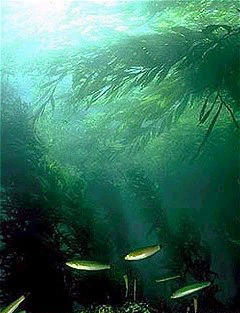
Laminaria ochroleuca
Golden kelp, a large brown alga with antimicrobial and antioxidant qualities.

Laminaria ochroleuca is a large brown alga in the order Laminariales, commonly known as golden kelp due to its blade colouration. It is notable for its antimicrobial, antioxidant, and nutritional properties, as well as for anticancer capabilities found in associated Actinobacteria strains.
Quick Facts
- Genus
- Laminaria
- Species
- ochroleuca
Facts from the source article.
Lore & Background
Laminaria ochroleuca grows to a length of 2 m, with large leathery blades divided into smooth linear sections and lacking a midrib. Its stipe is stalk-like, stiff, smooth, and attached to rocks by a claw-like holdfast. It resembles Laminaria hyperborea but is more yellow in colour and lacks the rough stipe of that species. Despite initial belief that the species was declining, investigations in 2022 and 2023 displayed recent growth and abundance of new individuals. It is suspected that due to climate change, the range of Laminaria ochroleuca will shift north. The ideal temperature for the sporophyte phase is 12-22 °C, while the gametophyte has a narrower range of 15-18 °C.
Reader's Guide
Laminaria ochroleuca is significant as a large kelp species in the order Laminariales, distinguished from related species like Laminaria hyperborea by its golden blade colouration and smooth stipe. Its distribution in the Northern Hemisphere spans from Morocco to the south of England, with a documented range expansion in the UK since its first recording in Plymouth Sound in 1946. By 1965, it had been found on the northeast coast of England beyond the Humber estuary. The species has demonstrated antimicrobial and antioxidant qualities, and is a valuable source of nutrition. Additionally, Actinobacteria strains isolated from Laminaria ochroleuca have revealed anticancer capabilities. Its life-cycle alternates between a large diploid sporophyte and microscopic haploid stages, with female gametophytes fertilized by male gametophytes (sperm). Recent investigations in 2022 and 2023 showed growth and abundance of new individuals, countering earlier beliefs of decline, though climate change is expected to shift its range northward.
Did You Know?
- It was first documented in the UK in Plymouth Sound in 1946.
- Actinobacteria strains isolated from this kelp have revealed anticancer capabilities.
- The gametophyte phase has a narrower ideal temperature range (15-18 °C) than the sporophyte phase (12-22 °C).
More in Brown Macroalgae and Kelp, Part 2 1-24
Spotted an error? Know more?
Reader corrections go straight into our review queue. Suggest an edit · How this site is sourced