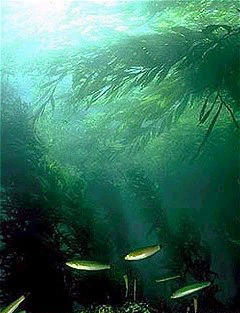
Laminaria hyperborea
A dominant northeast Atlantic kelp forming dense forests and rich habitats.

Laminaria hyperborea is a large, leathery brown kelp, also called tangle or cuvie, that lives in the sublittoral zone of the northern Atlantic Ocean. A wave-sheltered variety, *Laminaria hyperborea* f. *cucullata*, occurs in parts of Scandinavia.
This seaweed can reach up to 360 cm in length. Its holdfast is large and cone-shaped, with branched rhizoids that resemble a bird’s foot. The stipe is circular, rough, thick at the base, and tapers upward; older stipes often host epiphytic red algae. The blade is yellowish brown, deeply divided into linear segments, and has large digitate sections. It is a long-lived species, surviving up to 15 years. It can be told apart from the similar *Laminaria digitata* by its paler color and longer stipe, which snaps when bent sharply. Another look-alike, *Laminaria ochroleuca*, is more yellow and lacks the rough stipe.
Its range spans the northeast Atlantic, including the Baltic and North Seas, from the North Cape of Norway and the Kola Peninsula south to central Portugal. It grows on rocks in the sublittoral zone, down to about 10 m in turbid waters and 30 m in clear water. It tends to dominate a narrow zone near low-water at spring tides, and also thrives in deeper waters on stable substrates in exposed areas, while *Saccharina latissima* is more common in sheltered or less stable spots. Down to about 15 m, growth can be very dense, forming a "kelp forest"; deeper areas are more open and are called "parks."
In young plants, annual growth mainly enlarges the blade to maximize photosynthesis while the plant is short and overshadowed. In later years, growth shifts to the stipe and holdfast. Each spring, a new frond grows from the top of the stipe, and the old one is shed after much of its nutrients are transferred. During winter, *L. hyperborea* can release over a million zoospores from sori on the blade over a few weeks. These flagellated spores settle after about 24 hours and develop into microscopic gametophytes that become fertile in about 10 days. Male gametophytes release motile sperm, apparently triggered by nearby female gametes. Fertilized zygotes grow into young sporophytes. Sexual reproduction requires a minimum of blue light; otherwise, gametophytes may develop vegetatively.
Kelp beds serve as nursery areas and support a biodiverse habitat.
Quick Facts
- Genus
- Laminaria
- Species
- hyperborea
Facts from the source article.
Lore & Background
Laminaria hyperborea is a massive, leathery seaweed with a large cone-shaped holdfast resembling a bird's foot, a rough circular stipe that tapers upward, and a deeply divided yellowish-brown blade. It can be distinguished from similar species like L. digitata by its paler color and longer stipe that snaps when bent sharply, and from L. ochroleuca by its rough stipe. A variety, L. hyperborea f. cucullata, is known from more wave-sheltered areas in Scandinavia.
Its range extends from the North Cape of Norway and the Kola Peninsula south to central Portugal, including the Baltic and North Seas. It grows on rocks in the sublittoral zone, dominating a narrow zone near low-water at spring tides and forming dense growths down to about 15 m, referred to as 'kelp forest,' with more open 'parks' at greater depths. In young individuals, annual growth focuses on blade enlargement to maximize photosynthesis, while older plants invest more in stipe and holdfast growth, producing a new frond each spring.
Reproduction involves liberating upward of a million zoospores from sori on the blade over several weeks in winter. These develop into microscopic gametophytes that become fertile in about 10 days, with fertilization dependent on a minimum quantity of blue light. The grazing behavior of sea urchins, particularly Strongylocentrotus droebachiensis, can restrict new growth and, if too numerous, create 'urchin barrens' with reduced biodiversity.
Reader's Guide
Laminaria hyperborea is ecologically significant as a foundation species that provides nursery areas and biodiverse habitats. Studies have found up to 238 species of benthic macrofauna associated with a single plant, with densities of 8000 individuals per kelp plant. The blades host a bacterial biofilm, while the rough stipes anchor epiphytic red algae like Palmaria palmata, supporting gastropods, amphipods, and other invertebrates—up to 80,000 individuals on a single stipe. Holdfasts offer refuge for mobile macrofauna, including 61 species of nematode found in a British study, mostly omnivores or herbivores. Research also indicates an inverse relationship between macrofauna richness in holdfasts and pollution levels measured by heavy metal content and water clarity.
Its practical uses include potential as a fuel, with annual biomass increases of 16.5 and 8.0 metric tons per hectare at depths of 3 and 9 meters. Alginates extracted from stipes cast up on beaches are collected in France, Ireland, Scotland, and Norway, with some trawling in Norway. The kelp's water-absorbing properties have led to its use in wound dressings to prevent adhesions and to dilate the cervix during childbirth. It is also used for human consumption, notably in vegetarian imitation caviar.
Did You Know?
- Laminaria hyperborea can liberate upward of a million zoospores from sori on the blade during a few weeks in winter.
- In one study in Norway, up to 238 species of benthic macrofauna were found associated with a single L. hyperborea plant.
- The stipes of L. hyperborea can host up to 80,000 individual invertebrates on a single stipe, depending on season and density.
- Laminaria hyperborea has been used in wound dressings and to help dilate the cervix during childbirth.
More in Brown Macroalgae and Kelp, Part 2 1-24
Spotted an error? Know more?
Reader corrections go straight into our review queue. Suggest an edit · How this site is sourced