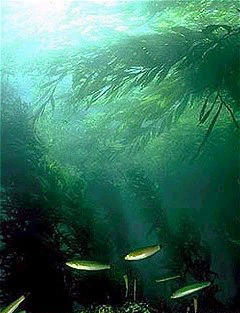
Laminaria digitata
A large brown alga with a hand-shaped blade, common in the North Atlantic.

Laminaria digitata, or oarweed, is a dark brown, leathery seaweed from the family Laminariaceae. It can reach 2 to 3 meters in length. Its holdfast is cone-shaped with root-like rhizoids, and its flexible, oval stipe can be over an inch thick and up to 1.5 meters long. The blade is large and hand-shaped, divided into finger-like segments. It is darker and has a shorter, less brittle stipe than the similar *Laminaria hyperborea*.
The life cycle alternates between large diploid sporophytes and microscopic gametophytes. Spores form in sori located over the central part of the blade.
This alga is found in the northern Atlantic, from Greenland to Cape Cod in the west, and from northern Russia and Iceland to France in the east. It is common around the British Isles except for much of England’s east coast.
*Laminaria digitata* grows mostly on exposed lower littoral shores, where it can form extensive meadows and become the dominant species. It has a high growth rate of 5.5% per day and a carrying capacity of about 40 kg wet weight per square meter, sometimes reaching 4 meters in length. Its distribution slightly overlaps with *Fucus serratus* and *Alaria esculenta*. It is highly vulnerable to grazing by sea urchins and other species. Its light requirements range from about 5 to 70 W per square meter, and its range is limited by salinity, wave exposure, temperature, desiccation, and general stress. It hosts the pathogenic fungus *Phycomelaina laminariae*.
Harvested off France, Morocco, and Ireland, it is mainly used to produce alginic acid. It is also an ingredient in some cosmetics and, in places like Rathlin Island in Northern Ireland, in food. Traditionally, it was used as fertilizer. In the 18th century, it was burned for potash for the glass industry, and in the 19th century, for iodine extraction. Historically, dried stalks, called sea-tangle tents, were used in medicine as an abortifacient and to induce labor mechanically.
Quick Facts
- Genus
- Laminaria
- Species
- digitata
Facts from the source article.
Lore & Background
Laminaria digitata is a tough, leathery, dark brown seaweed that grows to 2 or 3 metres long. Its holdfast is conical with spreading root-like rhizoids, and its stipe is flexible, oval in cross section, and may exceed 1 inch in diameter. The blade is large and palm-shaped with finger-like segments. It can be distinguished from the similar Laminaria hyperborea by its darker color and shorter stipe that does not snap easily when bent.
The life cycle alternates between large diploid sporophytes and microscopic gametophytes. Spores develop in sori over the central part of the blade. It occurs in the north west Atlantic from Greenland to Cape Cod and in the north east Atlantic from northern Russia and Iceland to France, and is common around the British Isles except much of the east coast of England.
Ecologically, Laminaria digitata is found mostly on exposed lower littoral shores, where it may form extensive meadows and be the dominant algal species. It has a high intrinsic growth rate of 5.5% per day and a carrying capacity of about 40 kg wet weight per square meter. It overlaps slightly in distribution with Fucus serratus and Alaria esculenta. It is highly susceptible to grazing by sea urchins and is a known host of the pathogenic fungus Phycomelaina laminariae.
Reader's Guide
Laminaria digitata has been harvested offshore of France, Morocco, and Ireland, primarily for manufacturing alginic acid. It is also used as an ingredient in some cosmetics and, in places such as Rathlin Island in Northern Ireland, as a food industry ingredient. Historically, it was used as a fertiliser spread on land. In the 18th century, it was burnt to extract potash for the glass industry, and in the 19th century, it was used for iodine extraction. Dried stalks, called sea-tangle tents, were used in traditional medicine as an abortifacient and for mechanically inducing labour. Its distribution is limited by factors including salinity, wave exposure, temperature, desiccation, and general stress. The alga's attributes have been summarized in publications listed in the source article.
Did You Know?
- Laminaria digitata is also known by the common name oarweed.
- Its blade is shaped like the palm of a hand with finger-like segments.
- Dried stalks were historically used as sea-tangle tents for inducing labour.
Frequently Asked Questions
What is Laminaria digitata?
Laminaria digitata, commonly called oarweed, is a dark brown, leathery kelp in the family Laminariaceae. It is a large North Atlantic seaweed instantly recognisable by its broad, hand-shaped blade that splits into finger-like lobes.
How large can Laminaria digitata grow?
A mature frond can stretch to roughly two or three metres in total length. Its stipe alone can reach about 1.5 metres and swell to more than an inch in diameter, and a dense stand can accumulate around 40 kg of wet biomass per square metre of seabed.
How is oarweed different from Laminaria hyperborea?
The two species look similar, but Laminaria digitata tends to be a darker shade of brown overall. Its stipe is also shorter and noticeably less brittle than that of L. hyperborea, giving the frond a more flexible feel.
How does Laminaria digitata reproduce?
It follows an alternating life cycle, switching between a large diploid sporophyte and a tiny microscopic gametophyte stage. Spores are produced in clusters called sori located across the central region of the blade.
How fast does Laminaria digitata grow and what light does it need?
Under suitable conditions the alga can put on roughly 5.5 % new growth each day. It tolerates a fairly wide light window, thriving at photosynthetic photon flux densities from about 5 up to 70 W per square metre.
More in Brown Macroalgae and Kelp, Part 2 1-24
Spotted an error? Know more?
Reader corrections go straight into our review queue. Suggest an edit · How this site is sourced