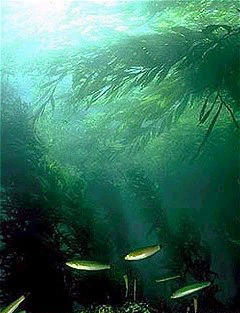
Fucus
Brown algae genus dominant on rocky shores worldwide.

Fucus is a genus of brown algae that grows on rocky shores in the intertidal zone, found nearly worldwide. Its body, or thallus, is perennial and attaches to rock with a disc-shaped or irregular holdfast, sometimes using haptera. The upright part is flattened, branches dichotomously or subpinnately, and has a clear midrib. In some species, gas-filled air bladders called pneumatocysts occur in pairs, one on each side of the midrib. The thallus also bears sterile surface pits called cryptostomata and caecostomata. Near the base, the thallus becomes stipe-like because tissue alongside the midrib wears away. Reproductive structures, the gametangia, develop inside conceptacles embedded in receptacles at the tips of the final branches. These algae can be monoecious or dioecious.
The life cycle is simple, producing just one type of thallus that reaches up to 2 metres long. Fertile conceptacles, which hold the reproductive cells, are sunk into the receptacles near the branch ends. After meiosis, oogonia and antheridia—the female and male organs—release eggs and sperm into the sea, where fertilization happens. The resulting zygote grows directly into a diploid plant. This differs from flowering plants, where eggs and sperm come from a haploid generation (though much reduced), and eggs are fertilized inside the parent’s ovules before being released as seeds.
Fucus species are recorded almost everywhere, both attached and free-floating. They dominate shores in the British Isles, the northeastern coast of North America, and California. In the British Isles, these large brown algae form distinct zones on sheltered shores from the high-water mark down to below low water. On exposed shores, fewer species appear, and on very exposed shores, few or none occur. *Pelvetia canaliculata* occupies the highest zone. Below it, *Fucus spiralis*, *Fucus vesiculosus*, *Fucus serratus*, and *Laminaria* form clear bands descending to low water. On sheltered shores, *Ascophyllum nodosum* often dominates the mid-littoral zone. Other brown algae, like *Himanthalia*, *Laminaria saxatilis*, and *Alaria esculenta*, live in the low-littoral. Small green and red algae, along with animals, find shelter under these large brown algae. When washed ashore, kelp flies such as *Coelopa pilipes* feed and breed on *Fucus*.
Quick Facts
- Taxon
- Fucus
Facts from the source article.
Lore & Background
The thallus of Fucus is perennial with an irregular or disc-shaped holdfast or haptera. The erect portion is dichotomous or subpinnately branched, flattened, and has a distinct midrib. Gas-filled pneumatocysts (air-vesicles) occur in pairs in some species, one on either side of the midrib. The erect portion bears cryptostomata and caecostomata (sterile surface cavities), and the base is stipe-like due to abrasion of tissue lateral to the midrib. Gametangia develop in conceptacles embedded in receptacles at the apices of the final branches; they may be monoecious or dioecious.
Fucus species are recorded almost worldwide as attached and unattached forms. They are dominant on the shores of the British Isles, the northeastern coast of North America, and California. On sheltered shores in the British Isles, they occur in well-defined zones from high-water mark to below low water mark, with species such as Pelvetia canaliculata, Fucus spiralis, Fucus vesiculosus, Fucus serratus, and Laminaria forming clear zones. On very exposed shores, few if any species occur. Ascophyllum nodosum often forms a broad zone at the mid-littoral on sheltered shores.
In Scotland and Norway, up until the mid-19th century, several Fucus species were harvested, dried, burned to ash, and processed into 'kelp', a type of soda ash with an alkali content of about 2.5%–5% mainly sodium carbonate, used in soapmaking and glassmaking. The seaweed was also used as fertilizer. Fucus species can be used for thalassotherapy. In 2005, bacteria grown on Fucus were reported to attack and kill the MRSA superbacterium. The seaweed fly Coelopa frigida and other Coelopa species feed, mate, and create habitats out of Fucus, especially when stranded on beaches.
Reader's Guide
Fucus holds significance as a dominant intertidal brown alga across the British Isles, northeastern North America, and California, forming distinct zones on sheltered shores. Its simple life cycle—where the diploid plant develops directly from a zygote after external fertilization—contrasts with flowering plants and makes it a valuable model for studying cell polarity and the development of growth axes, using its easily accessible apolar eggs and free-floating zygotes. Historically, Fucus species were economically important in Scotland and Norway for producing soda ash used in soap and glass industries, and as fertilizer. More recently, bacteria cultured on Fucus have shown ability to attack the MRSA superbacterium. The genus also supports ecological interactions, notably with seaweed flies of the genus Coelopa, which feed and breed on stranded Fucus. The taxonomy includes 19 listed species, with several recorded around Britain, such as Fucus serratus (toothed wrack), Fucus spiralis (spiral wrack), and Fucus vesiculosus (bladder wrack). Fucus distichus, up to 10 cm long, is specifically used as a model for cell polarity studies.
Did You Know?
- Fucus species can grow to a maximum size of 2 metres (6 feet).
- Fucus distichus is used as a model organism to study the development of cell polarity.
- The seaweed fly Coelopa frigida feeds and breeds on Fucus algae when stranded on beaches.
More in Brown Macroalgae and Kelp, Part 2 1-24
Spotted an error? Know more?
Reader corrections go straight into our review queue. Suggest an edit · How this site is sourced