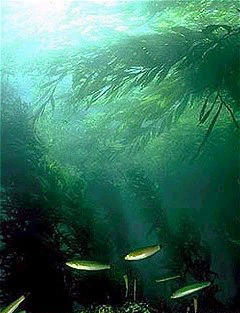
Fucus vesiculosus
Brown alga that was the original source of iodine.

Fucus vesiculosus, also called bladderwrack, rockweed, sea grapes, black tang, bladder fucus, sea oak, cut weed, dyers fucus, red fucus, and rock wrack, is a brown seaweed. It grows along the coasts of the North Sea, the western Baltic Sea, and the Atlantic and Pacific Oceans. In 1811, it became the first known source of iodine, and it was widely used to treat goiter.
The fronds can reach 150 cm long and 2.5 cm wide, with a clear midrib running their length. A disc-shaped holdfast usually anchors the plant, though it can also be unattached. Paired, almost spherical air bladders often appear on either side of the midrib, but young plants may lack them. The frond edges are smooth, and the branching is dichotomous. It can be mistaken for *Fucus spiralis*, with which it hybridizes, and resembles *Fucus serratus*.
These plants are dioecious. Gametes are typically released into calm seawater, where eggs are fertilized externally to form a zygote. Fertilization happens soon after the eggs leave the receptacle. A study on the Maine coast found 100% fertilization at both exposed and sheltered sites. In the Baltic Sea, continuously submerged populations are very sensitive to turbulence; high fertilization success occurs because gametes are only released when water velocities are low.
North Sea individuals colonized the Baltic Sea less than 8,000 years ago. This event coincided with a shift from mainly sexual reproduction to optional asexual reproduction. In Baltic populations, asexual reproduction happens when adventitious branches break off and reattach to the seafloor by forming rhizoids. This method also helps maintain unattached populations. Adventitious branches appear on thalli elsewhere, but new thalli forming asexually have never been reported outside the Baltic.
*Fucus vesiculosus* is a common large brown alga on British Isles shores. It has been recorded along the Atlantic coasts of Europe, northern Russia, the Baltic Sea, Greenland, the Azores, the Canary Islands, Morocco, and Madeira. On the Atlantic coast of North America, it ranges from Ellesmere Island and Hudson Bay down to North Carolina.
The species thrives on sheltered shores from the middle littoral to lower intertidal zones. It is rare on exposed shores, where specimens may be short, stunted, and lack air bladders. *F.
Quick Facts
- Genus
- Fucus
- Species
- vesiculosus
Facts from the source article.
Lore & Background
Fucus vesiculosus has fronds that grow to 150 cm long and 2.5 cm wide, with a prominent midrib throughout. It is typically attached by a basal disc-shaped holdfast but can also be unattached. It has almost spherical air bladders, usually paired one on either side of the mid-rib, though these may be absent in young plants. The margin is smooth and the frond is dichotomously branched. It is sometimes confused with Fucus spiralis, with which it hybridises, and is similar to Fucus serratus.
Plants of F. vesiculosus are dioecious. Gametes are generally released into seawater under calm conditions, and eggs are fertilized externally to produce a zygote. A study on the coast of Maine showed 100% fertilization at both exposed and sheltered sites. Continuously submerged populations in the Baltic Sea are very responsive to turbulent conditions, with high fertilization success achieved because gametes are released only when water velocities are low. Individuals from the North Sea colonized the Baltic Sea less than 8,000 years ago, paralleled by a switch from obligate sexual recruitment to facultative asexual recruitment. Asexual reproduction in Baltic Sea populations is accomplished by adventitious branches that come loose and reattach via rhizoids; this has never been reported outside the Baltic Sea.
The species is especially common on sheltered shores from the middle littoral to lower intertidal levels, and rare on exposed shores where specimens may be short, stunted, and without air vesicles. It supports few colonial organisms but provides canopy and shelter for the tube worm Spirorbis spirorbis, herbivorous isopods such as Idotea, and surface-grazing snails such as Littorina obtusata. Phlorotannins in F. vesiculosus act as chemical defenses against the marine herbivorous snail Littorina littorea, while galactolipids deter the sea urchin Arbacia punctulata. Methyl jasmonate may induce phlorotannin production, and fucophlorethol A is a type of phlorotannin found in the alga.
Reader's Guide
Fucus vesiculosus holds historical significance as the original source of iodine, discovered in 1811, and was used extensively to treat goitre, a swelling of the thyroid gland related to iodine deficiency. It is also sold as a nutritional supplement, with primary chemical constituents including mucilage, algin, mannitol, fucitol, beta-carotene, zeaxanthin, volatile oils, iodine, bromine, potassium, and other minerals. The alga can be cooked and eaten. However, consumption may cause platelet inhibition, which can potentiate the anticoagulant activity of warfarin (Coumadin), and it should be avoided before surgery. Some people may suffer an allergic reaction to the iodine in F. vesiculosus. Ecologically, it provides shelter for various marine organisms and uses chemical defenses such as phlorotannins and galactolipids against herbivores. Its reproductive biology includes both sexual and asexual strategies, with asexual reproduction via adventitious branches being unique to Baltic Sea populations. The species is widely distributed across the North Atlantic and adjacent seas, from the British Isles to North Carolina and from Greenland to Morocco.
Did You Know?
- Asexual reproduction via adventitious branches has never been reported outside the Baltic Sea.
- Consumption may cause platelet inhibition, potentiating the anticoagulant activity of warfarin.
More in Brown Macroalgae and Kelp, Part 2 1-24
Spotted an error? Know more?
Reader corrections go straight into our review queue. Suggest an edit · How this site is sourced