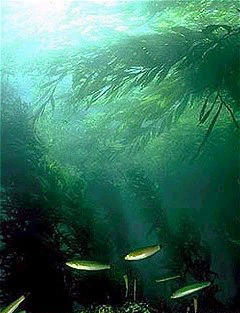
Fucus spiralis
A brown alga of Atlantic shores, also called spiral wrack.

Fucus spiralis, a brown alga in the group Heterokontophyta and class Phaeophyceae, inhabits the littoral zone along the Atlantic coasts of Europe and North America. Its common names are spiral wrack and flat wrack. Olive-brown in color, it resembles *Fucus vesiculosus* and *Fucus serratus*. Reaching about 30 centimeters in length, it branches somewhat irregularly in a dichotomous pattern and attaches to rock via a discoid holdfast. The flattened blade features a distinct midrib and is usually twisted into a spiral; it lacks the serrated edge of *Fucus serratus* and the air vesicles of *Fucus vesiculosus*. For reproduction, rounded, swollen tips—typically in pairs—form on the branches. Inside these conceptacles, oogonia and antheridia develop after meiosis and are released. Fertilization follows, and the resulting zygote grows directly into a diploid sporophyte plant. Along with *Fucus vesiculosus*, *Fucus serratus*, and *Ascophyllum nodosum*, *F. spiralis* is a dominant seaweed on rocky shores of the British Isles. These three *Fucus* species, plus *Pelvetia canaliculata* and *Ascophyllum nodosum*, create distinct zones along the shore. *F. spiralis* is common around the British Isles, on western European coasts, in the Canary Islands, and in northeastern America. Chemically, it produces phlorotannins of both the fucol and fucophlorethol types.
Quick Facts
- Genus
- Fucus
- Species
- spiralis
Facts from the source article.
Lore & Background
Fucus spiralis is olive brown in colour and grows to about 30 cm long. It branches somewhat irregularly dichotomous and is attached to rock by a discoid holdfast. The flattened blade has a distinct mid-rib and is usually spirally twisted, without a serrated edge (unlike Fucus serratus) and without air-vesicles (unlike Fucus vesiculosus).
The reproductive bodies form rounded swollen tips on the branches, usually in pairs. Within the conceptacles, oögonia and antheridia are produced after meiosis and then released. Fertilisation follows, and the zygote develops directly into the diploid sporophyte plant.
On the coasts of the British Isles, Fucus spiralis is one of the main and dominant seaweeds on rocky shores, along with Fucus vesiculosus, Fucus serratus, and Ascophyllum nodosum. These species form zones along the shore, together with Pelvetia canaliculata.
Reader's Guide
Fucus spiralis holds significance as a dominant intertidal seaweed on rocky shores of the British Isles and Atlantic coasts of Europe and North America. It is one of the key species that form distinct zones along the shore, alongside Fucus vesiculosus, Fucus serratus, Pelvetia canaliculata, and Ascophyllum nodosum. Its presence contributes to the ecological structure of littoral habitats. The species produces phlorotannins of both the fucol and fucophlorethol types, which are chemical compounds characteristic of brown algae. Its reproductive strategy—producing oögonia and antheridia after meiosis, followed by external fertilisation and direct development into a diploid sporophyte—is typical of the genus. The common names spiral wrack and flat wrack reflect its twisted, flattened blade morphology, which distinguishes it from related species that have serrated edges or air vesicles. Its distribution spans from the British Isles and western Europe to the Canary Islands and north-eastern America, indicating a broad Atlantic range.
Did You Know?
- Fucus spiralis is also known as spiral wrack and flat wrack.
- It grows to about 30 cm long and has a spirally twisted blade with a distinct mid-rib.
- It does not have air-vesicles, unlike Fucus vesiculosus.
More in Brown Macroalgae and Kelp, Part 2 1-24
Spotted an error? Know more?
Reader corrections go straight into our review queue. Suggest an edit · How this site is sourced