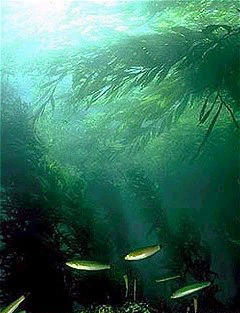
Fucus serratus
A robust olive-brown seaweed with serrated fronds and no air vesicles.

Fucus serratus, a brown seaweed found in the North Atlantic, goes by the common names toothed wrack, serrated wrack, or saw wrack. This robust alga grows from a discoid holdfast and can reach up to 180 centimeters in length. Its flat, bifurcating fronds are about two centimeters wide and up to one meter long, including a short stipe. The fronds branch irregularly and dichotomously, with a distinct midrib running down the flattened blade. Unlike the similar *Fucus vesiculosus*, it lacks air vesicles, and unlike *Fucus spiralis*, it is not spirally twisted. Instead, its most distinguishing feature is the serrated edge of the fronds. Male and female reproductive structures occur on separate plants, and the lamina contains cryptostomata—small cavities that produce colorless hairs. Reproductive bodies develop in conceptacles sunken into receptacles at the branch tips; here, oogonia and antheridia are produced and released after meiosis. Fertilization, which activates the egg, leads to a zygote that settles and grows directly into the diploid sporophyte.
Geographically, *Fucus serratus* is found along Europe’s Atlantic coast from Svalbard down to Portugal and the Canary Islands. It was introduced to northeastern North America over 140 years ago, first recorded at Pictou Harbour in the late 1860s by George Upham Hay and Alexander Howard McKay. Its arrival in Iceland and the Faroe Islands may date back to Viking times, within the last 1000 years, and was first noted in a phycological survey in 1900.
Ecologically, this species thrives on slow-draining shores, where it can cover up to a third of the seashore. It often dominates rocky areas of the lower shore, whether exposed or in rock pools, on all but the most exposed coastlines. The littoral zone in such areas is characterized by brown algae like *Pelvetia*, *Ascophyllum*, *Egregia*, *Fucus*, and *Laminaria*, especially on rocky shores. In the Canadian Maritimes—particularly Prince Edward Island, Nova Scotia, and northern New Brunswick—it is considered invasive. In Northern Europe and Iceland, it is known to hybridize with *Fucus distichus*.
As for human uses, *Fucus serratus* is employed in Ireland and France for cosmetics and thalassotherapy. In Scotland’s Western Isles, it is harvested as a liquid fertilizer. The organism contains triacylglycerols and fatty acids.
Quick Facts
- Genus
- Fucus
- Species
- serratus
Facts from the source article.
Lore & Background
Fucus serratus is a robust alga, olive-brown in colour, growing from a discoid holdfast up to 180 cm long. Its fronds are flat, about 2 cm wide, bifurcating, and up to 1 m long including a short stipe. It branches irregularly and dichotomously, with a distinct midrib and serrated edges that distinguish it from related taxa such as Fucus vesiculosus and Fucus spiralis. It lacks air vesicles and is not spirally twisted. The lamina shows cryptostomata—small cavities producing colourless hairs. Male and female receptacles are on different plants; reproductive bodies form in conceptacles sunken in receptacles near branch tips, where oogonia and antheridia are produced and released after meiosis. Fertilization follows, associated with egg activation, and the zygote develops directly into the diploid sporophyte plant.
Reader's Guide
Fucus serratus is found along the Atlantic coast of Europe from Svalbard to Portugal and in the Canary Islands. It was introduced to the shores of northeast America over 140 years ago, first described at Pictou Harbour in the late 1860s by George Upham Hay and Alexander Howard McKay. Its introduction to Iceland and the Faroe Islands could date back to the Vikings, within the last 1000 years, and was first noted in a phycological survey in 1900. Ecologically, it grows well on slow draining shores, occupying up to a third of the seashore area, and often dominates rocky parts of the lower shore. It is considered an invasive species in the Canadian Maritimes, particularly on Prince Edward Island, Nova Scotia, and the northern coastline of New Brunswick. In Northern Europe and Iceland, it is known to hybridize with Fucus distichus. The species is used in Ireland and France for cosmetics and thalassotherapy, and in the Western Isles of Scotland it is harvested as a liquid fertiliser, as it contains triacylglycerols and fatty acids.
Did You Know?
- Fucus serratus is known as toothed wrack, serrated wrack, or saw wrack.
- It does not have air vesicles, unlike Fucus vesiculosus.
More in Brown Macroalgae and Kelp, Part 2 1-24
Spotted an error? Know more?
Reader corrections go straight into our review queue. Suggest an edit · How this site is sourced