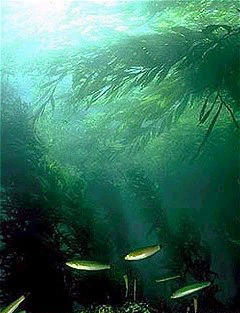
Fucus radicans
A recently evolved brown alga endemic to the Baltic Sea.

Fucus radicans is a brown alga belonging to the Fucaceae family, found only in the Baltic Sea. It is a recently evolved species, having split from its close relative, the widespread bladderwrack (Fucus vesiculosus), roughly 400 years ago. A key trait is its frequent clonal reproduction, which likely sped up its emergence as a distinct species.
First described in 2005 by Lena Bergström and Lena Kautsky from a site in Ångermanland, Sweden, its name comes from the Latin for "rooting." This refers to its main method of reproduction: detached fragments take root and grow into new plants.
In appearance, F. radicans looks much like bladderwrack—dichotomously branched, with brown, leathery fronds (thalli) that have a central midrib and round air bladders. However, it is smaller and bushier than F. vesiculosus, with narrower thalli. While bladderwrack is common along temperate and subarctic North Atlantic shores, F. radicans is confined to the Baltic Sea, where it grows alongside its relative in shallow water.
The Baltic Sea formed about 10,000 years ago as ice retreated. It started as a freshwater lake, then became brackish around 4,000 years ago, remaining relatively isolated from the North Sea. Over 200 rivers feed it, making surface waters much less salty than the open ocean (which averages 35‰). F. radicans is adapted to these low salinities and cannot tolerate higher ones. It favors the Gulf of Bothnia, where salinity can drop below 10‰. This brackish environment supports few species, and those present tend to be smaller than in marine or freshwater habitats.
Genetic studies using chloroplast or mitochondrial DNA were inconclusive, but microsatellite markers suggest the split between F. radicans and F. vesiculosus happened between 125 and 2,475 years ago, with a peak around 400 years ago—more recent than the Baltic’s shift to brackish water. The fact that F. radicans lives nowhere else supports this. An isolating factor may be that F. vesiculosus usually reproduces sexually, while F. radicans leans heavily on asexual reproduction via rooting fragments. Environmental stress, particularly falling salinity, likely contributed to this speciation.
F. radicans is found along the Bothnian Sea coast and in Estonian waters, possibly also in the Gulf of Finland. It can reproduce both sexually and asexually, but its genetic structure varies widely.
Quick Facts
- Genus
- Fucus
- Species
- radicans
Facts from the source article.
Lore & Background
Fucus radicans was first described by Lena Bergström and Lena Kautsky in 2005 from a location in Ångermanland, Sweden. The specific epithet is from the Latin and means 'rooting', referring to the fact that this species primarily reproduces by the taking root of detached fragments. It seems to have diverged from the closely related and widely distributed Fucus vesiculosus within about the last 400 years. Genetic analysis using microsatellite markers suggests a divergence between 125 and 2475 years ago with a posterior distribution peak at around 400 years ago, supporting the hypothesis of recent sympatric speciation.
Morphologically, Fucus radicans is similar to bladderwrack (Fucus vesiculosus), which is dichotomously branched and has brown leathery fronds known as thalli with a prominent midrib and globular air bladders. The main differences are that F. radicans is smaller and more bushy than F. vesiculosus and has narrower thalli. F. radicans is endemic to the Baltic Sea, where it grows in shallow water alongside F. vesiculosus. It seems specially adapted to low salinity levels and unable to tolerate higher salinities, favoring the northernmost part, the Gulf of Bothnia, where salinity may be less than 10‰.
The Baltic Sea was formed by retreating ice after the last ice age about ten thousand years ago. From about 4,000 years ago till the present it has been a brackish water area. An isolating mechanism between the two species may be that F. vesiculosus normally reproduces sexually whereas F. radicans shows a much greater tendency to reproduce asexually. Environmental stress, in this instance the decrease in salinity, has been shown to contribute to the formation of new species.
Reader's Guide
Fucus radicans is significant as a recently evolved species that provides a clear example of sympatric speciation in a marine environment. Its divergence from Fucus vesiculosus within the last 400 years, as supported by microsatellite genetic analysis, occurred more recently than the transition of the Baltic Sea to its present brackish state. The species' ability to reproduce clonally may have facilitated its rapid emergence. Its genetic structure is complex: Estonian populations are mostly sexually reproduced and harbor large genetic variation, while populations in the Bothnian Sea are dominated by two clones—one female and one male—with the female found along a 550 km coastline. This low sexual reproduction in large areas means the species has low potential for future genetic adaptation. Management recommendations from the BONUS BAMBI project include protecting sexually active populations (especially in Estonia), maintaining large population sizes and connectivity, and not using Estonian populations to replace lost populations in the Bothnian Sea. The warming and salinity decrease predicted for the Baltic Sea over the coming 50 to 100 years could risk the loss of populations and even the whole species.
Did You Know?
- Fucus radicans was first described in 2005 from a location in Ångermanland, Sweden.
- The species primarily reproduces by the taking root of detached fragments, reflected in its Latin epithet meaning 'rooting'.
- Genetic analysis suggests Fucus radicans diverged from Fucus vesiculosus within about the last 400 years.
- One female clone of Fucus radicans is found along a 550 km coastline in the Bothnian Sea, making up 20–95% of individuals in local populations.
More in Brown Macroalgae and Kelp, Part 2 1-24
Spotted an error? Know more?
Reader corrections go straight into our review queue. Suggest an edit · How this site is sourced