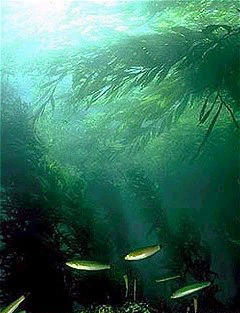
Fucus gardneri
A brown alga of Pacific North American shores.

Fucus gardneri is a brown alga found along the Pacific shores of North America, where it lives on the littoral zone. Commonly called rockweed or bladderwrack, it is olive brown and resembles Fucus spiralis. The seaweed grows to about 40–50 centimeters long, branching in an irregularly dichotomous pattern, and attaches to rocks using a disc-shaped holdfast. Airsacks develop at the top of the plant. As the tips of mature individuals swell, they provide flotation and also serve as reproductive chambers for sperm and eggs. During low tide, these swollen tips dry out and squeeze out the sperm and eggs. When the next flood tide arrives, they unite into a zygote, which then settles onto a substrate. In the middle intertidal zone, rockweed can form thick bands on rocky surfaces. Along with other common Fucus species—Fucus spiralis, Fucus vesiculosus, and Fucus serratus—as well as Ascophyllum nodosum, it is a dominant seaweed on rocky shores. These three species, along with two others Pelvetia canaliculata and Ascophyllum nodosum form the zones along the shore. Historically, Native Americans harvested the dried, swollen tips of Fucus gardneri, sometimes calling them "Indian popcorn." When the air bubbles inside are popped, the tips release a thick, very moisturizing lotion.
Quick Facts
- Genus
- Fucus
- Species
- gardneri
Facts from the source article.
Lore & Background
Fucus gardneri is olive brown in colour and similar to Fucus spiralis. It grows to 40–50 centimetres long and branches somewhat irregularly dichotomous, attached generally to rock by a discoid holdfast. It has airsacks at the top. The tips of mature individuals swell up and provide flotation for the plant as well as reproductive chambers for developing sperm and eggs. During low tide, the swollen tips dry up, squeezing out sperm and eggs which unite into a zygote during the next flood tide and settle onto a substratum. Rockweed can form thick bands in the middle intertidal on rocky substrates. The other common species of Fucus—Fucus spiralis, Fucus vesiculosus and Fucus serratus—along with Ascophyllum nodosum form the main and dominant seaweeds on rocky shores. These three species, along with two others Pelvetia canaliculata and Ascophyllum nodosum form the zones along the shore.
Reader's Guide
Fucus gardneri is significant as a dominant intertidal seaweed on rocky shores of the Pacific coast of North America, where it forms thick bands in the middle intertidal zone. Its life history is tied to tidal cycles: swollen tips at the ends of mature individuals provide flotation and house reproductive chambers; during low tide these tips dry and release sperm and eggs, which unite at the next flood tide to form zygotes that settle onto the substrate. Historically, Native Americans harvested the dried swollen tips—sometimes called 'Indian pop corn'—and when the air bubbles are popped, the tips secrete a thick, very moisturizing lotion. The species is one of several Fucus species that, along with Ascophyllum nodosum and Pelvetia canaliculata, define the zonation patterns on rocky shores. Its ecological role as a foundation species in the intertidal is underscored by its ability to form dense bands that influence the structure of the shoreline community.
Did You Know?
- Fucus gardneri is also known by the common names rockweed and bladderwrack.
- The swollen tips of mature individuals dry up during low tide, squeezing out sperm and eggs that unite into a zygote at the next flood tide.
- Native Americans historically harvested the dried swollen tips, sometimes called 'Indian pop corn', which secrete a thick, moisturizing lotion when the air bubbles are popped.
- It grows to 40–50 centimetres long and attaches to rock by a discoid holdfast.
More in Brown Macroalgae and Kelp, Part 2 1-24
Spotted an error? Know more?
Reader corrections go straight into our review queue. Suggest an edit · How this site is sourced