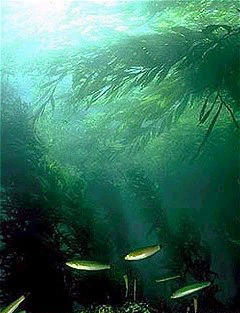
Ecklonia cava
Edible brown alga used in herbal extracts and traditional cuisine.

Ecklonia cava, also known as paddle weed, kajime, noro-kajime, or gamtae, is an edible marine brown alga found off the coasts of Japan and Korea. It is notable for its use as an herbal remedy in the form of extracts such as Seanol and Ventol, and as a source of phlorotannins and other bioactive compounds.
Quick Facts
- Taxon
- Ecklonia cava
Facts from the source article.
Lore & Background
The nomenclature of Ecklonia cava is historically confused with that of Eisenia bicyclis (arame) and Ecklonia kurome. Japanese authority Kichisaburo Endo noted that the terms kajime and arame are regionally confounded, with some places calling kajime 'arame' and vice versa. This confusion persists to the present day. Historically, during the Nara Period, wooden shipping tags (mokkan) indicate that products labeled as arame could have been either E. cava or E. bicyclis, while kajime likely referred to pulverized forms of either seaweed, as explained in the Wamyō Ruijushō dictionary.
Ecklonia cava is a perennial brown alga that forms seaweed beds in subtidal areas. It is distinguished from similar taxa by its smooth lamina, whereas E. kurome has wrinkled lamina and E. bicyclis has forked, wrinkled lamina. Recent papers treat E. kurome as a synonym of E. cava, proposing it as a subspecies alongside Ecklonia cava ssp. stolonifera. The algae determined to be kajime based strictly on morphology in Shikoku, parts of Kyushu, and southern Sea of Japan coasts tend to be the kurome or tsuruarame subspecies.
Ecklonia cava plays an important role in its ecosystem as a primary producer, providing food and shelter for marine organisms. It has been decreasing in numbers in recent years, possibly due to increased water temperature, overgrazing, and overuse. It is an important food source for snails such as Littorina brevicula and Haliotis discus, and has a defense mechanism that makes it less palatable after herbivore attack, with defenses specific to each herbivore species.
Reader's Guide
Ecklonia cava holds significance both ecologically and economically. Ecologically, it forms marine forests in waters 2–25 m deep, serving as a primary producer and habitat for many marine organisms. Its decline, attributed to factors like rising water temperature and overgrazing, underscores its vulnerability and the need for conservation. Economically, it is harvested for food and medicinal extracts. The health benefits of its components, such as fucosterol, have been studied for possible antidepressant, antidiabetic, and anticonvulsant effects. Its use in dietary supplements and herbal remedies, particularly as Seanol and Ventol, highlights its commercial value. Culinary uses date back to the Nara Period in Japan, where it was transported as tribute. Today, it is consumed in salads, soups, and as a dried powder for flavoring and coloring in candies, rice cakes, miso soups, and kimchi. The South Korean company Badasoop grows, processes, and exports Ecklonia cava. Additionally, it is used in processing Hizikia fusiformes (hijiki) to moderate bitter flavor and dark color. The taxonomic confusion with related species and the historical naming complexities add to its cultural and scientific interest, reflecting the intertwined history of seaweed use in East Asia.
Did You Know?
- Ecklonia cava is also called paddle weed, kajime, noro-kajime, and gamtae.
- The type locality for Ecklonia cava is Yokosuka, Kanagawa.
- Ecklonia cava has a defense mechanism that makes it less palatable after being attacked by a herbivore, with defenses specific to each herbivore species.
More in Brown Macroalgae and Kelp, Part 2 1-24
Spotted an error? Know more?
Reader corrections go straight into our review queue. Suggest an edit · How this site is sourced