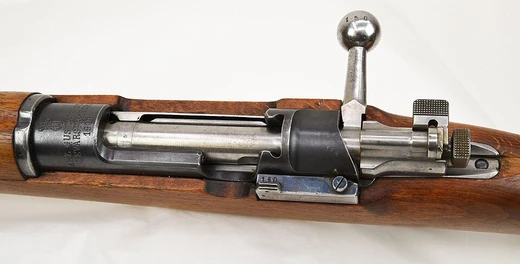
Type 99 sniper rifle
Japanese sniper variant of the Type 99 rifle, used in WWII.

The Type 99 sniper rifle was a Japanese bolt-action sniper rifle used during the Second World War. It was a sniper variant of the Type 99 rifle, chambered in the 7.7×58mm round. Although intended to replace the Type 97 sniper rifle, production never met wartime demands, and both rifles were used until the end of the war.
Quick Facts
- Origin
- Empire of Japan
- Is Ranged
- yes
- Service
- 1942–1945
- Used By
- Imperial Japanese Army
- Wars
- World War II
- Length
- 45 in
- Cartridge
- 7.7×58mm Arisaka
- Action
- Bolt action
- Velocity
- 2300 ft/s
- Max Range
- 3000 yd
- Feed
- 5-round internal box magazine, stripper clip loaded
Facts from the source article.
Lore & Background
The Type 99 sniper rifle was developed after trials in 1941 using both long and short Type 99 rifles modified as sniper rifles. Both showed a 35% increase in accuracy over the standard infantry rifle, and the short version was adopted for service. The rifle never received an official designation, being simply called the Type 99 Sniper Rifle. It was largely identical to the infantry rifle, with the main difference being a bent-down bolt handle to avoid hitting the scope. Each sight was adjusted for a specific rifle and marked with its serial number, though manufacturing tolerances were no more demanding than regular infantry rifles.
The scope was mounted on the left side of the receiver, allowing loading with single rounds or 5-round stripper clips, but making aiming somewhat awkward. Initial production rifles used 2.5x scopes from the Type 97, but later a fixed 4x scope with a 7° field of view was standardized. A few late-production rifles received a new 'Type 2' 4x scope with limited adjustment. About half of the Type 99 sniper rifles were fitted with the 4x scope. Approximately 850 Kokura Arsenal rifles (1942) and 2,000 Nagoya Arsenal rifles (1943–1945) used the 2.5x scope, possibly using leftover scopes after Type 97 production halted.
Introduced in June 1942, the Type 99 was intended to replace the Type 97, but production never met demand. As the war progressed, construction was simplified: low-grade steel was used, and features like bolt covers, sling swivels, and chrome-plated bores were omitted. The Nagoya Arsenal built around 10,000 rifles and Kokura around 1,000.
Reader's Guide
The Type 99 sniper rifle represents Japan's attempt to modernize its sniper capability during the Second World War by adopting the more powerful 7.7mm cartridge. Its development was driven by the limitations of the earlier 6.5mm Type 97 sniper rifle, which lacked power and accuracy at long ranges. The Type 99's 35% accuracy improvement over the standard infantry rifle was significant, yet the rifle never fully replaced the Type 97 due to insufficient production. Japanese snipers using the Type 99 were effective early in the Pacific War, operating from well-camouflaged positions and engaging targets at ranges under 550 yards, often using iron sights in jungle conditions. As the Allies regained the initiative, Japanese snipers became less of a threat due to supply shortages and effective counter-sniping tactics, including machine gun fire directed at treetop positions. The Type 99's legacy is that of a rugged, purpose-built sniper rifle that, despite its quality, could not be produced in sufficient numbers to meet wartime needs.
Did You Know?
- About half of all Type 99 sniper rifles were fitted with a 4x scope.
- Most Japanese sniper shots were taken at ranges of less than 550 yards.
More in Bolt-Action Rifles, Part 3 1-24
Spotted an error? Know more?
Reader corrections go straight into our review queue. Suggest an edit · How this site is sourced