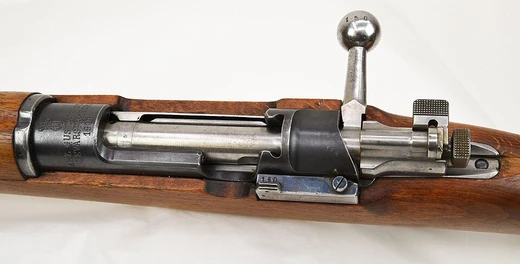
Mauser Standardmodell
A Mauser derivative that bridged export and German paramilitary use.

The Mauser Standardmodell, also referred to as the Model 1924 or Model 1933, is a bolt-action rifle firing the 7.92×57mm Mauser round. Though its design dates to 1924, it was not mass-produced until 1933. The rifle was intended for export and for arming German security guards, but it was also issued to the paramilitary Sturmabteilung (SA) and Schutzstaffel (SS). Its carbine variant closely resembled the later Karabiner 98k, the standard German service rifle of World War II.
The Standardmodell was derived from the Gewehr 98, built in defiance of the Treaty of Versailles. It combined features from both the Karabiner 98AZ and the Gewehr 98, including a 600 mm barrel similar to the 98AZ. A new tangent rear sight was graduated from 100 m to 2000 m in 50 m increments, and could be adjusted for either the standard 7.92×57mm S Patrone spitzer bullet or the heavier s.S. Patrone boat tail spitzer bullet, originally developed for aircraft and machine guns.
The initial 1924 version had a straight bolt handle and a sling mounted on the bottom, like the Gewehr 98. When full production began in 1933, the rifle featured a turned-down bolt and a butt slot for the sling, matching the Karabiner 98k design. Export models were chambered in 7×57mm Mauser, 7.65×53mm Mauser, and 7.92×57mm Mauser. A carbine version, identical to the Karabiner 98k, was also made.
The 1924 Standardmodell was used by the SA and SS, and exported to China and South America. According to the manufacturer, the 1933 model was sold only to the Deutsche Reichspost, designated the Gewehr für Deutsches Reichspost. However, part of that production was actually acquired by Nazi organizations or the Reichswehr, and the Wehrmacht may have used it through requisitions during World War II.
Bolivia purchased the Standardmodell in the 1920s and used it in the Chaco War, while its enemy Paraguay bought rifles in the 1930s. Honduras also placed orders. In China, the 1932 National Armament Standards Conference selected the Standardmodell as the standard rifle for the National Revolutionary Army. Imports from Germany began in 1934, and Chinese arsenals started production in 1935. The first 10,000 rifles went to the Chinese Tax Police. Initially called the Type 24 Rifle, it was soon renamed the Chiang Kai-Shek rifle. It saw action in the Chinese Civil War and the Second Sino-Japanese War.
Quick Facts
- Origin
- Weimar Republic
- Manufacturer
- Mauser
- Wars
- Chinese Civil War / Chaco War / Second Italo-Ethiopian War / Spanish Civil War / Second Sino-Japanese War / World War II / (limited)
- Is Ranged
- yes
- Design Date
- 1924
- Production Date
- 1924–1935
- Weight
- 3.99 kg
- Length
- 1100 mm
- Part Length
- 600 mm
- Cartridge
- 7.92×57mm Mauser / 7×57mm Mauser / 7.65×53mm Mauser
- Action
- Bolt-action
- Feed
- 5-round stripper clip, internal magazine
Facts from the source article.
Lore & Background
The Standardmodell was a derivative of the Gewehr 98, produced in violation of the Treaty of Versailles. It combined features of the Karabiner 98AZ and Gewehr 98, with a 600 mm barrel comparable to the Karabiner 98AZ. The rear sight could be modified to match the trajectory of either the standard 7.92×57mm Mauser S Patrone spitzer bullet or the heavier s.S. Patrone boat tail spitzer bullet originally designed for aerial combat and long range machine gun use. The first version (1924) used a straight bolt handle and a bottom-mounted sling from the Gewehr 98; the 1933 production version introduced a turned-down bolt and a Karabiner 98k type slot in the butt for the sling.
The rifle was exported to South America, Ethiopia, China and the Iberian Peninsula. Bolivia purchased the Standardmodell in the 1920s and used it in the Chaco War; Paraguay fielded rifles bought in the 1930s. Honduras also ordered the rifle. In China, the 1932 National Armament Standards Conference selected the Standardmodell as the standard-issue rifle of the National Revolutionary Army. Imports from Germany began in 1934, and Chinese production began in 1935. The first 10,000 rifles were bought for the Chinese Tax Police, and the rifle was initially named Type 24 Rifle, later renamed the Chiang Kai-Shek rifle. It saw service in the Chinese Civil War and the Second Sino-Japanese War.
According to the manufacturer, the Model 1933 was only sold to the Deutsche Reichspost (German post office) as the Gewehr für Deutsches Reichspost, though part of that production was actually purchased by Nazi organisations or the Reichswehr. The Wehrmacht may have used it through requisitions during World War II. The Imperial Japanese Navy used captured Chiang Kai-Shek rifles from China, and also procured rifles directly from the producer in three contracts: 8,000 in 1938, 20,000 in 1939, and an unclear number in 1940. Ethiopia bought 25,000 Model 1924 and Model 1933 rifles and carbines for the Second Italo-Ethiopian War. The Buenos Aires Police bought Model 1933 rifles and carbines (the latter with a 550 mm barrel), distinguished by an extended arm on the bolt release. Spain bought Standardmodell rifles and carbines both before and after the Spanish coup of July 1936; some were rebarreled for the Spanish 7×57mm round. The German Condor Legion also used the rifle during the Spanish Civil War. Portugal ordered Model 1933s to modernize its military.
Reader's Guide
The Standardmodell's significance lies in its role as a transitional design that directly influenced the Karabiner 98k, the iconic German service rifle of World War II. Produced in violation of the Treaty of Versailles, it allowed Germany to develop and test features—such as the turned-down bolt and sling slot—that would later define the 98k. Its widespread export to South America, Ethiopia, China, and the Iberian Peninsula made it a globally distributed arm, seeing combat in the Chaco War, the Second Italo-Ethiopian War, the Spanish Civil War, and the Second Sino-Japanese War. In China, it became the standard-issue rifle of the National Revolutionary Army under the name Chiang Kai-Shek rifle, and was produced locally. The rifle's use by the SA and SS, as well as its official sale to the Deutsche Reichspost, illustrates the covert rearmament of Germany during the interwar period. Its legacy is that of a versatile Mauser variant that bridged the Gewehr 98 and the Karabiner 98k, serving both domestic paramilitary and international customers.
Did You Know?
- Its carbine version was almost identical to the later Karabiner 98k.
- In China, it was first named Type 24 Rifle, then renamed the Chiang Kai-Shek rifle.
- The Imperial Japanese Navy procured Standardmodell rifles directly from the producer in three contracts during 1938–1940.
Design & Engineering Evolution
The Standardmodell was born as a clever hybrid, drawing its lineage from the venerable Gewehr 98 while incorporating elements from the shorter Karabiner 98AZ. Its 600-millimeter barrel struck a middle ground between the two parent designs, giving the rifle a compact yet effective profile. One of its most notable engineering choices was the new iron sight system: a tangent rear sight graduated from 100 to 2,000 meters in 50-meter steps, with the ability to swap the rear sight element to compensate for the different trajectories of the standard S Patrone spitzer round or the heavier s.S. Patrone boat-tail bullet originally intended for aerial and long-range machine gun applications. The rifle's external configuration evolved noticeably between its 1924 prototype and 1933 production run. The earlier version retained the straight bolt handle and bottom-mounted sling of the Gewehr 98, while the later model adopted a turned-down bolt and a Karabiner 98k-style slot in the buttstock for sling attachment. Exported in three calibers—7×57mm, 7.65×53mm, and 7.92×57mm Mauser—the Standardmodell offered buyers a familiar Mauser action in a modernized package.
Global Service Across Five Continents
Few export rifles of the 1930s saw action on as many continents as the Standardmodell. In South America, Bolivia equipped its forces with the rifle in the 1920s and deployed it during the Chaco War, while rival Paraguay acquired its own batch in the 1930s. Honduras also placed orders. In East Africa, the Ethiopian Empire purchased 25,000 rifles and carbines in both Model 1924 and Model 1933 configurations, fielding them against Italian forces during the Second Italo-Ethiopian War. On the Iberian Peninsula, Spain procured Standardmodells both before and after the July 1936 military coup, and the German Condor Legion operating in the Spanish Civil War also employed the rifle; some Spanish examples were rebarreled for the 7×57mm cartridge. Portugal similarly ordered Model 1933s to modernize its armed forces. The Buenos Aires Police acquired both rifles and carbines, the latter featuring a 550-millimeter barrel and a distinctive extended arm on the bolt release. The Imperial Japanese Navy also found its way to the Standardmodell, using captured Chiang Kai-Shek rifles from China and procuring additional rifles through three separate contracts totaling at least 28,000 units between 1938 and 1940.
The Chinese Connection
The Standardmodell achieved perhaps its most prominent service career in China. At the Chinese National Armament Standards Conference of 1932, delegates selected the rifle as the standard-issue weapon of the National Revolutionary Army. German imports began flowing in during 1934, and domestic production in Chinese arsenals commenced the following year. The first batch of 10,000 rifles was specifically purchased for the Chinese Tax Police. Initially designated the Type 24 Rifle, the weapon was soon renamed the Chiang Kai-Shek rifle in honor of the Generalissimo. The rifle went on to see extensive combat during both the Chinese Civil War and the Second Sino-Japanese War against Japan. Its presence in Chinese hands also created an unexpected supply channel for the Imperial Japanese Navy, which employed captured Chiang Kai-Shek rifles in the field. The IJN additionally procured Standardmodells directly from the manufacturer through three contracts: 8,000 rifles in 1938, 20,000 in 1939, and an unspecified quantity in 1940. These acquisitions may have been driven by ammunition supply difficulties or by the Imperial Japanese Army's arsenals being unwilling to supply the Navy with domestically produced rifles. The rifle was chambered in both 7.92mm and 7mm Mauser cartridges for Chinese service.
Legacy & the Karabiner 98k Connection
The Standardmodell occupies a fascinating position in the lineage of German military small arms. Officially designated for export markets and German security guards, the rifle carried the formal title Gewehr für Deutsches Reichspost, or rifle of the German Post Office. The manufacturer maintained that the Model 1933 was sold exclusively to the Deutsche Reichspost, yet portions of that production were in fact purchased by Nazi paramilitary organizations or the Reichswehr. The Wehrmacht may also have employed the rifle through wartime requisitions. The most significant legacy, however, is the rifle's intimate relationship with the Karabiner 98k. The Standardmodell's carbine variant was virtually identical to the K98k, which went on to become the standard German service rifle throughout World War II. The 1933 production version's turned-down bolt and buttstock sling slot directly prefigured the K98k's design. Produced in violation of the Treaty of Versailles, the Standardmodell served as a bridge between the interwar period and the full-scale military rearmament that followed, its 7.92×57mm Mauser chambering ensuring compatibility with Germany's existing ammunition infrastructure.
Frequently Asked Questions
What is the Mauser Standardmodell?
It is a bolt-action rifle chambered in 7.92×57mm Mauser, designed in 1924 but not entering full-scale production until 1933. The rifle served as a transitional design bridging export-market arms and German paramilitary equipment.
What cartridge does the Mauser Standardmodell fire, and what are its key dimensions?
Its standard round is the 7.92×57mm Mauser, with export variants also offered in 7×57mm Mauser and 7.65×53mm Mauser. The barrel is 600 mm long, and the tangent rear sight is graduated from 100 m to 2000 m in 50 m increments.
Why was the Mauser Standardmodell built if the Treaty of Versailles restricted German arms production?
Derived from the Gewehr 98, it was manufactured in defiance of the treaty's limitations on the Reich. By framing production as export sales and domestic security-guard armament, the makers could legally sidestep the restrictions.
How does the Mauser Standardmodell relate to the Karabiner 98k?
Its carbine variant closely resembled the later Kar98k, which went on to become Germany's standard service rifle in World War II. The Standardmodell essentially carried forward core Gewehr 98 features into a shorter, more practical configuration that foreshadowed the Kar98k.
Which organizations and countries used the Mauser Standardmodell?
Domestically it was issued to the SA, the SS, and Deutsche Reichspost security personnel. Internationally it was exported to Bolivia, Paraguay, Honduras, China, Ethiopia, Argentina, Spain, Portugal, and the Imperial Japanese Navy.
More in Bolt-Action Rifles, Part 3 1-24
Spotted an error? Know more?
Reader corrections go straight into our review queue. Suggest an edit · How this site is sourced