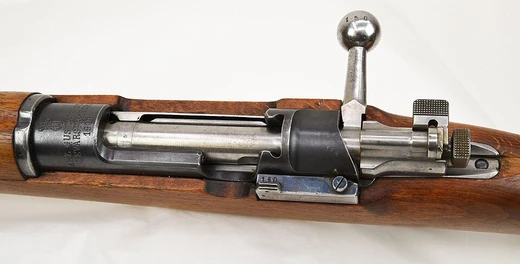
Mauser M 98
Civilian version of the Karabiner 98k with controlled round feed.

Michael Barera · CC BY-SA 4.0
The Mauser M 98 is a bolt-action rifle of German origin, produced by Mauser Jagdwaffen GmbH, a subsidiary of SIG Sauer, in Isny im Allgäu, Germany. It is a civilian version of the Karabiner 98k, one of the final developments in the long line of Mauser 98 military rifles dating back to World War I. The M 98 is offered in many different hunting rifle specializations and features a controlled round feed mechanism.
Quick Facts
- Origin
- Germany
- Manufacturer
- Mauser Jagdwaffen GmbH
- Is Ranged
- yes
- Design Date
- 1898
- Production Date
- 1898–1936 / 2009–present
- Variants
- Mauser M 98 Magnum
- Weight
- 3.6 kg (M 98) / 4.4 kg (M 98 Magnum)
- Length
- 1130 mm (M 98) / 1185 mm (M 98 Magnum)
- Part Length
- 600 mm (M 98) / 620 mm (M 98 Magnum)
- Cartridge
- Various
- Action
- Bolt action
- Feed
- 4 to 5-round internal magazine
Facts from the source article.
Lore & Background
The Mauser M 98 system consists of a receiver that serves as the system's shroud and a bolt group with three locking lugs: two large main lugs at the bolt head and a third safety lug at the rear of the bolt. This third lug is a distinctive feature not present on previous Mauser bolt action designs. The two main locking lugs display a locking surface of 56 mm², while the third safety lug normally plays no part in locking the action to avoid asymmetric bolt thrust forces. The receiver diameter was enlarged compared to previous Mauser receivers for additional strength and safety. The bolt handle is permanently attached and turned-down for use with optical sights.
The controlled round feed mechanism features a large, non-rotating claw extractor that engages the cartridge case rim as soon as the round leaves the magazine and firmly holds it until ejection. Combined with a slight bolt retraction at the last stage of the opening cycle, caused by a cammed surface on the rear receiver bridge, this results in positive extraction. The bolt action will cycle correctly irrespective of the rifle's position or movement during cycling, though if the bolt is not brought back far enough or sharply enough, a jam may result. The bolt houses a firing pin mechanism that cocks when the bolt is opened, with a cocking piece that protrudes visually and tactilely from the rear of the bolt. This bolt sleeve lock was not present on previous Mauser designs and reduced firing pin travel and lock time.
The action features large gas relief holes and a gas shield on the bolt sleeve designed to protect the user's head in case of a primer or cartridge rupture. In a catastrophic failure, debris is deflected away from the operator's face. The bolt mechanism can be easily removed by pulling out the bolt stop located at the left wall of the receiver, then rotating and pulling the bolt out.
Reader's Guide
The Mauser M 98 represents the continuation of a military bolt-action lineage into the civilian hunting market, with production of the controlled round feed Mauser 98 system for the German military ceasing at the end of World War II in 1945. The modern M 98 and M 98 Magnum rifles are produced in Isny im Allgäu by Mauser Jagdwaffen GmbH, a subsidiary of SIG Sauer. The M 98 is practically a civilian version of the Karabiner 98k, though more modern in appearance, and is offered in many hunting rifle specializations. The M 98 Magnum variant is intended for safari hunting, where absolute reliability under adverse conditions is important, and can be chambered in .375 Holland & Holland Magnum, .416 Rigby, and .450 Rigby with box magazine capacities. The standard M 98 is available in 7×57mm Mauser, .308 Winchester, .30-06 Springfield, 8×57 IS, and 9.3×62mm. The rifle features a hand-rubbed oil-finished walnut stock with a cheekpiece, rubber recoil pad, and pistol grip cap. Iron sights are zeroed at 50, 100, and 150 meters, with a Rigby-style diopter sight available, and the rifle is assembled with swing-off telescopic sight mounts. The three-position safety at the rear of the bolt allows the rifle to be locked, opened for reloading while safe, or set to fire. The safety secures the firing pin and can only be released by firing or by closing the cocked bolt with a previously-pulled trigger kept pulled back during closing.
Did You Know?
- The bolt sleeve lock on the M 98 reduced firing pin travel and lock time compared to earlier Mauser designs.
- The Mauser M 98 is produced in Isny im Allgäu, Germany, by Mauser Jagdwaffen GmbH, a subsidiary of SIG Sauer.
From Defeat to Breakthrough: The Road to the M1893
The Spanish Army's search for a dependable service rifle stretched across more than a decade of trial and error. Early experiments with Turkish-made Model 1887 Mausers chambered for black-powder cartridges failed to impress, and a string of defeats around the North African enclave of Melilla only sharpened the urgency for change. By late 1891, the Army had ordered 1,200 smokeless-powder Model 1891 rifles, but field experience with the 1889, 1890, and 1891 series had exposed a catalogue of flaws: a prone-to-failure extractor, a detachable magazine that dangled below the stock and was easily lost, unreliable stripper-clip guides, and a bolt that permitted double-feeding. Paul Mauser responded with the transitional Model 1892, built in limited runs of roughly 5,000 to 8,000 units, which introduced a large non-rotating claw extractor, fused the magazine box to the trigger guard as a single machined piece, and added a sear modification to prevent the firing pin from releasing unless the bolt was fully seated. The definitive M1893 then replaced those orders, swapping in a staggered five-round magazine that sat entirely within the stock—the first fully contained magazine on any Mauser rifle—and was formally adopted on 7 December 1893.
A Century of Service: From Cuba to the Guardia Civil
The M1893 and its descendant variants served as the backbone of Spanish infantry armament for well over half a century. Spanish troops carried these rifles into the Spanish–American War of 1898, the protracted Rif War spanning 1920 to 1927, and the bitter Spanish Civil War of 1936 to 1939. The M1916 short-rifle variant kept rolling off production lines in Spain until 1951, and a significant number of those later-built guns were subsequently re-chambered for either 7.92×57mm Mauser or 7.62×51mm NATO ammunition; some received extensive modifications under the FR7 designation. These converted rifles continued to see use in training programs and with the Guardia Civil well into the 1950s. In Ottoman service, the M1893 in its 7.65×53mm configuration saw more limited but still notable action, appearing in the Greco-Turkish War of 1897, the Balkan Wars of 1912–1913, and the broader conflicts of World War I between 1914 and 1918.
Blueprint for a Generation: The M1893's Enduring Influence
Perhaps no single achievement of the M1893 outweighs its role as the conceptual foundation for an entire lineage of bolt-action rifles that would dominate military arsenals for decades. The staggered-column magazine, the fully contained box, and the refined bolt mechanism that Paul Mauser perfected for Spain became the template for the Models 1894 and 1896—widely known as Swedish Mausers—as well as the Model 1895 and, ultimately, the legendary Gewehr 98, frequently cited as one of the most successful bolt-action designs ever fielded. The M1893's battlefield superiority over the Krag–Jørgensen rifles carried by American troops during the Spanish–American War sent a clear signal to the U.S. Army, which responded by developing the M1903 Springfield, a design that drew heavily on Mauser's engineering solutions. In recognition of the rifle's impact, the Spanish government awarded Paul Mauser the Grand Cross of the Order of Military Merit, a distinction that underscored how a single contract had reshaped small-arms design across multiple continents.
Engineering the Rifle: Variants, Ballistics, and Construction
For Spain, the M1893 was produced in two principal configurations: a full-length rifle with a 29.06-inch (738 mm) barrel and a shorter carbine sporting a 21.75-inch (552 mm) barrel, though historian John Walter has suggested the carbine may have remained an experimental prototype. Both Spanish variants fired the 7×57mm Mauser round through a four-groove, right-hand-twist rifling with a rate of one turn in 8.68 inches (220 mm), generating a muzzle velocity of approximately 2,330 feet per second (710 m/s) from the longer barrel. The standard rifle weighed 8.8 pounds (4.0 kg); the carbine came in at roughly 8.3 pounds (3.8 kg). The Ottoman version retained the 29.06-inch barrel but was chambered for the slightly larger 7.65×53mm Mauser cartridge and tipped the scales at about 9 pounds (4.1 kg). All versions featured forged-steel receivers and one-piece bolts, with stripper-clip guides milled directly into the receiver bridge for dependable rapid loading. The standard three-position safety could lock the action entirely, permit bolt movement with the firing pin disabled, or allow full firing. Shorter rifles received turned-down bolt handles, while full-length models kept the traditional straight handle with a rounded knob.
Gallery
Frequently Asked Questions
What is the Mauser M 98?
The Mauser M 98 is a German bolt-action hunting rifle that serves as the civilian sporting adaptation of the legendary Karabiner 98k. It sits at the tail end of the Mauser 98 action lineage, a design family that has been refined continuously since the World War I period.
Who manufactures the Mauser M 98 and where is it made?
The rifle is produced by Mauser Jagdwaffen GmbH, a subsidiary operating under the SIG Sauer umbrella. All manufacturing takes place in Isny im Allgäu, a small town in southern Germany.
How does the Mauser M 98 relate to the Karabiner 98k?
The M 98 is essentially the K98k reworked for the hunting and sport-shooting market, with military-specific features removed and a wider array of civilian calibers and stock options added. It preserves the core Mauser 98 action architecture, including the controlled round feed mechanism, that made the K98k famous.
What makes the Mauser M 98's bolt action distinctive?
Its action uses a three-lug locking system—two primary lugs plus a dedicated safety lug—to secure the bolt head in the receiver. Combined with the controlled round feed, where the bolt maintains a firm grip on the cartridge rim throughout the entire cycle, this gives the M 98 the robust, reliable feel that Mauser fans prize.
What barrel lengths and calibers does the Mauser M 98 come in?
The standard M 98 is fitted with a 600 mm (about 23.6 in) barrel, while the Magnum version stretches to 620 mm (roughly 24.4 in). Mauser offers the platform in a broad selection of hunting-specific calibers, letting buyers match the rifle to the game they pursue.
More in Bolt-Action Rifles, Part 3 1-24
Spotted an error? Know more?
Reader corrections go straight into our review queue. Suggest an edit · How this site is sourced