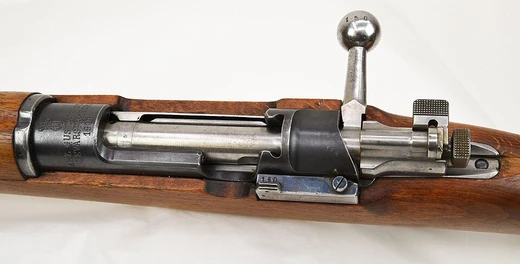
Mauser Model 1893
The Mauser Model 1893 introduced the flush staggered-box magazine.

The Mauser Model 1893 is a bolt-action rifle often called the Spanish Mauser, although other nations, particularly the Ottoman Empire, also adopted it in different calibers. It featured a short, staggered-column box magazine that sat flush with the stock’s bottom, holding five rounds of smokeless 7×57mm Mauser ammunition. Reloading was quick: a stripper clip was pushed into the open bolt from above. This rifle was a significant success for Mauser, forming the foundation for later designs such as the Gewehr 98, widely regarded as one of the finest bolt-action rifles ever made.
Quick Facts
- Service
- 1893–1958
- Designer
- Paul Mauser
- Action
- Bolt action
- Origin
- German Empire
- Is Ranged
- yes
- Design Date
- 1893
- Manufacturer
- Mauser / Ludwig Loewe & Company / de · Deutsche Waffen und Munitionsfabriken / Fabrique Nationale / es · Fábrica de Armas / es · Industrias de Guerra de Cataluña
- Production Date
- 1893–1951
- Weight
- Rifle: 4 kg · Carbine: 3.4
- Part Length
- m/1893: 738 mm / m/1895: 446 mm / m/1916: 552 mm
- Cartridge
- 7×57mm Mauser / 7.65×53mm Mauser
- Feed
- 5 round fixed box magazine
Facts from the source article.
Lore & Background
The M1893 was based on the experimental M1892 rifle, which Paul Mauser developed for the Spanish Army as part of a program to correct deficiencies in the earlier 1889, 1890, and 1891 series of Mauser rifles. Among the issues identified were an unreliable extractor, a detachable box magazine that was frequently lost and extended below the stock, and a bolt design that allowed double-feeding. The M1892 introduced a large non-rotating claw extractor and a one-piece magazine box and trigger guard, but still used a single-stack magazine that protruded below the stock. The M1893 replaced the M1892 order and incorporated a staggered 5-round magazine that did not extend below the bottom of the stock, the first time a Mauser rifle included a fully contained magazine. The action was essentially identical to the M1892 except for a redesigned receiver to fit the wider magazine.
The M1893 was manufactured in two variants for Spain: a standard rifle with a 29.06-inch barrel and a short carbine with a 21.75-inch barrel, though the short version might have been an experimental design only. Both were chambered in 7mm caliber with 4-groove rifling and a right-hand twist. The Ottoman variant used the same barrel length but was chambered in 7.65×53mm Mauser. The receiver and one-piece bolt were forged steel, with stripper clip guides milled into the bridge. The bolt was a cock-on-close design with two forward locking lugs; unlike later Mauser designs, it did not include a third rear locking lug. The magazine included a bolt stop that prevented closing on an empty magazine, indicating to the soldier that the rifle was empty.
Reader's Guide
The M1893 proved to be a major success for Mauser, as it provided the basis for later developments including the Models 1894 and 1896—commonly referred to as Swedish Mausers—the Model 1895, and ultimately the Gewehr 98, one of the most successful bolt-action rifle designs ever produced. The Mauser action was further refined in 1898 with the version adopted in Germany as the Gewehr 98, which led to various military rifles like the German Karabiner 98k, Czech vz. 24, and the Yugoslav M24 series. The Mauser M98 action is still copied in modern commercial hunting rifle designs.
The marked superiority of the M1893 over its American opponent in the Spanish–American War, the Krag–Jørgensens, led the US Army to develop the M1903 Springfield, which itself heavily copied Mauser's designs. All versions of the rifle saw extensive service in the Spanish Army beginning in the Spanish–American War in 1898, the Rif War of 1920–1927, and the Spanish Civil War of 1936–1939. The M1916 short rifles remained in production in Spain until 1951, and many were later converted to 7.92×57mm Mauser or 7.62×51mm NATO, including some extensively modified as the FR7. In Ottoman service, M1893 rifles saw limited action during the Greco-Turkish War of 1897, the Balkan Wars of 1912–1913, and World War I.
Did You Know?
- The M1893 was the first Mauser rifle to incorporate a fully contained staggered-column box magazine that did not extend below the stock.
- Paul Mauser received the Grand Cross of the Order of Military Merit from Spain for his work on the M1893.
- The M1893's superiority over the Krag–Jørgensen in the Spanish–American War influenced the US Army to develop the M1903 Springfield, which heavily copied Mauser designs.
- The M1893 action lacked the third rear locking lug that was introduced with the Model 1895.
From Defeat to Redesign
The M1893 didn't emerge from a blank slate. In 1887, Spain tested Turkish Model 1887 Mausers firing black powder, but the results disappointed. A string of defeats around the Melilla enclave in North Africa sharpened the urgency, and by December 1891 the Spanish Army had ordered 1,200 Model 1891 rifles chambered for new smokeless powder. Field experience with the 1889, 1890, and 1891 Mauser series had exposed a catalog of flaws: a failing extractor, a detachable box magazine that soldiers kept losing and that hung below the stock, unreliable stripper clips, and a bolt prone to double-feeding. Paul Mauser took these lessons and produced the Model 1892, a transitional design built in limited runs of 5,000 to 8,000 for Spain. It introduced a large non-rotating claw extractor to eliminate double-feeds and machined the magazine box and trigger guard as a single unit so the magazine could no longer be separated and lost. Yet the magazine still protruded below the stock. When Spain ordered 20,000 M1892s in July 1893, the design was already being superseded by the M1893, which solved the last major problem.
Engineering the Magazine Revolution
The M1893's most consequential innovation was its short staggered-column box magazine, which sat entirely flush with the underside of the stock. This was the first Mauser rifle to feature a fully contained magazine, eliminating the protruding box that had plagued earlier models and made slung carry cumbersome. The magazine held five rounds of the 7×57mm Mauser smokeless cartridge, and reloading was accomplished by pushing a stripper clip through the open bolt from above. The receiver was redesigned to accommodate the wider magazine, but the action itself remained essentially identical to the M1892. All versions used forged steel receivers and one-piece bolts, with stripper clip guides milled into the bridge for reliable loading. The standard rifle carried a 29.06-inch barrel with four-groove right-hand rifling at a twist of one turn in 8.68 inches, propelling the 7 mm round to 2,330 feet per second. The rifle weighed 8.8 pounds, while the shorter carbine variant came in at about 8.3 pounds. A three-position safety, standard across Mauser's line, could lock the action entirely, allow bolt movement with the firing pin disabled, or permit normal firing.
A Rifle Across Three Wars and a Century
The M1893 and its descendants served Spain for an extraordinary span. The standard rifle and the shortened M1895 carbine saw action in the Spanish–American War of 1898, then endured through the Rif War of 1920–1927 and the Spanish Civil War of 1936–1939. The M1916 short rifle variant kept rolling off Spanish production lines until 1951, and many of those later examples were re-chambered for 7.92×57mm Mauser or 7.62×51mm NATO, some receiving extensive modifications as the FR7. These converted rifles continued in training roles and with the Guardia Civil well into the 1950s. Meanwhile, the Ottoman Empire's version, chambered in 7.65×53mm Mauser, saw limited combat in the Greco-Turkish War of 1897, the Balkan Wars of 1912–1913, and World War I. A single rifle design thus spanned nearly a century of active military service across two nations and multiple conflicts.
The Blueprint That Shaped Modern Bolt-Actions
The M1893's influence radiated far beyond its own service life. It became the direct foundation for the Models 1894 and 1896, the rifles widely known as Swedish Mausers, and for the Model 1895, ultimately feeding into the development of the Gewehr 98, arguably the most successful bolt-action rifle design in history. Its impact also reached the United States: the marked superiority of the M1893 over the Krag–Jørgensen rifles it faced in the Spanish–American War prompted the US Army to develop the M1903 Springfield, a design that heavily borrowed from Mauser's engineering. In recognition of the rifle's effectiveness, the Spanish government awarded Paul Mauser the Grand Cross of the Order of Military Merit. A single design iteration, born from correcting the shortcomings of earlier models, thus became the seed from which some of the most influential military rifles of the twentieth century grew.
Frequently Asked Questions
Who designed the Mauser Model 1893 and who first adopted it?
Paul Mauser designed the rifle, and Spain officially adopted it on 7 December 1893, which is why it is commonly nicknamed the Spanish Mauser. The Ottoman Empire also fielded the design in a different caliber, so the rifle was not exclusive to one nation.
What makes the Mauser Model 1893's magazine design notable?
It was the first bolt-action rifle to use a short, staggered-column box magazine that sat completely flush with the underside of the stock, holding five rounds. Reloads were fast: with the bolt open, a shooter simply pushed a stripper clip down from above to seat all five cartridges at once.
What calibers was the Mauser Model 1893 chambered in?
The Spanish service version fired the 7×57mm Mauser cartridge, while the Ottoman variant was chambered in 7.65×53mm Mauser. Both were smokeless-powder rounds, representing a clear step forward from older black-powder ammunition.
What barrel lengths were available for the Mauser Model 1893?
The full rifle carried a 29.06-inch barrel, and the carbine variant shortened that to 21.75 inches. Both configurations shared the same five-round flush magazine and bolt-action operating mechanism.
Why is the Mauser Model 1893 considered a turning point in bolt-action rifle history?
By proving that a flush, staggered-box magazine could function reliably in a repeating bolt-action, it laid the mechanical groundwork for the later Gewehr 98. That successor is still widely regarded as one of the finest bolt-action rifles ever built, making the 1893 its essential ancestor.
More in Bolt-Action Rifles, Part 3 1-24
Spotted an error? Know more?
Reader corrections go straight into our review queue. Suggest an edit · How this site is sourced