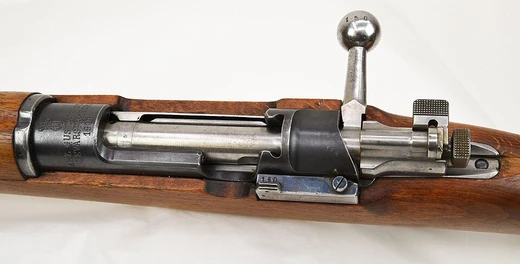
Mauser Model 1902
Mexican Mauser upgraded with Gewehr 98 features.

The Mauser Model 1902 is a bolt-action rifle designed for Mexico, based on the Mauser Model 1895 but incorporating features from the German Gewehr 98. It was produced under contracts signed by Mexican general Bernardo Reyes, with manufacturing by Loewe Berlin, Steyr, and DWM.
Quick Facts
- Origin
- German Empire
- Used By
- Mexico / Spain
- Manufacturer
- Loewe Berlin / DWM / Steyr / Fabrica Nacional de Cartuchos / Fábrica Nacional de Armas
- Wars
- Mexican Revolution / Yaqui Revolt of 1926-1928 / Spanish Civil War
- Is Ranged
- yes
- Production Date
- 1902-1934
- Variants
- Model 1910
- Weight
- 3.96 kg
- Length
- 123.2 cm
- Part Length
- 73.7 cm
- Cartridge
- 7×57mm Mauser
- Action
- Bolt-action
Facts from the source article.
Lore & Background
The Model 1902 was an upgraded version of the Model 1895, which was the standard rifle of the Mexican Army at the beginning of the 20th century. Improvements derived from the German Gewehr 98 included the use of three locking lugs and a gas protection system on the bolt. It fired the 7×57mm Mauser cartridge and accepted the Model 1895 bayonet.
Two contracts were signed in 1902 and 1906 by Mexican general Bernardo Reyes. Production was carried out by Loewe Berlin, Steyr, and DWM. A total of 38,000 DWM-made rifles were delivered, and 40,000 more were made by Steyr.
The Model 1902 saw combat use during the Mexican Revolution. A locally produced variant, the Mexican Mauser Model 1910, was based on the Model 1902 and was manufactured at the Fabrica Nacional de Cartuchos and the Fabrica Nacional de Armas, created with foreign assistance to reduce dependency on foreign suppliers.
Reader's Guide
The Mauser Model 1902 represents a transitional design that brought German Gewehr 98 improvements to the Mexican service rifle, notably the three-locking-lug bolt and gas protection. Its production under contracts by general Bernardo Reyes and by multiple manufacturers—Loewe Berlin, Steyr, and DWM—reflects the international arms trade of the early 20th century. The rifle's combat use during the Mexican Revolution underscores its role in a major historical conflict. The Model 1902 also served as the basis for the locally produced Model 1910, which was manufactured in significant numbers (40,000 until 1934) and later saw service in the Spanish Civil War, where 20,000 were sent to aid the Spanish Republicans. This lineage demonstrates the rifle's lasting influence and adaptation beyond its original context.
Did You Know?
- The Model 1902 used three locking lugs and a gas protection system derived from the German Gewehr 98.
- Two contracts for the rifle were signed by Mexican general Bernardo Reyes in 1902 and 1906.
- 38,000 rifles were delivered by DWM, and 40,000 more were made by Steyr.
- The Model 1902 saw combat during the Mexican Revolution.
From Defeat to Innovation: The Road to the M1893
The path to the Mauser Model 1893 began in frustration. In 1887, the Spanish Army tested Turkish-made Model 1887 Mausers firing black powder cartridges, but the results fell short. A string of defeats around the North African enclave of Melilla sharpened the urgency for modernization, and by December 1891 Madrid had ordered 1,200 Model 1891 rifles chambered for new smokeless powder ammunition. Field experience with the 1889, 1890, and 1891 series had exposed a catalogue of faults: an extractor prone to failure, a detachable magazine that soldiers kept losing and that hung below the stock, unreliable stripper-clip guides, and a bolt geometry permitting double-feeds. Paul Mauser answered with the transitional Model 1892, of which between five and eight thousand were built for Spain. That design introduced a large non-rotating claw extractor, a magazine box machined as one piece with the trigger guard, and a sear modification preventing the firing pin from releasing unless the bolt was fully seated. Yet the magazine still protruded below the stock. The decisive leap arrived when the M1893 replaced the pending M1892 orders with a staggered five-round box magazine sitting entirely flush within the buttstock—the first Mauser to achieve full magazine containment. Spain formally adopted the rifle on 7 December 1893.
A Rifle Across Three Conflicts and Two Armies
The M1893 earned its reputation in the field across decades and continents. In Spanish service, the rifle and its descendants saw action in the Spanish–American War of 1898, the Rif War spanning 1920 to 1927, and the Spanish Civil War of 1936 to 1939. Mauser developed several variants to meet evolving needs: a shortened carbine adopted as the M1895, and the M1913 and M1916 short rifles. Production of the M1916 continued in Spanish factories until 1951, and many of those later examples were re-chambered to fire either 7.92×57mm Mauser or 7.62×51mm NATO ammunition; some underwent extensive modification as the FR7. These converted rifles served in training roles and with the Guardia Civil well into the 1950s. On the other side of the Mediterranean, the Ottoman Army fielded its own M1893 variant, and those rifles saw limited combat in the Greco-Turkish War of 1897, the Balkan Wars of 1912–1913, and the Great War of 1914–1918. The rifle's long production life and repeated re-chambering speak to a design that remained mechanically sound across more than half a century of changing warfare.
Blueprint for an Era of Bolt-Actions
The M1893's influence extended far beyond the arsenals that purchased it. For Mauser, the rifle was a commercial and technical triumph that provided the architectural foundation for a lineage of celebrated designs: the Models 1894 and 1896, widely known as Swedish Mausers, the Model 1895, and ultimately the German Gewehr 98, frequently cited among the most successful bolt-action rifle platforms ever fielded. The rifle's battlefield performance also sent ripples across the Atlantic. During the Spanish–American War, the M1893 demonstrated a marked advantage over the Krag–Jørgensen rifles carried by American troops. That disparity prompted the U.S. Army to develop the M1903 Springfield, a design that drew heavily on Mauser's engineering solutions. In recognition of the rifle's impact, the Spanish government awarded Paul Mauser the Grand Cross of the Order of Military Merit. Few single weapons have shaped the trajectory of an entire category of firearms the way the M1893 shaped the bolt-action rifle of the twentieth century.
Engineering the Contained Magazine
At the heart of the M1893's design philosophy was the elimination of the protruding magazine that had plagued earlier Mauser rifles. The new staggered-column box magazine held five 7×57mm Mauser smokeless-powder rounds and fit entirely within the lower profile of the stock, a first for the company. Reloads were quick: with the bolt open, a stripper clip could be pushed from above to seat all five rounds at once, though individual loading remained possible. The receiver and one-piece bolt were both forged steel, and the bridge carried milled guides for the stripper clips to improve feeding reliability. Standard rifles featured a 29.06-inch barrel with four-groove right-hand rifling at a twist of one turn in 8.68 inches, propelling the 7 mm round to roughly 710 metres per second. The full rifle weighed about 4.0 kilograms; a shorter carbine version came in at 3.8 kilograms. Ottoman variants used the same barrel length but were chambered for the slightly larger 7.65×53mm Mauser cartridge and weighed around 4.1 kilograms. A three-position safety, standard across Mauser rifles, could lock the action, allow bolt travel with a disabled firing pin, or permit full firing.
Frequently Asked Questions
What is the Mauser Model 1902?
The Mauser Model 1902 is a bolt-action military rifle developed specifically for the Mexican armed forces. It evolved from the earlier Mauser Model 1895 while integrating select mechanical features borrowed from Germany's Gewehr 98 service rifle.
Who manufactured the Mauser Model 1902 and under whose authority?
Production was carried out by three firms—Loewe Berlin, Steyr, and DWM—under contracts negotiated by Mexican General Bernardo Reyes. DWM alone accounted for roughly 38,000 units of the total output.
What cartridge and action type does the Mauser Model 1902 use?
The rifle is chambered in 7×57mm Mauser and operates on a bolt-action mechanism derived from the Gewehr 98 design, giving it a more robust locking system than the original 1895 pattern.
How does the Model 1902 differ from the Mauser Model 1895?
While the 1895 served as the foundational platform, the 1902 upgraded the internal action to match the Gewehr 98's stronger bolt and receiver geometry. This made the Mexican service rifle more durable and consistent with contemporary European standards.
Why is the Mauser Model 1902 considered important in rifle history?
It represents a notable case of a non-European nation commissioning a modernized bolt-action rifle from multiple European manufacturers simultaneously. The project also demonstrated how the Gewehr 98's mechanical improvements were spreading beyond the German military into client arsenals by the early 1900s.
More in Bolt-Action Rifles, Part 3 1-24
Spotted an error? Know more?
Reader corrections go straight into our review queue. Suggest an edit · How this site is sourced