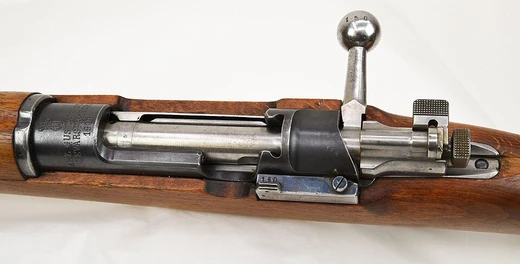
Mauser Model 1903
Ottoman Mauser, a Gewehr 98 variant with distinctive sight and bolt changes.

The Mauser Model 1903, often called the Ottoman Mauser, is a bolt-action rifle based on the Gewehr 98 pattern. It was built by Mauser in Germany specifically for the Ottoman Army. The design modified the Gewehr 98 by swapping the Lange Visier sight for a tangent leaf sight and simplifying the nose cap. It could also use older Ottoman M1890 bayonets. A curved arm on the bolt stop blocked the cartridge clip when rounds were stripped into the magazine. Compared to the German version, it had a larger receiver, a longer cocking cam, and a longer firing pin. A shortened version, the Model 1905 carbine, was made for cavalry and artillery units. In service, 200,000 long rifles were received before 1905. The Ottoman Navy got 406 Marine-gewehre in 1904, and the Gendarmerie in Ottoman Macedonia received 7,617. A modified batch of 1,100 rifles, sometimes called M1910, was ordered in 1910 to fire spitzer bullets. The Ottoman customs also received some. The Model 1905 carbine was produced from 1903 to 1906, and 30,000 M1908 carbines were delivered in 1908 and 1909. The Model 1903 saw combat in the Italo-Turkish War, the Balkan Wars, World War I, and the Turkish War of Independence. After World War I, most were converted to fire the 7.92×57mm Mauser round. Many long rifles were later refurbished as Mauser Model 1938 short rifles. Both the Model 1903 and Model 1905 remained in service into the 1960s.
Quick Facts
- Origin
- German Empire
- Service
- 1903–1960s
- Used By
- Ottoman Empire / Republic of Turkey / Austria-Hungary
- Manufacturer
- Mauser
- Wars
- Italo-Turkish War · Balkan Wars · World War I · Turkish War of Independence
- Is Ranged
- yes
- Design Date
- 1903
- Production Date
- 1903–1910
- Variants
- Model 1905 carbine
- Weight
- Model 1903: 4.17 kg / Model 1905 carbine: 3.6 kg
- Length
- Model 1903: 124 cm / Model 1905 carbine: 105.6 cm
- Part Length
- Model 1903: 74 cm / Model 1905 carbine: 55.6 cm
Facts from the source article.
Lore & Background
The Mauser 1903 was a modified version of the Gewehr 98. Its Lange Visier sight was replaced by a tangent leaf sight, the nose cap was simplified, and it could be fitted with older Ottoman M1890 bayonets. The weapon featured a curved arm on its bolt stop to block the cartridge clip when cartridges are stripped into the magazine, along with a larger receiver and a longer cocking cam and firing pin than the German variant.
The Model 1905 carbine was a shortened version of the Model 1903, designed for cavalry and artillery units. After the adoption of the long rifle, 200,000 were received before 1905. Deliveries included 406 Marine-gewehre to the Ottoman Navy in 1904, 7,617 to the Gendarmerie in Ottoman Macedonia, and 1,100 more modified to fire spitzer bullets (sometimes known as M1910) ordered in 1910. The Ottoman customs also received some. The Model 1905 carbine was produced between 1903 and 1906, and 30,000 M1908 carbines were delivered in 1908 and 1909.
The Model 1903 saw combat during the Italo-Turkish War, the Balkan Wars, World War I, and the Turkish War of Independence. After World War I, most were modified to fire the 7.92×57mm Mauser round. Many long rifles were refurbished as Mauser Model 1938 short rifles. Models 1903 and 1905 were still in service in the 1960s.
Reader's Guide
The Mauser Model 1903 served as the primary bolt-action rifle for the Ottoman Empire across multiple major conflicts, including the Italo-Turkish War, the Balkan Wars, World War I, and the Turkish War of Independence. Its design modifications from the Gewehr 98—such as the tangent leaf sight, simplified nose cap, and compatibility with older Ottoman bayonets—reflected adaptation to Ottoman military needs. The rifle's production and delivery figures, including 200,000 long rifles before 1905, 406 Marine-gewehre for the navy, and 7,617 for the Gendarmerie, indicate widespread distribution. The introduction of the Model 1905 carbine for cavalry and artillery, along with later M1908 carbines and M1910 spitzer-firing variants, demonstrated continued development. After World War I, most were rechambered to 7.92×57mm Mauser, and many long rifles were later refurbished as Model 1938 short rifles. The weapon's longevity is evidenced by its continued service into the 1960s, making it a significant piece of Ottoman and Turkish military history.
Did You Know?
- It had a larger receiver and longer cocking cam and firing pin than the German Gewehr 98.
- 406 Marine-gewehre were delivered to the Ottoman Navy in 1904.
From Defeat to Breakthrough: The Road to the M1893
In 1887, the Spanish Army tested Turkish Model 1887 Mauser rifles chambered for black powder, but the results fell short. The urgency sharpened after Spanish forces endured repeated defeats around the North African enclave of Melilla, leading the Army to order 1,200 Model 1891 rifles on 2 December 1891, now using smokeless powder ammunition. Trials with those guns, layered over years of field experience with the 1889, 1890, and 1891 Mauser series, exposed a long list of weaknesses: an unreliable extractor, a detachable box magazine that soldiers often lost and that protruded below the stock, making slung carry difficult, poorly functioning stripper clips, and a bolt that could double-feed rounds. Paul Mauser distilled these lessons into the Model 1892, a transitional design produced in limited runs of roughly 5,000 to 8,000 units for Spain. It featured a large non-rotating claw extractor, a one-piece magazine-and-trigger-guard casting, and a sear change that blocked the firing pin unless the bolt was fully seated. Spain ordered 30,000 of these in mid-1893, but the refined Model 1893 superseded that order, and the Army adopted it on 7 December 1893.
The Staggered Magazine and the 7×57mm Cartridge
The single most consequential innovation in the M1893 was its short, staggered-column box magazine, which sat flush with the underside of the stock. This marked the first time a Mauser rifle housed a fully contained magazine, eliminating the protruding, easily lost box that had plagued earlier models. The five-round capacity was fed by the newly developed 7×57mm Mauser cartridge, a smokeless round Mauser created specifically for the Spanish Army. Reloading was quick: with the bolt open, a stripper clip was pushed from the top, dropping all five rounds into the staggered columns in one motion. The receiver for every variant was forged steel, and the one-piece bolt carried a straight handle with a rounded grasping knob on standard rifles, while shorter variants received turned-down handles. Stripper-clip guides were milled into the receiver bridge for added reliability, though individual round loading remained possible. The standard rifle's 29.06-inch barrel carried four right-hand grooves with a twist of one turn in 8.68 inches, propelling the 7 mm projectile to 2,330 feet per second. The complete rifle weighed 8.8 pounds, and the three-position safety could lock the action, permit bolt movement with the firing pin disabled, or allow full firing.
Three Wars, Two Empires, Five Decades of Service
The M1893 and its descendants served in some of the most consequential conflicts of the early twentieth century. In the Spanish Army, the rifle first saw combat during the Spanish–American War of 1898, then endured the brutal Rif War in Morocco from 1920 to 1927, and finally fought on both sides of the Spanish Civil War between 1936 and 1939. The Spanish also adopted a shortened carbine version as the M1895 and later developed the M1913 and M1916 short rifles. Remarkably, M1916 production in Spain continued all the way until 1951, and many of those later rifles were re-chambered to fire either 7.92×57mm Mauser or 7.62×51mm NATO, with some receiving extensive modifications as the FR7. These converted weapons served in training roles and with the Guardia Civil through the 1950s. Meanwhile, the Ottoman Empire fielded its own variant of the M1893, chambered in the slightly larger 7.65×53mm Mauser round. Ottoman troops carried these rifles through the Greco-Turkish War of 1897, the Balkan Wars of 1912–1913, and World War I from 1914 to 1918, giving the design a remarkably broad and prolonged combat record across two empires and more than five decades.
The Blueprint for Modern Bolt-Actions
The M1893's influence on the future of bolt-action rifle design cannot be overstated. It provided the direct foundation for the Models 1894 and 1896, widely known as Swedish Mausers, as well as the Model 1895, and ultimately fed into the development of the Gewehr 98, which is routinely cited as one of the most successful bolt-action rifle designs ever produced. The rifle's combat performance also sent shockwaves across the Atlantic. During the Spanish–American War, the M1893 demonstrated a marked superiority over the Krag–Jørgensen rifles carried by American forces, a disparity that prompted the US Army to develop the M1903 Springfield. That Springfield, in turn, drew heavily on Mauser's design principles, meaning the M1893's engineering choices indirectly shaped the standard infantry rifle of the United States for decades. In recognition of the rifle's effectiveness, the Spanish government awarded Paul Mauser the Grand Cross of the Order of Military Merit. A single design, born from the need to fix a handful of mechanical flaws, ended up seeding an entire lineage of service rifles and influencing the armament choices of rival nations.
Gallery

Frequently Asked Questions
What is the Mauser Model 1903?
It is a bolt-action rifle that Mauser built in Germany specifically for the Ottoman Army, derived from the Gewehr 98 pattern. Collectors and historians most often refer to it as the 'Ottoman Mauser.'
How does the Mauser Model 1903 differ from the standard German Gewehr 98?
The Ottoman version swapped the Lange Visier for a tangent leaf sight, simplified the nose cap, and accepted the older M1890 bayonet. Internally it carried a larger receiver, a longer cocking cam, and a longer firing pin, plus a curved bolt-stop arm that blocked the clip during magazine stripping.
What caliber was the Mauser Model 1903 chambered in?
It was originally loaded in 7.65×53mm, though a large number of examples were later re-chambered to the 7.92×57mm Mauser round.
How many Mauser Model 1903 rifles were produced for the Ottoman Army?
The Army received 200,000 rifles before 1905, supplemented by 406 Marine-gewehre in 1904 and 7,617 issued to the Gendarmerie. Later orders added 30,000 M1908 carbines (1908–1909) and 1,100 M1910-pattern rifles in 1910.
What variants of the Mauser Model 1903 exist, and how long did the platform serve?
Known variants include the Model 1905 carbine, the Model 1908 carbine, and the M1910. The design remained in Ottoman and successor-service use from 1903 into the 1960s.
More in Bolt-Action Rifles, Part 3 1-24
Spotted an error? Know more?
Reader corrections go straight into our review queue. Suggest an edit · How this site is sourced