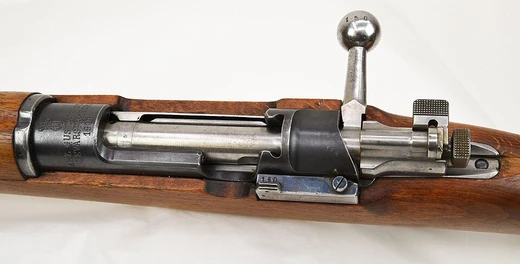
Mauser Tankgewehr M1918
The first purpose-built anti-tank rifle, used in World War I.

Europeana staff photographer · Public domain
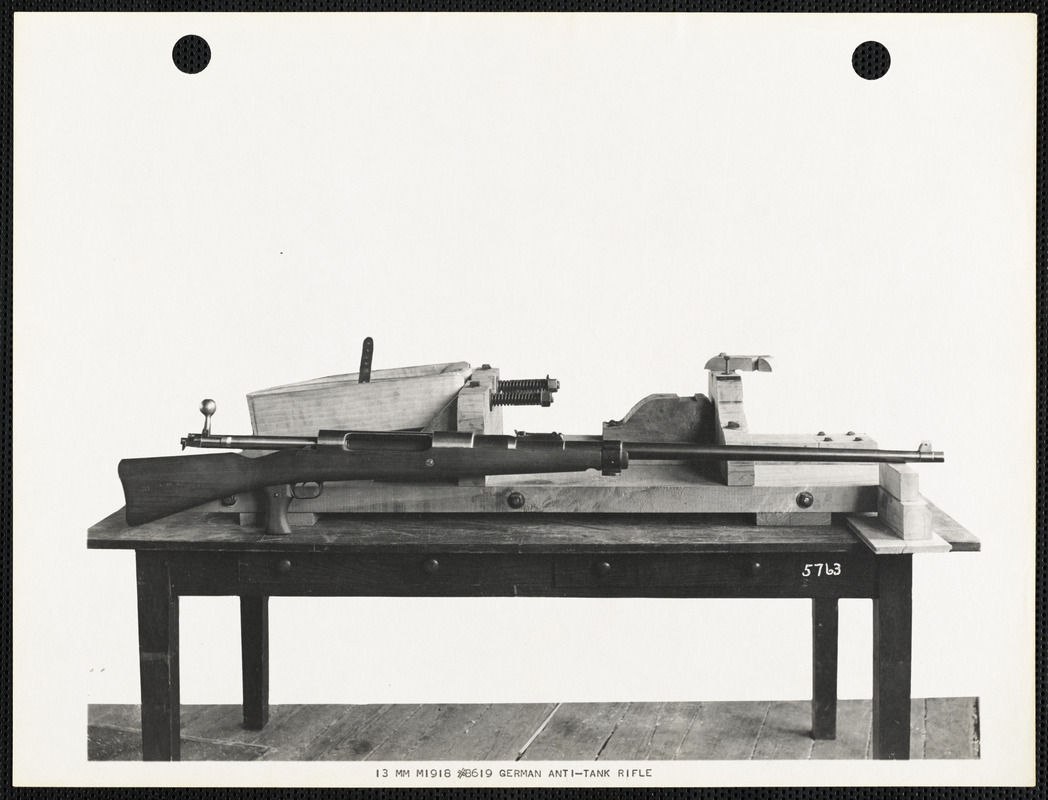
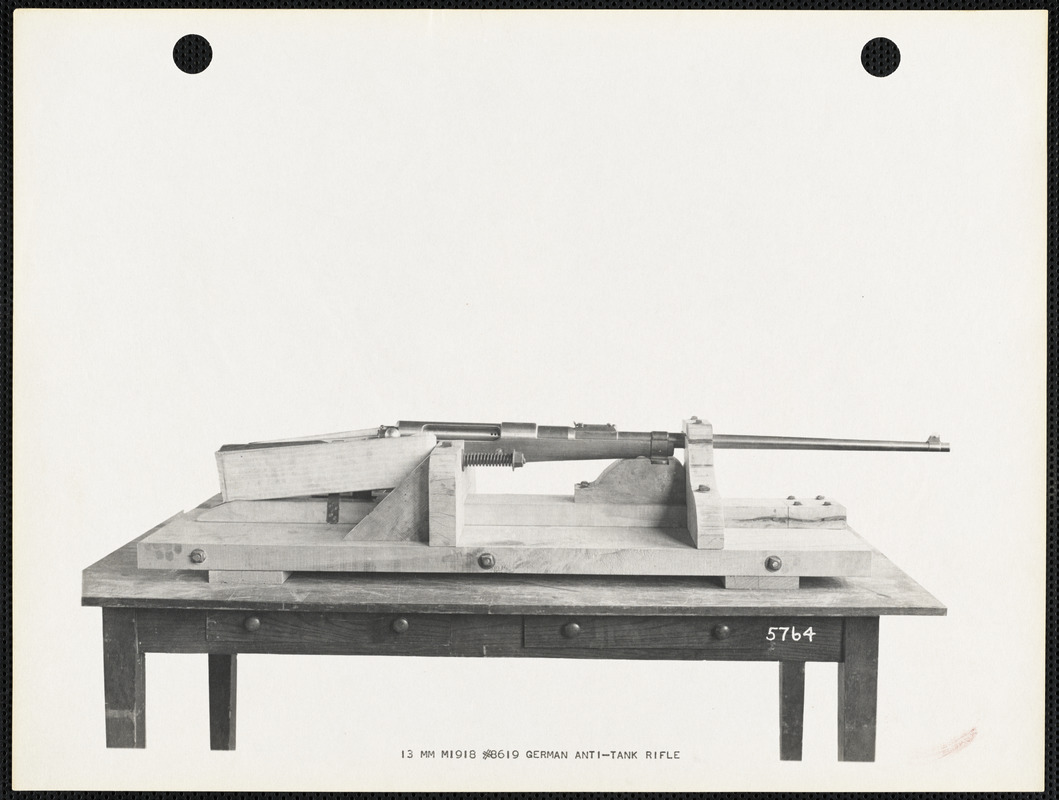
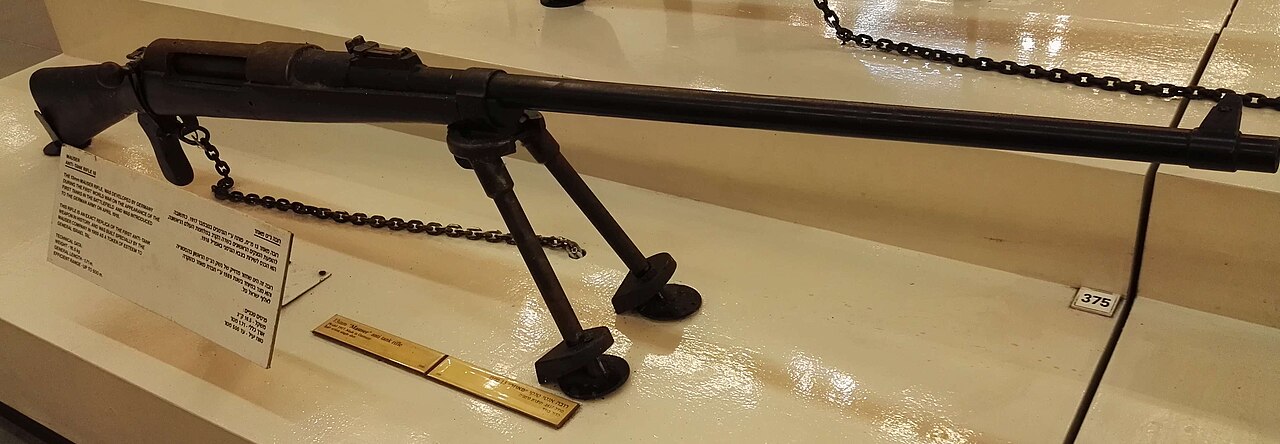
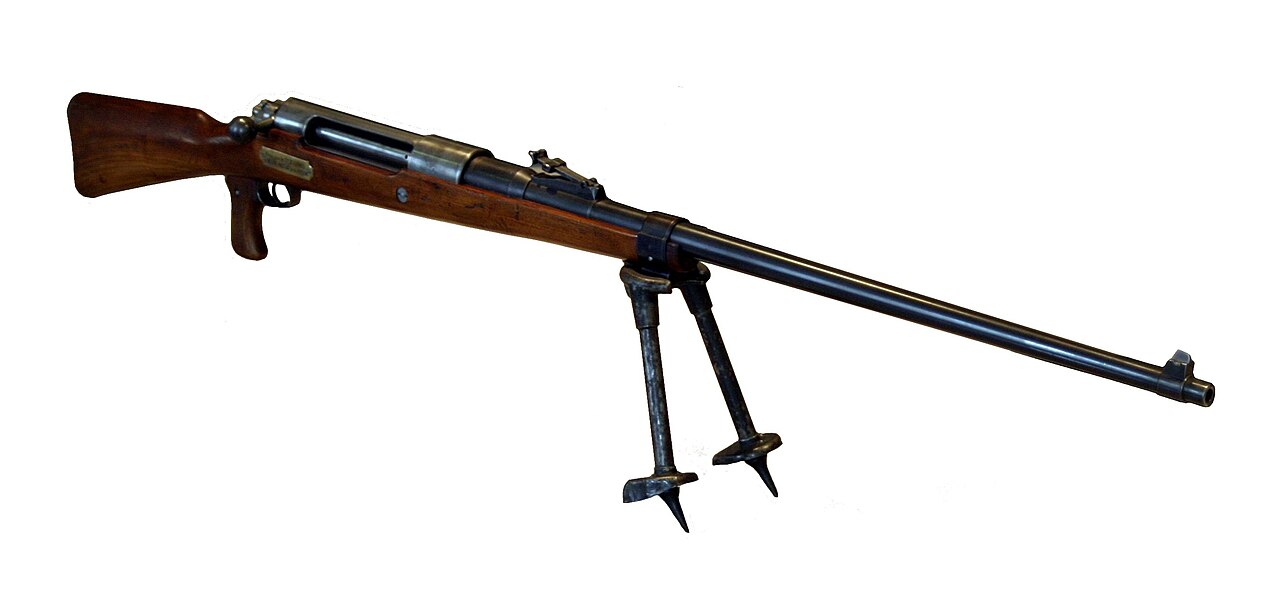
The Mauser Tankgewehr M1918, also known as the T-Gewehr, is a German anti-tank rifle and the first rifle designed solely for destroying armored targets. It was the only anti-tank rifle to see service in World War I.
Quick Facts
- Origin
- German Empire
- Is Ranged
- yes
- Service
- 1918–1933
- Used By
- German Empire / Weimar Republic / Sweden / Republic of the Rif
- Wars
- World War I / German Revolution of 1918–1919 / Rif War
- Manufacturer
- Mauser
- Production Date
- January 1918 – April 1919
- Number
- 16,900
- Variants
- M1918 shortened / Magazine-fed
- Weight
- 15.9 kg, 18.5 kg loaded with the bipod
- Length
- 169.1 cm
- Part Length
- 98.4 cm
Facts from the source article.
Lore & Background
The Tankgewehr M1918 was developed by the Mauser Company in response to the German Army's need for a weapon capable of penetrating the armor of the Mark IV tank, against which the standard 7.92 mm K bullet had become ineffective by June 1917. The designers were inspired by African elephant guns used for big-game hunting. Mass production began at Oberndorf am Neckar in May 1918, and the first rifles were issued to specially raised anti-tank detachments.
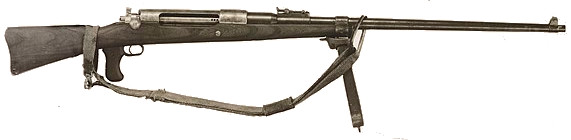
The rifle used a modified Mauser bolt-action, with rounds manually loaded into the chamber. It featured a pistol grip and bipod but had no recoil-reducing device such as a soft buttpad or muzzle brake, making repeated firing difficult. The iron sights consisted of a front blade and tangent rear graduated from 100 to 500 meters. It was operated by a two-man crew—a gunner and an ammunition bearer—both trained to fire it. Due to its heavy recoil, it was designed to be fired from a static position, either prone or from within a trench.
Approximately 14,700 T-Gewehrs were produced before the Armistice, and production ceased in April 1919. An additional 1,490 were produced after hostilities ended.
Reader's Guide
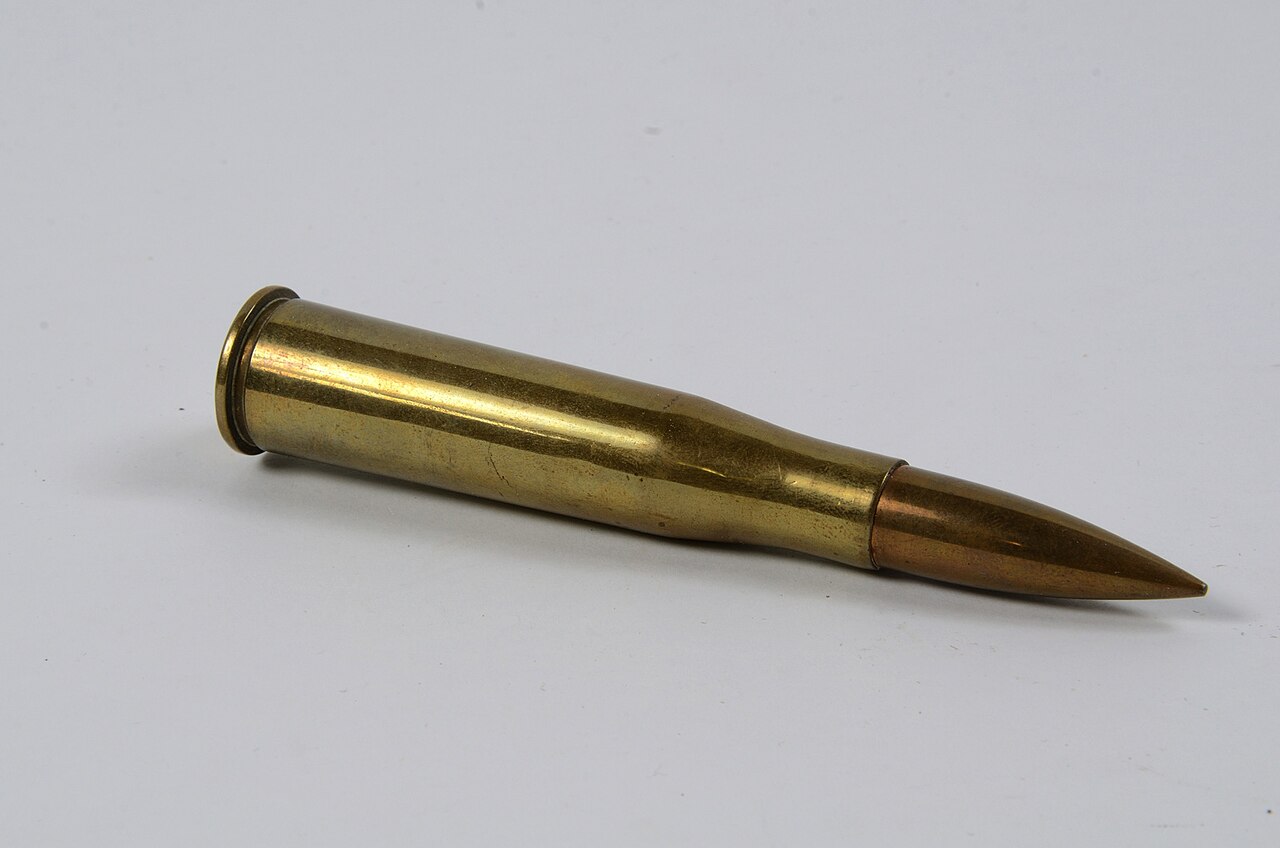
The Tankgewehr M1918 holds significance as the world's first anti-tank rifle, marking a shift in infantry weaponry to counter armored vehicles. Its development was a direct response to the battlefield introduction of tanks by the British and French. The rifle's legacy includes influencing later anti-tank designs: after World War I, the United States Army and other Allied powers tested it. Poland obtained a few during border skirmishes in 1920, and the Reichswehr kept some in service into the 1930s, with 805 in secret arsenals in 1925. Sweden purchased a number, designating them Pansarvärnsgevär m/21. During the Rif War, Rifian rebels smuggled M1918s to counter Spanish tanks. In 1939, a Soviet team led by V.N. Shokolov reverse-engineered the T-Gewehr to fire the Soviet 12.7×108mm B-32 bullet, with small numbers hand-produced by the Bauman Institute in July 1941. After the Winter War, Finland bought 100 from Great Britain but never used them, scrapping them in 1944. The cartridge, a 13.2×92mm semi-rimmed round originally planned for the heavy Maxim MG.18 TuF machine gun, weighed 51.5 g and had an initial velocity of 785 m/s. Surviving examples are held in numerous museums worldwide.
Did You Know?
- The T-Gewehr was the first rifle designed exclusively for destroying armored targets.
- Approximately 16,900 T-Gewehrs were produced in total.
- The cartridge was originally developed for the Maxim MG.18 TuF machine gun.
- Sweden used the T-Gewehr under the designation Pansarvärnsgevär m/21.
The Broader WWI Infantry Weapons Landscape
The Mauser Tankgewehr M1918 existed within an extraordinarily diverse ecosystem of infantry armament that defined the First World War. The weapons of that era spanned an enormous spectrum, from edged weapons like the Kukri knife carried by Gurkha regiments and the Da Dao of Chinese forces, to heavy support guns such as the Škoda 14cm Minenwerfer. Infantry units fielded everything from pocket pistols like the Colt M1903 to large-calibre mortars and even portable flamethrowers. The Tankgewehr occupied a niche in this vast catalogue, a specialized infantry weapon designed for a specific tactical role amid a conflict where soldiers needed tools far beyond the standard bolt-action rifle. The sheer breadth of the arsenal—from the Webley M1872 Bull Dog to the 15cm Esslingen Luftminenwerfer—shows how WWI infantry armament had become a layered system of overlapping capabilities, and the Tankgewehr was one more specialized element in that layered approach.
A Proliferation of Manufacturers and Nations
The WWI infantry weapons lists reveal a world where no single nation or manufacturer held a monopoly on armament. Mauser designs appeared across multiple national arsenals: the C96 pistol served in Austro-Hungarian, Bulgarian, and Chinese forces; the Gewehr 98 and various Mauser rifles were standard or captured equipment in Austria-Hungary and Bulgaria; and Mauser variants like the M1903, M1899, and M1910 appeared as captured weapons in Austro-Hungarian service. Meanwhile, other prolific manufacturers like Mannlicher, Steyr, Browning, and Hotchkiss supplied their own nations. The Tankgewehr M1918 emerged from this same competitive, multinational industrial environment, a product of a German arms industry that had already produced numerous rifles, pistols, and support weapons for its own military and for export. The era's weapon lists make clear that infantry armament was a global industrial undertaking, with dozens of firms competing to equip the millions of soldiers on all sides of the conflict.
Specialized Support and Anti-Armour Roles
Within the WWI infantry weapons taxonomy, the Tankgewehr M1918 belonged to a category of specialized support weapons that went beyond the standard rifle and machine gun. The era saw dedicated roles for flamethrowers like the Flammenwerfer M1916 and Kleinflammenwerfer M1911, for trench mortars ranging from the 2-inch to the 12cm Minenwerfer, and for even more exotic tools such as the British Leach Trench Catapult and the McClintock Bangalore torpedo for obstacle clearing. The British even employed an ad hoc elephant gun against sniper armour, showing how armies improvised solutions to new threats. The Tankgewehr fit into this same tradition of purpose-built infantry weapons designed to solve a specific problem on the battlefield. It was not a general-purpose rifle or a crew-served machine gun, but a dedicated tool for a particular tactical challenge, much like the grenade mortars and portable flame projectors that filled similar niche roles in the infantry armament of the period.
Captured Weapons and Tactical Adaptation
A striking feature of WWI infantry armament, visible throughout the weapons lists, was the widespread practice of adopting and utilizing captured enemy weapons. Austro-Hungarian forces fielded large quantities of Mosin–Nagant rifles captured from Russian soldiers, along with captured Mauser M1903, M1899, and M1910 rifles. Brazilian forces used captured FIAT submachine guns, while Belgian and British units incorporated various foreign designs into their arsenals. This pattern of tactical adaptation—taking what the enemy provided and integrating it into one's own infantry equipment—was a hallmark of the war. The Tankgewehr M1918, as a German weapon, would have been subject to the same dynamics: potentially captured by opposing forces, studied, and either adopted or discarded based on its performance. The era's weapons lists, with their frequent notations of captured and ad hoc equipment, illustrate a conflict where the boundaries between nations' arsenals were constantly blurred by the realities of combat and the practical need to arm available troops with whatever functional weapons could be obtained.
Gallery
Frequently Asked Questions
What is the Mauser Tankgewehr M1918?
It is a German bolt-action anti-tank rifle from World War I, commonly nicknamed the T-Gewehr. It holds the distinction of being the very first rifle ever designed with the sole purpose of knocking out armored vehicles.
What cartridge does the Mauser Tankgewehr M1918 fire?
It chambers the 13.2×92mm semi-rimmed round, a large-caliber projectile that leaves the muzzle at roughly 785 m/s. That velocity gave it a practical engagement window of about 100 to 500 meters with its iron sights.
How is the Mauser Tankgewehr M1918 loaded and operated?
The rifle uses a single-shot, bolt-action feed system, meaning the shooter must manually load one round, close the bolt, and fire before repeating the cycle. There is no magazine or internal clip to manage.
How many Mauser Tankgewehr M1918 rifles were actually produced?
German factories turned out approximately 16,900 units over the course of the war. That run made it the only dedicated anti-tank rifle to reach front-line service during World War I.
Why do firearms historians consider the Mauser Tankgewehr M1918 a landmark design?
Before the T-Gewehr, crews relied on improvised or repurposed weapons to fight tanks. It proved that a shoulder-fired, purpose-built rifle could genuinely threaten early armored vehicles, setting the template for every anti-tank rifle that followed.
More in Bolt-Action Rifles, Part 3 1-24
Spotted an error? Know more?
Reader corrections go straight into our review queue. Suggest an edit · How this site is sourced