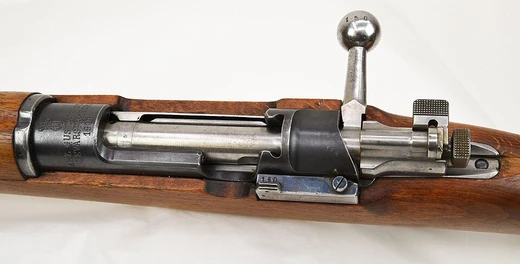
Mauser Model 1910
Export Mauser with a rare enveloping bolt head.

Daderot · Public domain
The Mauser Model 1910 is a bolt-action rifle derived from the Gewehr 98, designed for the export market. It is notable for incorporating a rarely-used Mauser invention from 1898, in which the bolt head enveloped the cartridge rim, leaving only the cartridge case visible—a feature that increased the rifle's complexity.
Quick Facts
- Origin
- German Empire
- Service
- 1910–1945
- Manufacturer
- Mauser
- Wars
- Balkan Wars · World War I · World War II
- Is Ranged
- yes
- Design Date
- 1910
- Production Date
- 1911–1914
- Weight
- 4.0 kg
- Length
- 124 cm
- Part Length
- 74.0 cm
- Cartridge
- 7×57mm Mauser
- Action
- Bolt-action
Facts from the source article.
Lore & Background
The Mauser Model 1910 was based on the Gewehr 98 and could accept the bayonet of the Mauser Model 1895. It used a standard tangent leaf rear sight. The rifle's distinctive feature was a Mauser patent from 1898: the bolt head enveloped the cartridge rim, exposing only the cartridge case. This design made the rifle more complex than contemporary Mauser models.
Costa Rica ordered 5,000 Model 1910 rifles chambered in 7×57mm Mauser, produced between 1911 and 1913. Some of these rifles later had their barrels shortened to 58 cm and were modified to fire the .30-06 Springfield cartridge. Ecuador also ordered an unknown number in the same caliber.
Serbia ordered the Model 1910 in 7×57mm Mauser, and it saw service during the Balkan Wars and World War I. By 1918, it became the standard rifle of the Kingdom of Serbs, Croats and Slovenes (Yugoslavia), where it was designated Puška 7 mm M 10. Some were exported to Guatemala. In Yugoslav service, it saw further use during World War II. Some examples were shortened and rechambered in 7.92×57mm Mauser as Puška 7,9 mm M 10C. Rifles captured by Nazi Germany were designated Gewehr 221 (j) and Gewehr 291/3 (j). Venezuelan leader Juan Vicente Gómez ordered 6,000 Model 1910 rifles to modernize his army's equipment, delivered before 1914.
Reader's Guide
The Mauser Model 1910 represents a specialized export variant of the Gewehr 98, notable for its adoption by multiple nations in the early 20th century. Its most distinctive technical feature—the enveloping bolt head—was a Mauser invention that saw limited use, likely due to the added complexity it introduced. The rifle's service history spans the Balkan Wars, both World Wars, and post-war modifications, reflecting its durability and adaptability. Costa Rica's order of 5,000 rifles, some later converted to .30-06, and Venezuela's purchase of 6,000 under Gómez illustrate its role in arming smaller nations. The Serbian and Yugoslav adoption, with subsequent rechambering to 7.92mm, shows how the rifle was adapted to changing ammunition standards. German capture designations further attest to its presence on European battlefields. While not as widely known as other Mauser models, the Model 1910's unique bolt design and multinational service make it a noteworthy entry in bolt-action rifle history.
Did You Know?
- The Model 1910 used a rarely-employed Mauser patent from 1898 where the bolt head enveloped the cartridge rim.
- Costa Rican Model 1910 rifles were later shortened to 58 cm and modified to fire .30-06 Springfield.
- In Yugoslav service, the rifle was called Puška 7 mm M 10 and later some were rechambered to 7.92×57mm as Puška 7,9 mm M 10C.
- Nazi Germany designated captured Yugoslav Model 1910 rifles as Gewehr 221 (j) and Gewehr 291/3 (j).
The Road to a Contained Magazine
The Spanish Army's search for a dependable service rifle stretched back to 1887, when trials of the Turkish Model 1887 Mauser—still firing black-powder cartridges—failed to impress. Defeats around the North African enclave of Melilla sharpened the urgency, and by December 1891 the Army had ordered 1,200 smokeless-powder Model 1891 rifles. Field experience with the 1889, 1890, and 1891 series exposed a catalogue of flaws: an unreliable extractor, a detachable magazine that soldiers kept losing or that hung below the stock, faulty stripper-clip guides, and a bolt permitting double-feeds. Paul Mauser answered these complaints with the transitional Model 1892, built in limited numbers of five to eight thousand. That design introduced a large non-rotating claw extractor, a magazine box machined as one piece with the trigger guard, and a sear that would not release the firing pin unless the bolt was fully locked. The decisive leap came with the Model 1893, which swapped the single-stack magazine for a staggered five-round box sitting entirely within the stock—the first Mauser rifle with a fully contained magazine. Spain adopted the weapon on 7 December 1893, and the government honored Mauser with the Grand Cross of the Order of Military Merit.
A Rifle That Outlived Its Era
The Spanish Mauser proved remarkably durable in the hands of the Spanish Army, seeing action across nearly half a century of conflict. It first saw combat in the Spanish–American War of 1898, then endured the brutal Rif War in Morocco from 1920 to 1927, and ultimately fought on both sides of the Spanish Civil War between 1936 and 1939. The family of rifles also spawned several shorter variants: the M1895 carbine, the M1913, and the M1916 short rifle. The M1916 in particular remained on Spanish production lines until 1951, an extraordinary span for a bolt-action design. After production ended, many of these later rifles were re-chambered for 7.92×57mm Mauser or 7.62×51mm NATO, and some received extensive modifications as the FR7. These converted weapons continued in use for training purposes and with the Guardia Civil well into the 1950s. Beyond Spain, the Ottoman Empire adopted the M1893 in a 7.65×53mm variant. Ottoman troops carried the rifle through the Greco-Turkish War of 1897, the Balkan Wars of 1912–1913, and the First World War of 1914–1918, though its service in those conflicts was described as limited.
Blueprint for a Generation of Rifles
The M1893's influence on global small-arms design far exceeded its own production numbers. For Mauser, it was a commercial triumph that provided the architectural foundation for a long line of successors: the Models 1894 and 1896, widely known as Swedish Mausers, the Model 1895, and ultimately the German Gewehr 98, routinely cited as one of the most successful bolt-action rifle designs ever fielded. The rifle's impact also reached across the Atlantic. During the Spanish–American War, the marked superiority of the Spanish Mauser over the American Krag–Jørgensen was impossible to ignore. That performance gap directly pushed the U.S. Army to develop the M1903 Springfield, a weapon whose design heavily borrowed from Mauser's solutions. The M1893 thus stands as a rare case in firearms history where a single national contract—Spain's—produced a platform whose engineering principles shaped the standard-issue rifles of multiple other nations, from Sweden to Germany to the United States. Paul Mauser's personal reward for this achievement was the Grand Cross of the Order of Military Merit, a distinction that underscored how deeply the Spanish government valued the weapon that had transformed its infantry.
Engineering the Details
Every M1893 was built around a forged-steel receiver and a matching one-piece bolt, hallmarks of Mauser construction. The standard Spanish rifle carried a 29.06-inch barrel with four-groove, right-hand rifling at a twist rate of one revolution in 8.68 inches, while the shorter carbine variant used a 21.75-inch barrel. Both were chambered for the 7×57mm Mauser round, which left the standard barrel at roughly 2,330 feet per second. The full rifle weighed about 8.8 pounds; the carbine came in near 8.3 pounds. The Ottoman version, chambered in the slightly larger 7.65×53mm, weighed approximately nine pounds. Stripper-clip guides were milled directly into the receiver bridge for reliable loading, though individual round insertion remained possible. Most bolts carried a straight handle with a rounded grasping knob, while the short rifles used turned-down handles for better clearance. A three-position safety, standard across Mauser rifles, could lock the action entirely, allow the bolt to cycle with the firing pin disabled, or permit full firing. The five-round staggered magazine was reloaded quickly by pushing a stripper clip from the top of the open bolt.
Gallery
Frequently Asked Questions
What is the Mauser Model 1910?
It is an export-market bolt-action rifle manufactured by Waffenfabrik Mauser-Oberndorf, built on the Gewehr 98 platform and chambered in 7×57mm Mauser. Production ran in the early 1910s, supplying several Central American and Balkan governments.
What makes the Mauser Model 1910's bolt head unusual?
It employs a rarely seen 1898 Mauser patent in which the bolt head wraps around the cartridge rim, leaving only the case body exposed in the chamber. This enveloping design added mechanical complexity beyond the standard G98 bolt.
Which countries used the Mauser Model 1910?
Costa Rica took 5,000 rifles in 1911–1913 and Venezuela ordered 6,000 before 1914, while smaller, unquantified batches went to Ecuador and Serbia. The Kingdom of Serbs, Croats and Slovenes (Yugoslavia) also fielded the type, and captured examples later appeared in Nazi German service.
What variants of the Mauser Model 1910 are known?
Serbia rechambered a shortened version as the Puška 7,9 mm M 10C in 7.92×57mm Mauser, alongside the original 7 mm M 10. German ordnance records later catalogued captured rifles under the designations Gewehr 221 (j) and Gewehr 291/3 (j).
Why is the Mauser Model 1910 considered notable?
With only about 11,000 confirmed units across its two main contracts, it is far rarer than the standard G98. The seldom-used enveloping bolt-head mechanism gives it a distinctive engineering pedigree that collectors and historians find particularly intriguing.
More in Bolt-Action Rifles, Part 3 1-24
Spotted an error? Know more?
Reader corrections go straight into our review queue. Suggest an edit · How this site is sourced