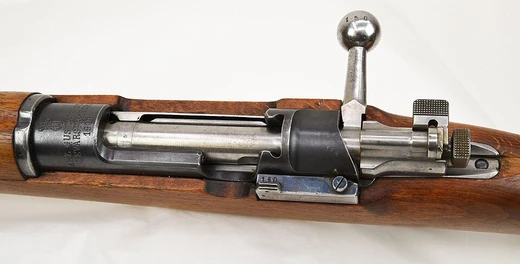
Mauser Model 1895
A modified Mauser 1893 exported widely and used in multiple wars.

Don-vip · CC BY-SA 4.0
The Mauser Model 1895 is a bolt-action, magazine-fed rifle that fires the 7×57mm Mauser cartridge. It represents the first significant update to the Mauser Model 1893 and was built by Deutsche Waffen und Munitionsfabriken (DWM) and its forerunner, the Ludwig Loewe Company, between 1895 and 1900. The rifle was sold to several foreign nations, most notably Chile, where it was adopted as the Fusil Mauser Chileno Modelo 1895.
The rifle first appeared during a small arms race between Argentina and Chile in 1896 and 1898. Ludwig Loewe & Co. supplied the first batches from 1895 to 1896, followed by DWM from 1897 to 1900. Over 80,000 rifles and 30,000 carbines were shipped to the Chilean army. The Model 1895 was also sent to the Orange Free State and the South African Republic (Transvaal) after the Jameson Raid in December 1895 to address a shortage of modern magazine-fed rifles. About 55,000 of the 70,000 ordered Mauser rifles were delivered; some undelivered rifles were diverted to Chile, leaving many Chilean rifles marked “O.V.S.” (Oranje Vrij Staat). Rifles delivered to the Transvaal, known as the "Boer Model" Mauser, bore no state markings but were stamped “Mod. Mauser” with the manufacture date. This led to confusion between the Model 1896 and Model 1897. An Afrikaans farmer could buy a Model 1895 for £3. A variant called the Plezier Mauser was sold slightly above cost by governments and private dealers for sport and private use, with variations in stock style, barrel, sight lines, and ornamentation. Some of the last DWM deliveries had turned-down bolt handles for use by mounted farmers. Production of the Model 1895 stopped in 1899 due to the Second Boer War.
The rifle also saw service in Mexico, Costa Rica, Paraguay, Iran, El Salvador, and Honduras. It was the standard weapon for various Mexican armies during the Mexican Revolution, and Paraguayan rifles were used in the Chaco War.
The Model 1895 is a modification of the Model 1893. It has a flush-mounted, staggered-column box magazine holding five 7×57mm Mauser cartridges. The magazine can be loaded singly through the receiver top or with five-round stripper clips inserted into clip guides on the rear receiver bridge; the empty clip is ejected when the bolt closes. The stock has a straight wrist and a handguard running from the receiver ring to the lower barrel band.
Quick Facts
- Origin
- German Empire
- Service
- 1895–1945
- Manufacturer
- Ludwig Loewe & Company 1895–1896 / Deutsche Waffen und Munitionsfabriken 1897–1909 / Zastava Arms 1899–1915
- Wars
- Spanish-American War / Second Boer War / World War I / Mexican Revolution / Cristero War / Chaco War / World War II
- Is Ranged
- yes
- Design Date
- 1895
- Production Date
- 1895–1915
- Number
- approx.1,800,000
- Variants
- Mauser Model 1895 Short Rifle / Mauser Model 1895 Carbine
- Weight
- 3.9 kg
- Length
- m/1895 Rifle: 1220 mm / m/1895 Short: 1046 mm / m/1895 Carbine: 947 mm
- Part Length
- m/1895 Rifle: 740 mm / m/1895 Short: 540 mm / m/1895 Carbine: 465 mm
Facts from the source article.
Lore & Background
The Mauser Model 1895 first appeared during a small arms race between Argentina and Chile in 1896 and 1898. Over 80,000 rifles and 30,000 carbines were shipped to the Chilean army. The rifle was also deployed to the Orange Free State and the South African Republic (Transvaal) shortly after the Jameson Raid in December 1895 to address a shortage of modern magazine-fed rifles. Roughly 70,000 Mauser rifles were ordered but only 55,000 were delivered; some undelivered rifles were diverted to Chile, resulting in many Chilean rifles bearing the inscription “O.V.S” (Oranje Vrij Staat). Rifles delivered to the Transvaal bore no state markings, while those for the Orange Free State were marked “O.V.S.” above the serial number. All were marked “Mod. Mauser” followed by the date of manufacture. An Afrikaans farmer could purchase a Model 1895 for £3. A variant known in Afrikaans as the Plezier Mauser was sold slightly above cost for sport and private use, with variations in stock style, barrel, sight lines, and ornamentation. Some of the last rifles delivered by DWM had turned-down bolt handles for use by South African farmers on horseback. Manufacturing halted in 1899 due to the Second Boer War.
The Model 1895 also saw service in Mexico, Costa Rica, Paraguay, Iran, El Salvador, and Honduras. It was the standard weapon of various Mexican armies during the Mexican Revolution, and Paraguayan rifles saw combat during the Chaco War.
Design-wise, the Model 1895 is a modification of the Mauser Model 1893. It features a flush-mounted staggered column box magazine with a capacity of 5 smokeless powder 7×57mm Mauser cartridges, loadable singly or via stripper clips. The bolt face was cylindrical, differing from the square bolt face of the Model 1893, though rifles supplied to the two Boer republics retained the square bolt face. The Model 1895 had an auxiliary shoulder behind the bolt handle for additional locking in case of bolt failure. The forward receiver ring diameter is 33 mm. The magazine follower tail was rounded so the bolt could be closed on an empty chamber. The iron sight line consists of an open post front sight and a tangent-type rear sight with a rear notch, graduated for 1893 pattern 7×57mm cartridges from 400 to 2000 m in 100 m increments.
Reader's Guide
The Mauser Model 1895 holds significance as a widely exported military rifle that saw action in multiple conflicts across different continents. Its adoption by Chile and the Boer republics, as well as its use in the Mexican Revolution and the Chaco War, demonstrates its global reach. The rifle's design modifications from the Model 1893, such as the cylindrical bolt face and the auxiliary shoulder behind the bolt handle, represent incremental improvements in reliability and safety. The production by both Ludwig Loewe and DWM, and the diversion of rifles originally intended for the Boer republics to Chile, illustrate the interconnected nature of arms procurement in the late 19th century. The Model 1895's legacy includes its variants, such as the short rifle and carbine, and the Serbian M1899 produced under license by Zastava Arms. The rifle's role in the Second Boer War and its use by various nations cement its place as a notable bolt-action design of its era.
Did You Know?
- The Mauser Model 1895 was the first major modification of the Mauser Model 1893.
- Some Chilean rifles bore the inscription “O.V.S” because undelivered Orange Free State rifles were diverted to Chile.
- The Model 1895 was also known as the 'Boer Model' Mauser in the Transvaal.
From Defeat to Breakthrough: The Design Journey
The road to the Mauser Model 1895 began in frustration. After Spanish forces suffered setbacks around their North African enclave at Melilla, the Army pushed to replace aging black-powder rifles. Trials of the Turkish Model 1887 in 1887 failed to impress, and even the smokeless-powder Model 1891 ordered in December 1891 exposed persistent flaws: a fickle extractor, a detachable magazine that dangled below the stock and was easily lost, unreliable stripper-clip guides, and a bolt prone to double-feeding. Paul Mauser took these field complaints as a design brief. His transitional Model 1892, built in runs of five to eight thousand, introduced a large non-rotating claw extractor, a magazine box machined as one piece with the trigger guard, and a sear that would not release the firing pin unless the bolt was fully closed. The Model 1893 then replaced the single-stack magazine with a staggered five-round box sitting flush in the stock—the first Mauser to achieve full magazine containment. The shortened carbine derived from this system, the M1895, carried the same 7×57mm cartridge and action into a more compact package. For a rifle that so thoroughly resolved earlier shortcomings, Spain awarded Mauser the Grand Cross of the Order of Military Merit.
A Decades-Long Combat Career
The M1893 family, including the M1895 carbine, proved remarkably durable in the hands of the Spanish Army. It first saw combat in the Spanish–American War of 1898, where its performance against American Krag–Jørgensen rifles was notably superior. Decades later, the same action family served through the Rif War of 1920–1927 in North Africa and the Spanish Civil War of 1936–1939. In Ottoman service, M1893-pattern rifles in 7.65×53mm saw limited action during the Greco-Turkish War of 1897, the Balkan Wars of 1912–1913, and World War I. The system's longevity in Spain was extraordinary: the M1916 short rifle, a descendant of the M1893/1895 line, remained in production until 1951. Many of those later rifles were subsequently converted to fire 7.92×57mm Mauser or 7.62×51mm NATO ammunition, with some receiving extensive modifications as the FR7. These converted weapons continued to serve in training roles and with the Guardia Civil well into the 1950s, giving the original 1893 design a practical service life spanning more than half a century.
Technical Architecture and Variant Lineup
The M1893 system was produced in two Spanish variants: a standard rifle with a 29.06-inch (738 mm) barrel and a shorter carbine with a 21.75-inch (552 mm) barrel, the latter being the M1895. Both were chambered in the 7×57mm Mauser cartridge, with four-groove right-hand rifling at a twist of one revolution per 8.68 inches (220 mm). Muzzle velocity from the full-length barrel reached 2,330 feet per second (710 m/s). The rifle weighed 8.8 pounds (4.0 kg); the carbine about 8.3 pounds (3.8 kg). An Ottoman variant shared the 29.06-inch barrel but was chambered in the slightly larger 7.65×53mm round, weighing roughly 9 pounds (4.1 kg). All versions featured a forged-steel receiver and one-piece bolt. Strripper-clip guides were milled into the receiver bridge for reliable loading, though individual round insertion was also possible. Standard rifles carried a straight bolt handle with a rounded knob, while short rifles used a turned-down handle. The three-position safety, a Mauser hallmark, could lock the action entirely or permit bolt movement with the firing pin disabled. The staggered five-round magazine, loaded via a stripper clip from the top of the open bolt, sat flush with the stock's underside.
Ripple Effects: Shaping the Future of the Bolt Action
The M1893's influence extended far beyond its own service life. It served as the direct foundation for the Models 1894 and 1896—widely known as Swedish Mausers—as well as the M1895 carbine and, ultimately, the Gewehr 98, which is widely regarded as one of the most successful bolt-action rifle designs ever produced. The rifle's marked superiority over the American Krag–Jørgensen during the Spanish–American War of 1898 sent a clear signal to the U.S. Army. That signal helped drive the development of the M1903 Springfield, a weapon that heavily borrowed Mauser's design principles. In other words, a rifle born from the need to fix Spanish field complaints at Melilla ended up shaping the infantry rifle of the United States and the iconic Gewehr 98. Paul Mauser himself was recognized for the achievement: the Spanish government conferred upon him the Grand Cross of the Order of Military Merit. The M1893/1895 family thus stands not merely as a successful contract rifle, but as a pivotal node in the evolution of modern bolt-action design, linking 19th-century field trials to the defining weapons of the 20th century.
Gallery
Frequently Asked Questions
What is the Mauser Model 1895?
It is a bolt-action, magazine-fed military rifle that served as the first major revision of the Mauser Model 1893 design. Produced between 1895 and 1900, it became one of the most widely exported small arms of its era.
What are the key specifications of the Mauser Model 1895?
The rifle chambers the 7×57mm Mauser cartridge and carries a five-round internal box magazine. Its controlled-feed bolt-action mechanism represented a clear step forward from earlier tubular-fed or single-shot designs.
Who manufactured the Mauser Model 1895?
Ludwig Loewe & Co. produced the earliest batches from 1895 to 1896, after which Deutsche Waffen und Munitionsfabriken (DWM) took over manufacturing through 1900.
Which countries adopted the Mauser Model 1895?
Chile is the most prominent foreign user, adopting it as the Fusil Mauser Chileno Modelo 1895 and receiving over 80,000 rifles plus 30,000 carbines. Several other nations also purchased the rifle during the late-1890s South American arms race.
Why is the Mauser Model 1895 historically significant?
It marked the evolutionary bridge from the 1893 design to the more refined platforms that would follow, and its broad export footprint meant it saw service in multiple conflicts across continents. Its role in the 1896–1898 Argentina–Chile arms race gave it a particularly visible part in military history.
More in Bolt-Action Rifles, Part 3 1-24
Spotted an error? Know more?
Reader corrections go straight into our review queue. Suggest an edit · How this site is sourced