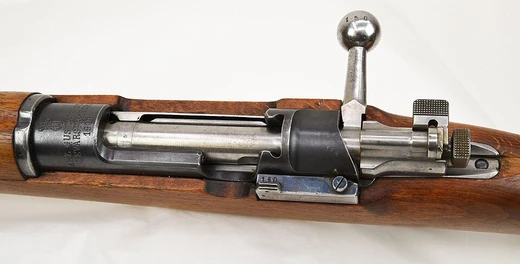
Mauser Model 1904
Export bolt-action rifle based on the Gewehr 98 pattern.

The Mauser Model 1904 is a bolt-action rifle produced by Mauser and Deutsche Waffen und Munitionsfabriken (DWM) for the export market. It follows the Gewehr 98 pattern and is notable for its use by several nations, including China, where it was later copied and produced in large numbers.
Quick Facts
- Origin
- Imperial Germany
- Service
- 1905–1960s
- Manufacturer
- Mauser / DWM / Various Chinese arsenals / Oviedo
- Wars
- World War I · Chaco War · Second Sino-Japanese War · Chinese Civil War
- Is Ranged
- yes
- Design Date
- 1904
- Production Date
- 1905–1935
- Weight
- 3.76 kg (Chinese Model 1907)
- Length
- 125 cm (Chinese Model 1907)
- Part Length
- 74.0 cm (Chinese Model 1907)
- Cartridge
- 6.8×57mm Mauser / 7×57mm Mauser / 7.65×53mm Mauser / 7.92×57mm Mauser
- Action
- Bolt-action
Facts from the source article.
Lore & Background
The Mauser Model 1904 and its close relative the Model 1907 were designed for foreign sales, sharing the Gewehr 98 action with a longer cocking piece. Most export rifles omitted the Lange Visier sight, except those made for Paraguay. Bayonet lugs varied: most had a short lug requiring a muzzle-ring bayonet, while Paraguayan and Ecuadorian orders included an additional lug for the Mauser Model 1895 bayonet. The Siamese model was heavier and slightly longer.
China tested the Model 1904 from 1907, adopting it as the Model 1904/1907 rifle and Model 1907 carbine. Early examples used a special 6.8×57mm cartridge. Production began at the Guangdong arsenal with DWM assistance. The 1911 revolution slowed purchases, and in 1914 thousands of stored 6.8mm rifles were re-chambered to 7.92×57mm and pressed into German service. The Republic of China designated it the Type 1 rifle, later renamed Type 4 after switching to 7.92mm. Over 200,000 were produced until 1935, with the Gongxian Arsenal's guns nicknamed 'Gong 98'. They remained in use during the Second Sino-Japanese War and even with Red Guards in the 1960s.
Spain's Fabrica Nacional de Armas in Oviedo produced a derivative for Paraguay, the Mauser/Oviedo Model 1927, in long rifle, short rifle, and carbine variants. These featured an extended bolt stop for different clips and a tangent leaf sight. Paraguayan troops reportedly called them 'Mata Paraguayo' due to poor performance and a tendency to fail during the Chaco War.
Reader's Guide
The Mauser Model 1904's significance lies in its role as a major export weapon that bridged German military design and foreign requirements. Its adoption by China led to extensive local production, making it a standard Chinese infantry rifle for decades. The Model 1904/1907 and its Type 1/Type 4 derivatives equipped Chinese forces through the Warlord Era, the Second Sino-Japanese War, and even into the 1960s with the Red Guards. The Paraguayan experience with the Model 1907 and the later Oviedo-built Model 1927 during the Chaco War highlighted the risks of low-cost production, as the rifles gained a notorious reputation for unreliability. The Model 1904's legacy is thus twofold: as a successful export design that saw widespread use in Asia, and as a cautionary example of quality issues in wartime procurement.
Did You Know?
- The Model 1904 and Model 1907 were produced by both Mauser and DWM.
- Chinese copies were produced at the Guangdong arsenal and later at Gongxian Arsenal, where they were nicknamed 'Gong 98'.
- Over 200,000 Chinese Type 1/Type 4 rifles were produced until 1935.
- Paraguayan troops called the Oviedo-built Model 1927 'Mata Paraguayo' (Paraguayan Killer) due to its tendency to fail.
Origins & the Mauser Family
The story of Mauser begins not with a single inventor but with a royal decree. On 31 July 1811, King Frederick I of Württemberg established the Königliche Waffen Schmieden, a royal weapons forge initially split between Ludwigsburg and Christophsthal. The enterprise later relocated to the former Augustine Cloister in Oberndorf am Neckar, where a master gunsmith named Andreas Mauser took up his trade. Andreas raised seven sons who all worked alongside him in the workshop. Among them, Peter Paul Mauser—born on 27 June 1838 in that same small kingdom of Württemberg—distinguished himself with a remarkable talent for devising faster, more efficient operating methods. His older brother Wilhelm, four years his senior, gradually absorbed many of their father's responsibilities as Andreas's health declined. The family's reach extended even to the American continent: another brother, Franz, emigrated in 1853 with his sister and found employment at E. Remington and Sons, a connection that would later echo in the company's own international dealings.
Paul's Engineering Vision & the Turning-Bolt
Paul Mauser possessed a rare and defining trait: throughout his entire career he consistently designed both the firearm and its corresponding ammunition as a unified system. His very first invention was a cannon together with its own projectile. After the Dreyse needle gun proved successful on the battlefield, Paul redirected his creative energy toward surpassing that design. The Dreyse relied on a firing pin that pierced the base of a paper cartridge to strike a primer located in the center. Paul's breakthrough was a needle that ignited the powder charge at the base of the cartridge—a fundamentally superior arrangement. He also introduced a turning-bolt mechanism that cocked the weapon as the user cycled it. Paul and his brother Wilhelm maintained a clear division of labor: Paul served as the engineer and designer, while Wilhelm handled management and business affairs with the Oberndorf factory. Their partnership was not without strain; the brothers separated over disagreements, but Paul's new turning-bolt concept impressed Wilhelm enough to reunite the team. Wilhelm then secured the financing needed to purchase machinery and push development forward.
The Norris Episode & Prussian Acceptance
The Mauser brothers' path to Prussian adoption was anything but straightforward. Because the Dreyse needle gun had just been adopted locally, the brothers sought an alternative market and approached the Austrian ambassador, who forwarded their rifle to Vienna for evaluation. There, Samuel Norris of E. Remington & Sons spotted the design and, in 1867, hired the Mausers to travel to Liège to refine a new version. Norris insisted that patents be filed under his name, with a royalty paid to the brothers. He envisioned selling the design to France for converting their Chassepot rifles to fire metallic cartridges. A Norris-Mauser patent was registered in the United States, though Remington itself was furious at Norris's independent move and never attempted to market the rifle. When the French government expressed no interest, the partnership collapsed. Paul returned to Oberndorf in December 1869; Wilhelm followed in April 1870. Before departing Liège, however, the Mausers had the rifle tested at the Royal Prussian School of Riflemanship. The results were so impressive that Wilhelm was summoned to the Spandau arsenal, setting the stage for Prussian acceptance on 2 December 1871.
Legacy: The Gewehr 98 and a Global Footprint
The most enduring testament to the Mauser engineering tradition is the Gewehr 98, a bolt-action rifle that became one of the most replicated firearm designs in history. Approximately ten million Gewehr 98-style rifles were manufactured over the years, a staggering figure that speaks to the design's reliability and adaptability. In the late nineteenth and early twentieth centuries, Mauser designs were exported and licensed to a wide array of nations, which adopted them for both military service and civilian sporting use. The influence of the Gewehr 98 extends well beyond the battlefield: it serves as the structural and mechanical foundation for a large portion of today's sporting bolt-action rifles. The company behind these achievements evolved from a royal Württemberg forge into the stock company Waffenfabrik Mauser on 1 April 1884, and its ownership later passed to Ludwig Löwe & Company, which held a fifty-per-cent stake in Fabrique Nationale d'Armes de Guerre. Paul Mauser remained the technical leader even after the ownership change, ensuring that the engineering philosophy he had pioneered continued to shape the product line.
Frequently Asked Questions
What is the Mauser Model 1904?
It is a bolt-action rifle built by Mauser and DWM specifically for foreign military buyers, rather than for the German army itself. The design draws directly on the proven Gewehr 98 action while being packaged as a commercial export product.
What cartridge does the Mauser Model 1904 chamber?
The original Chinese contract version was loaded with 6.8×57mm, but later production runs switched to the more common 7.92×57mm Mauser round.
Which countries adopted the Mauser Model 1904?
A wide range of nations fielded it, including China, Paraguay, Ecuador, Siam, Turkey, Uruguay, Mexico, and Spain. China went on to copy the design and manufacture it domestically in very large quantities.
How does the Mauser Model 1904 differ from the standard Gewehr 98?
Mechanically it follows the same G98 bolt-action pattern, but it was engineered and contracted as an export rifle rather than as a domestic German service weapon. This gave Mauser and DWM the flexibility to offer different calibers and carbine lengths tailored to each buyer's needs.
What notable variants of the Mauser Model 1904 exist?
Recognized derivatives include a Brazilian carbine, separate Paraguayan and Chinese carbine versions, the Chinese Type 1 and Type 4 long guns, and the Mauser/Oviedo Model 1927. Together these show how a single export platform was adapted across multiple countries and decades.
More in Bolt-Action Rifles, Part 3 1-24
Spotted an error? Know more?
Reader corrections go straight into our review queue. Suggest an edit · How this site is sourced