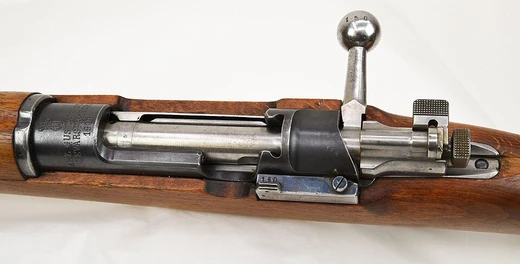
Mauser M1996
A straight-pull rifle introduced by Mauser in 1996.

The Mauser M1996, also called the Mauser M96 or Mauser M96 S, is a straight-pull bolt-action rifle that Mauser, a German firearms maker, launched in 1996. It uses a blind magazine that loads from the top, and the bolt is worked by pulling the handle roughly 30 degrees along the rifle’s length. The factory trigger pull weight is just over 2 kg and cannot be adjusted; the trigger’s design makes it hard to reduce the pull weight without causing light primer strikes. The locking lugs are slightly angled to help with primary extraction. The rifle came with a traditional slim wooden stock, with the comb height set for iron sights. The receiver is drilled and tapped for scope mount attachment.
The M1996 did not become an immediate commercial success, especially against competitors like the Blaser R93, which came out three years earlier. Roessler later bought the patent and rights, selling it as the Rößler Titan 16, which was still produced as of 2020 but has since been discontinued. The name “Titan 16” comes from the bolt having two rows of eight locking lugs, totaling 16 lugs. The Titan 16 is a modular firearm whose barrel can be swapped with a hex key. Unlike the M1996, the Titan 16 has an adjustable direct trigger.
Quick Facts
- Is Ranged
- yes
- Origin
- Germany
- Designer
- Mauser
- Manufacturer
- Mauser (1996-1997), / Roessler (2013-current)
- Cartridge
- Standard: .243 Win, .308 Win, .25-06 Rem, .270 Win, 7x64 mm, .30-06, 9.3x62 mm. / Magnum: 7 mm Rem Mag, .300 Win Mag
- Action
- Straight-pull bolt-action
- Weight
- 2.8 kg / [https: · www.jaktjournalen.se/mauser-m-96-100-ar-senare/ Mauser M 96 100 år senare
- Part Length
- 560 mm (standard), 610 mm (magnum)
- Sights
- Drilled and tapped for a scope mount
Facts from the source article.
Lore & Background
The Mauser M1996 was introduced in 1996 as a straight-pull bolt-action rifle. Its bolt is operated by pulling the bolt handle about 30 degrees along the longitudinal axis. The rifle has a blind magazine loaded from the top, and the factory trigger pull weight is a little over 2 kg, with no adjustment possible. Due to the trigger geometry, lightening the pull has proven difficult without causing light primer strikes. The locking lugs are angled slightly to aid primary extraction. The rifle was delivered with a traditional slim wooden stock, with the comb height adapted for shooting with iron sights, and the receiver came drilled and tapped for scope mount attachment.
The Mauser M1996 was not immediately a commercial success compared to competitors such as the Blaser R93, which had been launched three years earlier. The patent and rights to the M1996 were later acquired by Roessler and sold under the model name Rößler Titan 16. The Titan 16, produced as of 2020 but since discontinued, is a modular firearm where the barrel can be changed using a hex key. Its name comes from the bolt having two rows of 8 locking lugs, giving 16 total. Unlike the M1996, the Titan 16 has an adjustable direct trigger.
Reader's Guide
The Mauser M1996 represents an attempt by Mauser to enter the straight-pull rifle market in 1996, three years after the Blaser R93 had already established itself. Its design includes a blind magazine, a 30-degree bolt rotation, and a non-adjustable trigger with a pull weight just over 2 kg. The trigger geometry made lightening the pull problematic, often leading to light primer strikes. The rifle's locking lugs are angled to aid extraction, and it came with a traditional wooden stock suited for iron sights, with the receiver pre-drilled for scope mounting.
Despite these features, the M1996 did not achieve immediate commercial success. Its intellectual property was later acquired by Roessler, who produced it as the Rößler Titan 16, a modular rifle with a user-changeable barrel and an adjustable direct trigger. The Titan 16 was still in production as of 2020 but has since been discontinued. The M1996's legacy is thus tied to its role as a precursor to the Titan 16, which addressed some of its limitations while retaining the distinctive 16-lug bolt system.
Did You Know?
- The Mauser M1996 is also known as the Mauser M96 or Mauser M96 S.
- The bolt is operated by pulling the handle about 30 degrees along the longitudinal axis.
- The patent and rights were later acquired by Roessler and sold as the Rößler Titan 16.
Modular Architecture and Caliber Flexibility
The Blaser R8 was conceived as a highly adaptable hunting platform centered on a single aluminium alloy receiver frame. This core component accepts a wide range of stock configurations and barrels of differing lengths and thicknesses, while an optional steel receiver adds roughly 550 grams for shooters who prefer extra mass. The rifle spans an extraordinary caliber spectrum, from the lightweight .204 Ruger all the way up to the massive .500 Jeffery, with user-swappable bolt heads grouped by caliber family. Barrel changes require only two screws and a hex key, making the quick-change system genuinely practical in the field. For budget-conscious training, a .22 Long Rifle conversion kit swaps in a new barrel, bolt head, and magazine insert. Optics mount directly to the barrel through a proprietary Blaser mechanism rather than the receiver, meaning the entire sight-and-barrel assembly can be lifted off and reinstalled without disturbing zero. Aftermarket picatinny adapters extend compatibility further. In 2019, Blaser partnered with Carl Zeiss to introduce the iC illumination control, which activates a red dot sight the moment the action is cocked.
Radial Collet Locking and Pressure Tolerance
At the heart of the R8's straight-pull action sits a 14-lug radial collet that engages a full 360-degree groove machined into the barrel. This geometry yields a locking surface of 96 square millimeters, substantially larger than the 66 square millimeters found on the earlier R93 and the 56 square millimeters of the classic Mauser M98 system. The bolt is symmetric and self-centering, a design choice Blaser credits for improved shot-to-shot accuracy. All stressed components are hammer-forged steel, then plasma nitrided for corrosion resistance and mechanical durability. Beyond the primary collet lockup, the R8 incorporates two secondary lockup points, one more than its R93 predecessor. To achieve higher pressure tolerance, the barrel was thickened at the critical groove area, the groove itself was enlarged, and the collet locking angle was steepened from roughly 50 degrees to nearly 90 degrees. The DEVA institute laboratory validated the lockup at 1,450.0 MPa piezo pressure. The trade-off is a slightly less smooth bolt stroke compared to the R93 and a modest weight increase. Notably, the bolt head travels in purely linear motion, and no primary extraction problems have been reported.
Detachable Magazine-Trigger Unit and Safety Philosophy
One of the R8's most distinctive features is its detachable box magazine integrated with the trigger mechanism into a single unit. Removing this assembly renders the rifle completely inoperable and safe, a built-in safeguard that goes beyond conventional bolt-action design. To eliminate the risk of accidents associated with set triggers, Blaser offers the R8 exclusively with a direct trigger mechanism. The compact magazine-trigger unit also plays a role in overall balance, which is particularly important because the straight-pull action is approximately 50 to 60 millimeters shorter than a conventional bolt-action layout. The lower-priced R8 Professional S variant originally omitted this detachable unit, and following that model's introduction, most subsequent R8 variants became available without it as well. This design decision reflects a practical balance between the premium safety and convenience features of the full system and the cost expectations of a broader market segment. The detachable unit concept remains a hallmark of the more expensive R8 configurations, distinguishing them clearly from the simplified Professional S line.
Production Scale, Predecessor, and Ecosystem
By 2015, Blaser had produced more than 100,000 complete R8 rifles, a figure that underscores the platform's commercial success in the German and international hunting markets. The R8 evolved directly from the Blaser R93 series, which was discontinued in 2016, marking a clear generational transition within the company's straight-pull lineup. Despite this lineage, parts from the R93 generally do not interchange with the R8, with the notable exception of scope mounts. This limited compatibility means owners upgrading from an R93 must purchase new components for most subsystems. The R8 retains the manual cocking system and direct trigger that characterize the Blaser straight-pull family, while adding the enhanced radial locking architecture described above. The 2019 collaboration with Carl Zeiss AG on the iC illumination control system further extended the rifle's ecosystem, tying the action's cocking cycle to an electronic sight feature. Together, these elements position the R8 as a mature, high-volume platform that carries forward the R93's heritage while introducing meaningful engineering refinements in locking strength, modularity, and electronic integration.
Frequently Asked Questions
What is the Mauser M1996?
It is a straight-pull bolt-action rifle that the German manufacturer Mauser released in 1996. The design features a top-loading blind magazine and a bolt handle that travels along the body of the rifle rather than rotating in the traditional way.
How does the straight-pull mechanism on the Mauser M1996 work?
Instead of lifting and rotating a bolt handle, the shooter pulls the handle back roughly 30 degrees along the length of the rifle to cycle the action. The locking lugs are cut at a slight angle to assist with primary extraction during the forward stroke.
Can the trigger pull weight on the Mauser M1996 be adjusted?
No, the factory-set trigger breaks at just over 2 kilograms and offers no user-adjustable setting. Attempting to lighten the pull is discouraged because the internal design can result in light primer strikes if modified improperly.
What type of stock does the Mauser M1996 ship with?
Mauser pairs the rifle with a slim, traditional wooden stock. The comb height is specifically shaped to align the shooter's eye with the iron sights.
What is the magazine configuration of the Mauser M1996?
It uses a blind magazine that is loaded from the top, meaning cartridges are inserted one at a time through the ejection port. This keeps the action compact while maintaining a straightforward loading process.
More in Bolt-Action Rifles, Part 3 1-24
Spotted an error? Know more?
Reader corrections go straight into our review queue. Suggest an edit · How this site is sourced