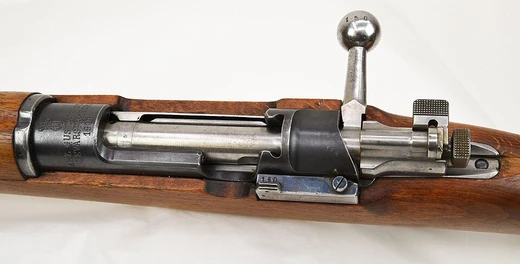
Type 99 rifle
A 7.7mm Arisaka bolt-action rifle of Imperial Japanese Army service.

The Type 99 rifle was a bolt-action rifle of the Arisaka design used by the Imperial Japanese Army during World War II. It was developed to replace the Type 38 rifle, which fired a 6.5×50mm cartridge, after the Japanese Army found the 7.7mm cartridge of the Type 92 heavy machine gun superior during the Second Sino-Japanese War. The Type 99 was based on the Type 38 but chambered in 7.7mm, and it was the first mass-produced infantry rifle to feature a chrome-lined bore.
Quick Facts
- Origin
- Empire of Japan
- Is Ranged
- yes
- Service
- 1939–1945 (Japan)
- Designer
- Arisaka Nariakira / Kijirō Nambu / Dōgane Giichi / Iwashita Kenzō
- Design Date
- 1939
- Production Date
- 1939–1945
- Number
- ~3,500,000
- Weight
- 3.79 kg
- Length
- 1118 mm or 1258 mm
- Part Length
- 657 mm
- Cartridge
- 7.7×58mm Arisaka / 7.92×57mm Mauser (KMT conversion) / .30-06 Springfield (South Korean/Thai conversion) / 7.62×39mm (Post-WW2 PRC conversion)
- Action
- Bolt action
Facts from the source article.
Lore & Background
The Type 99 was developed during the Second Sino-Japanese War in the 1930s, when the Japanese Army determined that the 7.7mm cartridge used by the Type 92 heavy machine gun outperformed the 6.5×50mm round of the Type 38 rifle. This led to the creation of a new rifle to standardize on a single cartridge. The Type 99 utilized a cock-on-closing action and an unusual safety mechanism operated by pressing a knurled disk at the rear of the bolt and rotating it clockwise. It featured a quick-release bolt, anti-aircraft sights, a dust cover, and a wire monopod, though these features were abandoned by mid-war. The rifle had one of the strongest bolt actions ever made, but late-war "last ditch" rifles were crudely finished with simplifications such as wooden buttplates held by nails, lack of an upper handguard, and fixed sights, though the bolt mechanism remained safe.
The Type 99 was produced in four versions: the regular short rifle, a limited-production long rifle, the take-down Type 2 paratroop rifle, and a sniper variant. The long rifle was made only by Nagoya Arsenal and Toyo Kogyo, with about 38,000 produced between summer 1940 and spring 1941 before production shifted to the short rifle. The Imperial Japanese Army intended to fully replace the Type 38, but the outbreak of the Pacific War prevented this, and both rifles were used extensively. After the war, many Type 99 rifles were converted by other nations: South Korea re-chambered approximately 133,300 to .30-06 Springfield, the Republic of China converted some to 8×57mm IS and 7.62×39mm, and Thailand converted some to .30-06. Indonesian forces used large numbers during the Indonesian National Revolution.
Reader's Guide
The Type 99 rifle holds significance as the standard infantry arm of the Imperial Japanese Army during World War II, though it never fully replaced the earlier Type 38. Its development marked Japan's shift to a larger 7.7mm cartridge for improved hitting power. The rifle's legacy is shaped by its wartime production: early examples were well-finished with features like a chrome-lined bore, monopod, and anti-aircraft sights, while late-war "last ditch" rifles reflect Japan's industrial struggles with crude finishes and omitted parts. Despite these simplifications, the bolt action remained strong and safe. Post-war, the Type 99 saw extensive use by other nations, notably South Korea, which converted over 133,000 rifles to .30-06 Springfield for the Korean War, though accuracy suffered due to cartridge differences. The Republic of China and Thailand also performed conversions. In the collector market, rifles with an intact imperial chrysanthemum, original dust cover, anti-aircraft sights, and monopod command higher prices, while "last ditch" rifles are valued lower. The Type 99's reputation was sometimes unfairly tarnished by incidents involving training rifles made of mild steel, which were never intended for ball ammunition and could explode if fired with live rounds.
Did You Know?
- The Type 99 was the first mass-produced infantry rifle to have a chrome-lined bore to ease cleaning.
- Late-war 'last ditch' rifles often had wooden buttplates held in with nails and lacked an upper forward handguard.
- Approximately 126,500 short and 6,650 long Type 99 rifles were re-chambered to .30-06 Springfield for South Korea.
- The imperial chrysanthemum on the receiver indicated the rifle was the Emperor's personal property; defaced rifles are less valuable to collectors.
More in Bolt-Action Rifles, Part 3 1-24
Spotted an error? Know more?
Reader corrections go straight into our review queue. Suggest an edit · How this site is sourced