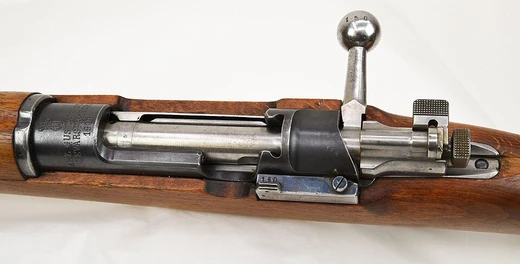
Type 97 sniper rifle
Japanese sniper rifle adopted in 1937, based on the Type 38.

The Type 97 sniper rifle was a Japanese bolt-action design, adapted from the Type 38 infantry rifle and officially adopted in 1937. Its development was spurred by Japanese combat experiences in Manchuria. Although the military intended to phase it out in favor of the Type 99 sniper rifle—which boasted better range and penetration—the Type 97 saw service throughout World War II.
Japan was slow to develop dedicated sniper rifles. Trials in the 1920s with scoped Type 38 rifles generated little interest. However, after fighting in Manchuria, the Imperial Japanese Army, led by Colonel Tatsumi Namio, began new trials in 1935. Around 700 modified Type 38 rifles were produced at Kokura Arsenal for testing. At the Futsu Proving Ground, these rifles showed a 10% accuracy improvement at 300 meters and a 30% improvement at 600 meters over the standard Type 38. The design was formally adopted as the Type 97 in 1937.
The Type 97 was essentially a Type 38 with a longer, bent-down bolt handle to clear the scope, plus mounts for a telescopic sight. The scopes had fixed focus, 2.5x magnification, and a 10-degree field of view. They were factory-zeroed and non-adjustable, each matched to a specific rifle and marked with its serial number. Snipers used reticle marks to compensate for range and drift. The scope was offset to the left, allowing loading with single rounds or five-round stripper clips, though this made aiming somewhat awkward. According to U.S. Army manuals, the scope weighed 1.1 pounds.
Most Type 97s included a folding monopod, but as Japanese manufacturing declined late in the war, later production rifles often lacked it. The rifle retained the Type 38’s internal five-round box magazine, chambered for the semi-rimmed 6.5×50mm Arisaka round, and a leaf-type rear sight graduated from 500 to 2,600 meters. The 6.5mm round produced light recoil, and the unusually long barrel burned most propellant before the bullet left, resulting in little muzzle flash—making counter-sniping difficult.
Production occurred at Nagoya and Kokura Arsenals. Nagoya produced about 14,500 rifles, while Kokura made around 8,000. Kokura-made rifles were generally well-finished, with flat buttplates, spring-retained barrel bands, and polished bolt faces.
Quick Facts
- Origin
- Empire of Japan
- Is Ranged
- yes
- Service
- 1937–1945
- Wars
- Second Sino-Japanese War / World War II / Chinese Civil War
- Design Date
- 1937
- Cartridge
- 6.5x50mm Arisaka
- Action
- Bolt-action
Facts from the source article.
Lore & Background
The Type 97 was developed after Japanese combat experience in Manchuria, where they faced German-trained Chinese snipers. Trials under Colonel Tatsumi Namio in 1935 led to about 700 modified Type 38 rifles being produced at Kokura Arsenal for testing. Testing at the Futsu Proving Ground showed a 10% increase in accuracy at 300 m and 30% at 600 m compared to the standard Type 38. The rifle was adopted in 1937 as the Type 97 sniper rifle.
Design-wise, the Type 97 is a slightly modified Type 38 with a bent-down bolt handle to clear the scope and mountings for a telescopic sight. The scopes have fixed focus, 2.5x magnification, and a 10° field of view. They were factory-zeroed for each specific rifle and marked with the rifle's serial number, requiring the sniper to use reticule marks for range and drift compensation. The scope was offset to the left, allowing loading with single rounds or 5-round stripper clips, though this made aiming somewhat awkward. Most rifles featured a folding monopod, though late production rifles discarded it as Japanese manufacturing capabilities deteriorated.
Manufacturing occurred at Nagoya Arsenal and Kokura Arsenal. Kokura-made rifles were generally well-made with flat buttplates, spring-retained barrel bands, and polished bolt faces. Nagoya-made rifles usually had rounded buttplates, an adjustable 2200 m leaf sight, screw-retained barrel bands, chromed bolts, and a hollowed-out forend to minimize wood-metal contact. Late production rifles showed noticeably lower quality, with blued bolts instead of chrome-lined and no monopod.
Reader's Guide
The Type 97's significance lies in its role as Japan's first purpose-built sniper rifle, developed relatively late compared to other nations. Its 6.5×50mm Arisaka round produced light recoil and, due to the unusually long barrel, little muzzle flash, making counter-sniping difficult. This characteristic allowed Japanese snipers to fire from treetops without easy detection, though Allied forces countered by raking treetops with machine gun fire. The rifle's flat trajectory at short range and soft recoil led many IJA snipers to prefer it over the later Type 99, especially in the close-quarters jungles of Southeast Asia. Despite being less capable of penetrating thick foliage than the M1903 Springfield or M1 Garand, it could penetrate an M1 helmet at 150 yards or more. American soldiers sometimes used captured Type 97 rifles to take advantage of the reduced muzzle flash, preventing their positions from being interdicted by Japanese forces. The Type 97 remained in service throughout the war, even after the introduction of the Type 99, and was used by the Imperial Japanese Army as well as in limited numbers by captured rifle users.
Did You Know?
- The Type 97's scope was factory-zeroed for each specific rifle and marked with the rifle's serial number, with no user adjustments possible.
- The 6.5×50mm Arisaka round's light recoil and minimal muzzle flash made counter-sniping difficult for Allied forces.
- Late production Type 97 rifles discarded the folding monopod and had blued bolts instead of chrome-lined ones due to deteriorating Japanese manufacturing.
- American soldiers sometimes used captured Type 97 rifles to exploit the reduced muzzle flash and avoid detection.
More in Bolt-Action Rifles, Part 3 1-24
Spotted an error? Know more?
Reader corrections go straight into our review queue. Suggest an edit · How this site is sourced