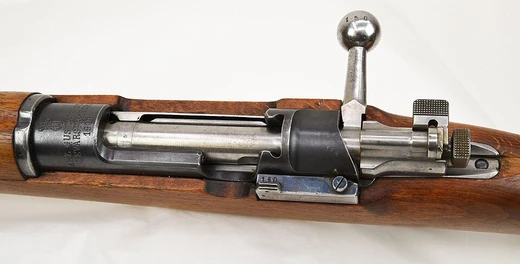
Type 44 carbine
Japanese cavalry carbine with a folding needle bayonet.

The Type 44 carbine is a Japanese bolt-action weapon, designed in 1911 by Arisaka Nariakira for cavalry use. It is often confused with the Type 38 carbine because both are based on the Type 38 service rifle. The Type 44 entered production in 1911 and service in 1912, taking its name from the 44th year of the Meiji period. It was first issued before World War I, produced in large numbers, and remained in production until 1942, three years before the end of World War II. Approximately 91,900 were made by Japanese arsenals.
The carbine featured a fixed, folding needle-type bayonet that locked under the barrel, eliminating the need for a separate saber and bayonet. A hook below the front sight replicated the quillon of the Type 30 bayonet for fencing drills. It fired the 6.5×50mm Arisaka round from a five-round internal box magazine fed by chargers. The buttstock contained a compartment for a two-piece cleaning rod, accessed by a rotating door. A brief experiment with the 7.7×58mm Arisaka round was dropped due to recoil issues.
Three variations were produced, differing mainly in the bayonet housing, which grew longer and more durable with each version to improve accuracy and strengthen the stock. The cleaning rod compartment also changed: first variation stocks had two separate holes for each rod half, while later variations used a single larger hole for both halves.
Though intended for cavalry, the Type 44 was also issued to transportation and other units; some cavalry troops continued using the Type 38 carbine. After World War I, one Type 44 was donated to the Australian War Memorial to display standard Japanese equipment. Following World War II, the carbine saw continued use by the Chinese People's Liberation Army and Navy during the Chinese Civil War and the Korean War. Captured Type 44s were converted by the PLA to fire the 7.62×39mm cartridge, with some receiving SKS barrels and front stock caps with folding bayonets. Modern air-gun clones are produced in Japan by Tanaka Works.
Quick Facts
- Origin
- Empire of Japan
- Is Ranged
- yes
- Service
- 1912–1960s
- Wars
- World War I / Second Sino-Japanese War / World War II / Chinese Civil War / Indonesian National Revolution / Korean War / First Indochina War / Malayan Emergency
- Designer
- Nariakira Arisaka
- Design Date
- 1911
- Production Date
- 1911–1942
- Number
- 91,900
- Weight
- 3.3 kg
- Length
- 966 mm
- Part Length
- 487 mm
- Cartridge
- 6.5×50mm Arisaka / 7.62×39mm (post-war Chinese modified)
Facts from the source article.
Lore & Background
The Type 44 entered production in 1911 and entered service in 1912, the 44th year of the Meiji period, hence 'Type 44'. It served until the end of the Second World War in 1945, with production running until 1942. Approximately 91,900 Type 44 rifles were produced by Japanese arsenals. Although intended for cavalry troops, many other units such as transportation units were issued these carbines, and some cavalry troops continued to use the Type 38 carbine.
Developed from the Type 38 carbine, the Type 44 provided a cavalryman a carbine with a bayonet, eliminating the need for a separate Type 32 cavalry saber, Type 38 carbine, and bayonet. The main difference is the needle-type bayonet that folds backward and locks underneath the barrel. A hook located below the front sight on the right side replicated the hooked quillon of the Type 30 bayonet for bayonet fencing techniques. The rifle also included a compartment in the buttstock for a unique two-piece cleaning rod, accessed via a rotating door.
The Type 44 was produced in three variations, differing mainly in the folding bayonet housing, which increased length and durability with each variation due to accuracy issues and to strengthen the stock. First variation stocks had two holes for each half of the cleaning rod, while second and third variations had single larger holes for both halves. The Type 44 was briefly used to experiment with the 7.7×58mm Arisaka round before being dropped due to recoil problems.
Reader's Guide
The Type 44 carbine holds significance as a specialized cavalry weapon that integrated a folding bayonet directly into the rifle, addressing the practical need for a compact arm that did not require a separate saber or bayonet. Its production of approximately 91,900 units indicates substantial use by the Imperial Japanese Army, particularly among cavalry and transportation units. The rifle's legacy extended beyond World War II, as it continued to be used by the Chinese People's Liberation Army and Navy, seeing action in the Chinese Civil War and the Korean War. After the war, captured Type 44s were converted by the PLA to fire the 7.62×39mm cartridge, reflecting adaptation to new standard calibers. Modern clones made as air guns are currently produced in Japan by Tanaka Works, demonstrating enduring interest in the design. The Type 44 is sometimes confused with the Type 38 carbine, as both were based on the Type 38 service rifle, but its distinctive folding bayonet and cleaning rod compartment set it apart.
Did You Know?
- The Type 44 was designed in 1911 by Arisaka Nariakira for cavalry troops.
- It featured a folding needle-type bayonet that locked underneath the barrel.
- Approximately 91,900 Type 44 rifles were produced between 1911 and 1942.
- After World War II, captured Type 44s were converted by the PLA to use the 7.62×39mm cartridge.
More in Bolt-Action Rifles, Part 3 1-24
Spotted an error? Know more?
Reader corrections go straight into our review queue. Suggest an edit · How this site is sourced