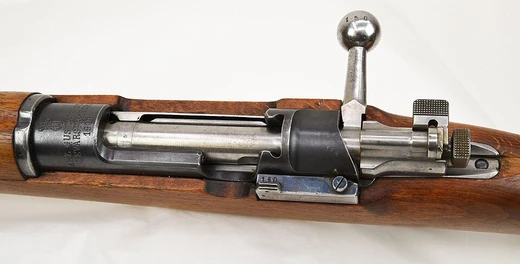
Type 38 rifle
The longest bolt-action rifle of World War II, used by Imperial Japan.

The Type 38 rifle is a bolt-action service rifle fielded by the Empire of Japan, most heavily used during the Second Sino-Japanese War and World War II. It was adopted by the Imperial Japanese Army in 1905, the 38th year of the Meiji period, which gave the rifle its designation. Concerns that its 6.5×50mmSR Arisaka cartridge lacked sufficient power led to the partial introduction of the Type 99 rifle, chambered in 7.7×58mm Arisaka, during World War II. However, both rifles remained in service until the war ended.
The Type 38 was developed from the earlier Type 30 rifle, which had shown serious flaws during the early Russo-Japanese War, including bursting cartridges, a poorly designed lock that collected gunpowder and burned the shooter, frequent misfires, jamming, difficult cleaning, and extraction problems. Major Kijiro Nambu redesigned the Type 30, reducing its bolt from nine parts to six, simplifying manufacture and allowing tool-free disassembly. A dust cover was added after dust rendered rifles inoperable in the Russo-Japanese War. Production occurred at several arsenals: Tokyo Arsenal (1906–1932, about 2,029,000 units), Kokura Arsenal (1937–1941, about 495,500), Nagoya Arsenal (1932–1942, about 312,500), Jinsen Arsenal in modern Incheon (1942, about 13,400), and Hoten Arsenal, formerly Mukden, in modern Shenyang (1937–1944, about 148,800). In 1939, a Type 38 cost 75.9 yen. By 1940, over three million had been issued. The 6.5×50mm cartridge produced little recoil and was comparable to Norwegian and Italian 6.5mm rounds, but was weaker than many other nations' ammunition. This led to the Type 99 rifle in 1939, using the 7.7×58mm cartridge already employed in the Type 92 heavy machine gun and Type 97 light machine gun. The mix of rifles using incompatible cartridges created significant logistics problems during the war.
At 128 cm, the Type 38 was the longest rifle of the war, a design choice reflecting the emphasis on bayonet training for Japanese soldiers, whose average height was 160 cm. With the 40 cm Type 30 bayonet attached, it was even longer. It weighed about 4.25 kg. Post-war inspections by the U.S. military and the National Rifle Association found the Type 38's receiver to be the strongest of any nation's bolt-action rifle, capable of handling more powerful cartridges. In the West, Japanese equipment is commonly called "Type XX," though "Model"
Quick Facts
- Is Ranged
- yes
- Service
- 1906–1945 (Japan)
- Origin
- Empire of Japan
- Design Date
- 1905
- Part Length
- Rifle: 797 mm / Carbine: 487 mm
- Cartridge
- 6.5×50mm Arisaka / 7.62×39mm (post-war Chinese modified) / 7.92×57mm Mauser (Chinese modified) / .303 British / (Estonian modified)
- Feed
- 5-round stripper clip
- Action
- Bolt action
- Rate
- 10–15 rounds per minute
- Velocity
- 762 m/s
- Weight
- Rifle: 4.19 kg / Carbine: 3.3 kg
- Length
- Rifle: 1275 mm / Carbine: 966 mm
Facts from the source article.
Lore & Background
The Imperial Japanese Army introduced the Type 30 rifle in 1897, but combat experience in the early stages of the Russo-Japanese War highlighted numerous shortcomings, including bursting cartridges, a poorly designed lock that accumulated gunpowder and burned the shooter's face, frequent misfires, jamming, difficulty in cleaning, and cartridge extraction. Major Kijiro Nambu undertook a redesign of the Type 30, introduced in 1906. Nambu reduced the number of parts in the bolt from nine to six, simplifying manufacture and disassembly without tools. A dust cover was added due to experiences in the Russo-Japanese War that left rifles inoperable from dust.
The Type 38 was produced at several arsenals: Tokyo Arsenal (1906–1932, estimated 2,029,000 units), Kokura Arsenal (1937–1941, estimated 495,500 units), Nagoya Arsenal (1932–1942, estimated 312,500 units), Jinsen arsenal (1942, estimated 13,400 units), and Hoten/Mukden Arsenal (1937–1944, estimated 148,800 units). At 128 cm, it was the longest rifle of the war, due to the emphasis on bayonet training for the Japanese soldier, whose average height was 160 cm. The rifle was even longer when the 40 cm Type 30 bayonet was fixed. The 6.5×50mm cartridge produces little recoil but was not as powerful as several others in use by other nations.
Reader's Guide
The Type 38 rifle's significance lies in its widespread use by the Empire of Japan during the Second Sino-Japanese War and World War II, and in its role as the primary service rifle before and alongside the Type 99. Its design, by Major Kijiro Nambu, addressed the failures of the earlier Type 30, simplifying the bolt and adding a dust cover. The rifle's length—the longest of any nation's bolt-action in the war—reflected the Japanese military's emphasis on bayonet training. Post-war inspection by the U.S. military and the National Rifle Association of America found that the Type 38's receiver was the strongest bolt action of any nation's and capable of handling more powerful cartridges. The rifle's legacy includes numerous variants and copies, such as the Type 38 short rifle, Type 38 carbine, Type 44 carbine, Type 97 sniper rifle, Chinese copies, and exports to Siam and Thailand. The mixture of Type 38 and Type 99 rifles with incompatible cartridges led to considerable logistics issues during World War II.
Did You Know?
- The Type 38 was the longest bolt-action rifle of World War II, at 128 cm.
- The Type 38's dust cover was added due to dust-related failures in the Russo-Japanese War.
- Over three million Type 38s had been issued to the Imperial Japanese Army by 1940.
More in Bolt-Action Rifles, Part 3 1-24
Spotted an error? Know more?
Reader corrections go straight into our review queue. Suggest an edit · How this site is sourced