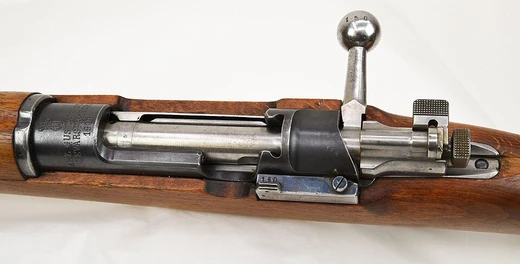
Type 35 rifle
A Japanese Navy rifle derived from the Type 30 to correct its flaws.

The Type 35 rifle was a bolt-action rifle developed for the Imperial Japanese Navy as a replacement for their aging Type 22 Murata rifles. It was created from the Type 30 rifle and was intended to correct deficiencies of that earlier design. The designation '35' refers to the adoption date, Year 35 (1902) in the Meiji period according to the Japanese calendar.
Quick Facts
- Is Ranged
- yes
- Origin
- Empire of Japan
- Design Date
- 1902
- Production Date
- 1902–1905
- Service
- 1902–1945 (Japan)
- Wars
- World War I / Spanish Civil War / World War II / Chinese Civil War / Indonesian National Revolution / Malayan Emergency / Korean War / First Indochina War / Vietnam War
- Part Length
- 797 mm
- Cartridge
- 6.5×50mm Arisaka
- Feed
- 5-round internal magazine
- Action
- Bolt action
- Rate
- 10–15 rpm
- Velocity
- 765 m/s
Facts from the source article.
Lore & Background
Not long after the Imperial Japanese Army adopted the Type 30 rifle, the Imperial Japanese Navy realized they needed a modern rifle to replace their obsolete Type 22 Murata rifles used by their Special Naval Landing Forces. Additionally, the Tokyo Artillery Arsenal stopped manufacturing the black powder used by the 8mm Murata cartridge. Army Captain Kijirō Nambu of the Tokyo Artillery Arsenal was appointed leader of the commission assigned to correct the issues of the Type 30 that had arisen in the field.
The Type 35 incorporated minor modifications intended to overcome some defects of the Type 30, including converting the rear sight leaf from a slide-out type to a different design and adding a manually actuated dust cover. Unlike the later Type 38 rifle, the dust cover was not connected to the bolt action and had to be moved manually before and after firing. However, the modified design was unable to overcome the shortcomings of the Type 30, and it was superseded by the Type 38 rifle. The dust cover design, slightly modified, was also used on the Type 46 rifles and Type 47 carbines made for Siam at the Tokyo Artillery Arsenal around the same time.
A variant known as the Type Hiroki sub-caliber training device was designed to be temporarily fastened to a cannon barrel for training Imperial Japanese Navy gun crews. It used a stripped-down Type 35 action lacking a serial number and the manually actuated dust cover. Some of these actions may have been made into so-called '02/45' rifles, which were assembled from pre-production Type 35 models, barreled actions from Hiroki devices, and uncompleted rifles left in storage, mated with Type 99 long rifle training rifle stocks and parts. These rifles were reportedly used on Okinawa.
Reader's Guide
The Type 35 rifle represents a transitional step in Japanese military small arms development, bridging the earlier Type 30 and the more successful Type 38. Its significance lies in its role as the Imperial Japanese Navy's attempt to modernize its infantry armament while addressing the Type 30's field-reported issues. Though production was limited to a short period from 1902 to 1905, the rifle saw use by several nations beyond Japan, including the Russian Empire during World War I, Finland (captured or left behind), Siam for testing, and the Spanish Republic during the Spanish Civil War. The Type 35's legacy is also tied to the improvised '02/45' rifles assembled late in World War II from leftover parts, reflecting Japan's desperate wartime resourcefulness. The Type Hiroki training device variant further illustrates the rifle's adaptation for naval gunnery training. Despite its shortcomings, the Type 35 contributed to the evolutionary line that led to the more robust Type 38, and its dust cover design influenced later rifles made for Siam.
Did You Know?
- The Type 35 was adopted in 1902, corresponding to Year 35 of the Meiji period.
- Captain Kijirō Nambu led the commission to correct the Type 30's defects.
- The Type 35's dust cover was manually operated, not connected to the bolt.
- Some '02/45' rifles were assembled from Type 35 parts and Type 99 training rifle stocks.
More in Bolt-Action Rifles, Part 3 1-24
Spotted an error? Know more?
Reader corrections go straight into our review queue. Suggest an edit · How this site is sourced