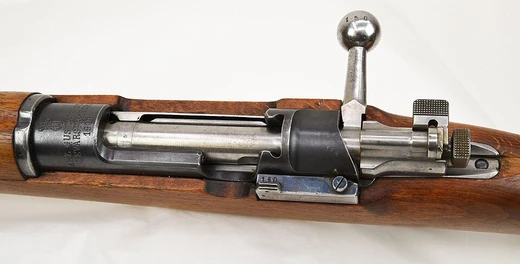
Type 30 rifle
First Arisaka rifle, standard Japanese infantry arm from 1897 to 1905.

The Type 30 rifle is a box-fed bolt-action repeating rifle that served as the standard infantry rifle of the Imperial Japanese Army from 1897 to 1905. It was the first in a series of Arisaka rifles that would be used through World War II, developed under the direction of Colonel Arisaka Nariakira at the Koishikawa Arsenal in Tokyo.
Quick Facts
- Is Ranged
- yes
- Origin
- Empire of Japan
- Design Date
- 1897
- Used By
- Users
- Service
- 1899–1945 (Japan)
- Part Length
- 790 mm / 480 mm (carbine)
- Cartridge
- 6.5×50mm Arisaka / 6.5×54mm Mannlicher–Schönauer / 7.62×39mm (post-war Chinese modified) / .303 British
- Feed
- 5-round internal magazine
- Action
- Bolt action
- Velocity
- 765 m/s
- Weight
- 3.95 kg / 3.2 kg (carbine)
- Length
- 1,274 mm / 964 mm (carbine)
Facts from the source article.
Lore & Background
Development of a new rifle began in December 1895 to replace the Murata rifle, which had been in use since 1880. The project was handled by the Koishikawa Arsenal in Tokyo under Colonel Arisaka Nariakira. The prototype was called the 'Type 29 rifle' and, after enhancements, was redesignated as the 'Type 30'. It went into production in 1899. By 1900, most Imperial Japanese Army divisions were fully equipped with the rifle. The Type 30 was first designed for the semi-rimmed 6.5×50mm Arisaka cartridge, and its sights could be set up to 2000 m. A carbine version, 962 mm long, was intended for cavalry and other troops needing a shorter weapon; it had a sight range of 1500 m and lacked a handguard over the barrel. The weapon could be equipped with the Type 30 bayonet.
The Type 30 was used by front-line Japanese forces in the Russo-Japanese War. Although a major improvement over the Type 22 rifle (Murata), it had some reliability and safety issues. Based on combat experience, an improved version, the Type 38 rifle, was introduced in 1905, though not all units received it, and a mixture of models was retained into World War I and later into World War II. Aside from Japan, the Type 30 was supplied to numerous nations during and after World War I. The most predominant user was the Russian Empire, which ordered up to 600,000 Arisaka rifles, with at least half being Type 30 rifles and carbines. Early in World War I, Britain ordered around 150,000 Type 30 and Type 38 rifles and carbines from Japan as a stopgap; some were handed over to the Royal Navy and to Arab forces fighting with Lawrence of Arabia. The majority were handed over to Russia in 1916. Russia also bought many more thousands of Type 30s and other Arisaka models. A number of these rifles ended up in Finland or were captured from Red Finns in the Finnish Civil War. Finland later gave some to Estonia, which converted some to .303 British. The Czechoslovak Legion fighting in the Russian Civil War was also armed with Type 30s.
Reader's Guide
The Type 30 rifle marks the beginning of the Arisaka line, which would serve Japan through two world wars. Its introduction in 1897 replaced the outdated Murata rifle and gave the Imperial Japanese Army a modern, box-fed bolt-action design. The Type 30 saw its first major combat in the Russo-Japanese War, where its performance—though an improvement—revealed reliability and safety issues that led to the development of the Type 38. Despite being superseded, the Type 30 remained in service alongside later models for decades. Its significance extends beyond Japan: large numbers were exported to Russia and Britain during World War I, arming troops on multiple fronts. The rifle also appeared in the hands of the Czechoslovak Legion, Arab forces under Lawrence of Arabia, and various other users. The Type 30's legacy includes numerous variants and copies, such as the Chinese 'Manchu Arisaka' contract rifles and a crude Chinese copy in 7.92×57mm Mauser. Training rifles were also converted from service weapons. The Type 30 thus represents both a foundational Japanese military arm and a globally distributed weapon of the early 20th century.
Did You Know?
- The Type 30 was named for the 30th year of the Meiji period (1897).
- A pre-production carbine version lacked a bayonet.
- Approximately 10,000 Type 30 rifles were converted into blank-firing training rifles between 1905 and 1921.
- The 'Manchu Arisaka' contract rifles were stamped with a coiled dragon instead of the Imperial Chrysanthemum.
More in Bolt-Action Rifles, Part 3 1-24
Spotted an error? Know more?
Reader corrections go straight into our review queue. Suggest an edit · How this site is sourced