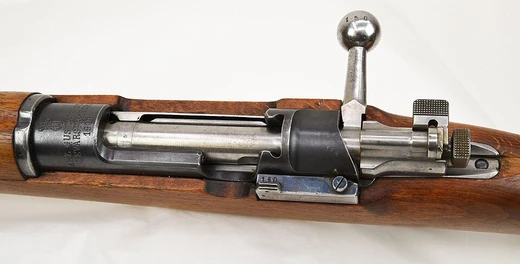
TERA rifle
Japanese paratrooper takedown rifles designed for airborne deployment.

The TERA rifles were a family of Japanese takedown rifles built specifically for paratroopers in the Imperial Japanese Army and Navy. Every model could be broken down or folded into two halves, making them easy to assemble or disassemble.
Before the Pacific War, Japanese paratroopers jumped with only a Type 94 pistol and three hand grenades. Standard Type 38 and Type 99 rifles were too long to carry during a jump, so they were dropped separately in containers with ammunition. Paratroopers often struggled to find and retrieve their rifles, forcing them to attack with just pistols, grenades, or captured enemy weapons.
Development of dedicated paratrooper rifles began at the 1st Laboratory of the 1st Army Technical Research Institute, which produced two prototypes. The Type 100 was designed to be carried broken down by a descending parachutist, while the Type 1 could be carried with its buttstock folded. A handful of these prototypes were acquired by the IJA but neither was used during the Battle of Palembang. This resulted in the loss of many rifles and heavier weapons for Japanese airborne forces—a problem similar to what German paratroopers faced at Crete—and renewed interest in a purpose-built paratrooper rifle.
In mid-1942, the 1st Laboratory developed a practical takedown design based on the Type 100. Instead of an interrupted screw, it used a tapered wedge to hold the detachable barrel in place. Tests at the Futsu Proving Ground in October 1942 were satisfactory, and after minor adjustments, the Type 2 paratrooper rifle was officially adopted in May 1943.
The Toriimatsu factory of the Nagoya Arsenal produced roughly 19,000 to 22,000 of these rifles. Some were used during the Battle of Leyte, but by the time the Type 2 entered production, major Japanese airborne operations had largely stopped. Many—if not most—surviving TERA rifles were captured by American forces on Leyte.
**Variants**
**Type 100** Modified from the Type 99 rifle, the Type 100 used an interrupted screw between the barrel and receiver, allowing the two parts to be joined or separated with a 90-degree turn. The bolt handle was also detachable. When broken down, the rifle could be carried in bags strapped to the paratrooper's legs. The locking mechanism was deemed inadequate, so it never went into mass production.
Quick Facts
- Origin
- Empire of Japan
- Is Ranged
- yes
- Service
- 1943–1945 (Type 2)
- Used By
- Imperial Japanese Army / Imperial Japanese Navy
- Wars
- World War II
- Number
- 1,000 (Type 100 and Type 1) / 19,000–22,000 (Type 2)
- Cartridge
- 6.5×50mmSR Arisaka (Type 1) / 7.7x58mm Arisaka
- Action
- Bolt action
- Feed
- 5-round stripper clip, internal box magazine
Facts from the source article.
Lore & Background
Before the Pacific War, Japanese paratroopers carried only a Type 94 pistol and three hand grenades when jumping. The length of the Type 38 and Type 99 rifles made them impractical to carry during deployment, so they were dropped separately in containers with ammunition. Paratroopers often had difficulty locating their rifles, forcing them to attack with pistols, grenades, and captured enemy weapons.
Development of dedicated paratrooper rifles was conducted by the 1st Laboratory of the 1st Army Technical Research Institute. Two prototypes were presented: the Type 100, designed to be carried broken down, and the Type 1, with a folding buttstock. Neither was used during the Battle of Palembang, resulting in many rifles and heavier weapons being lost, which renewed interest in a purpose-built paratrooper rifle.
In mid-1942, the 1st Laboratory developed a practical take-down design based on the Type 100, using a tapered wedge instead of an interrupted screw. Tests in October 1942 were satisfactory, and after tweaks, the Type 2 was officially adopted in May 1943. Some rifles were used during the Battle of Leyte, though significant Japanese airborne operations had largely ceased by the time it entered production. Many surviving TERA rifles were captured by American forces in Leyte.
Reader's Guide
The TERA rifles represent a focused attempt by the Imperial Japanese Army and Navy to solve a specific tactical problem: equipping paratroopers with a rifle they could carry during a jump. The earlier practice of dropping rifles in separate containers proved disastrous, as paratroopers often could not retrieve them. The Type 100 and Type 1 prototypes were produced in limited numbers but were not used in the Battle of Palembang, leading to heavy losses. The Type 2, adopted in 1943, was the only model to see significant production, with roughly 19,000–22,000 built at the Toriimatsu factory. However, by the time it entered service, large-scale Japanese airborne operations had largely ended. The Type 2 saw some use during the Battle of Leyte, where many were captured by American forces. The rifles are notable for their takedown mechanisms: the Type 100 used an interrupted screw, the Type 1 a folding buttstock, and the Type 2 a tapered wedge lock tightened by a folding wire ring. These designs highlight the engineering challenges of creating a reliable, quickly assembled rifle for airborne troops, though production and operational timing limited their impact.
Did You Know?
- The Type 2 used a tapered wedge to join barrel and receiver, unlike the interrupted screw of the Type 100.
- The Type 1 had a hinged buttstock that folded behind the trigger guard but was rejected due to insufficient robustness.
- Approximately 500 Type 100 rifles and 500 Type 1 rifles were made in total.
- The Type 2 was carried broken-down in a canvas chest bag or in two leg bags lowered on a short rope after the parachute opened.
More in Bolt-Action Rifles, Part 3 1-24
Spotted an error? Know more?
Reader corrections go straight into our review queue. Suggest an edit · How this site is sourced