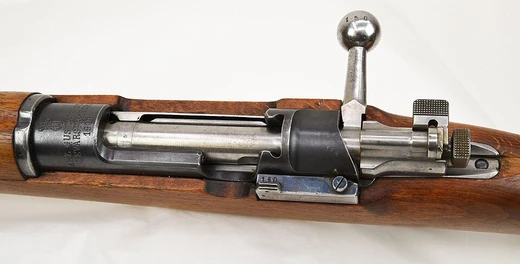
Swedish Mauser
Swedish Mausers: cock-on-closing rifles in 6.5×55mm with unique Swedish steel.

The Swedish Mauser is a group of bolt-action rifles that evolved from an improved version of the earlier Mauser Model 1893, but they fire the 6.5×55mm Swedish cartridge and include special features Sweden asked for. The main models are the m/94 (Model 1894) carbine, the m/96 (Model 1896) long rifle, the m/38 (Model 1938) short rifle, and the m/41 (Model 1941) sniper rifle. Production started in 1898 at Carl Gustafs stads gevärsfaktori in Eskilstuna, Sweden.
All Swedish Mausers, except for trial rifles, use the 6.5×55mm Swedish round. Every Swedish-made action was proof-tested with a single 6.5×55mm proof round that creates about 455 MPa piezo pressure (55,000 CUP). These rifles were built by Waffenfabrik Mauser AG in Oberndorf a/N, Germany, and in Sweden by Carl Gustafs stads gevärsfaktori and Husqvarna Vapenfabriks Aktiebolag. Whether made in Germany or Sweden, all Swedish Mausers were made from a Swedish-supplied high-grade tool steel alloyed with nickel, copper, and vanadium, which was known at the time for being strong and resistant to corrosion.
Like other Mauser rifles that came before the M98 system, these lack the third safety locking lug at the rear of the bolt and use "cock-on-closing" (similar to the contemporary Lee–Enfield) instead of the "cock-on-opening" found on the German Gewehr 98 and most later bolt-action rifles. The forward receiver ring, where the two front locking lugs engage, has a diameter of 33 mm. The internal magazine can be loaded with single 6.5×55mm rounds by pushing them into the top opening of the receiver, or with five-round stripper clips. The clip guides are machined into the rear receiver bridge. After loading, the empty clip is ejected when the bolt is closed. To make loading easier, a crescent-shaped thumb hole cutout was added to the left rear of the receiver top.
For Swedish trials, the m/1892 rifle and carbine were submitted. They were based on parts of the m/1889 Belgian, m/1890 Turkish, and m/1891 Argentine Mauser rifles. These had a single-stack magazine but included many improvements described in the Mauser Model 1893 development. Spain bought small batches of them for troop trials in both 7.65 mm and the new 7 mm cartridges. Existing examples of these Swedish test firearms are chambered in 8×58mmR Danish Krag (adopted by Sweden in 1889) as well as 6.5 mm.
Quick Facts
- Origin
- German Empire / Sweden
- Is Ranged
- yes
- Service
- 1895–1995
- Wars
- Winter War / Continuation War
- Designer
- Paul Mauser
- Design Date
- 1893–1896
- Manufacturer
- Waffenfabrik Mauser AG / Carl Gustafs stads gevärsfaktori / Husqvarna Vapenfabriks AB
- Production Date
- 1895–1948
- Number
- 750,000 of which 127,000 were m/94 carbines, 535,000 m/96 long rifles and 88,000 m/38 short rifles (converted m/38's not included)
- Variants
- m/38 short rifle, m/41 sniper rifle, m/94 carbine.
- Weight
- Rifle: 4 kg / carbine: 3.4 kg
- Length
- m/1894: 950 mm / m/1896: 1260 mm / m/1938: 1120 mm
Facts from the source article.
Lore & Background
The Swedish Mauser family includes the m/94 (Model 1894) carbine, m/96 (Model 1896) long rifle, m/38 (Model 1938) short rifle, and m/41 (Model 1941) sniper rifle. All Swedish Mausers other than trials rifles were chambered for the 6.5×55mm Swedish cartridge, and all Swedish-made actions were proof-tested with a single 6.5×55mm proof round developing approximately 455 MPa piezo pressure. These rifles lack the third safety locking lug at the rear of the bolt and feature 'cock-on-closing' instead of the 'cock-on-opening' style found on the German Gewehr 98. The internal magazine can be loaded with single rounds or via five-round stripper clips inserted into clip guides machined into the rear receiver bridge; the empty clip is ejected when the bolt is closed. A crescent-shaped thumb hole cutout was introduced at the left rear of the receiver top for easier loading.
The m/1894 carbine was adopted in 1894, with the first 12,000 manufactured by Waffenfabrik Mauser in Oberndorf am Neckar, Germany, in 1895. Swedish production under license commenced in 1898 and continued sporadically until 1918, with very limited numbers later produced with receiver dates of 1929 and 1932. The m/1894 carbine is still used today by the Royal Guards at Stockholm Palace. The m/1896 long rifle was adopted in 1896 for infantry use, replacing the Model 1867–1889 Remington rolling block rifle. Standard production at Carl Gustafs continued until 1925, with additional rifles produced by Husqvarna during World War II for civilian marksmanship training.
Reader's Guide
The Swedish Mauser family represents a significant evolution in bolt-action rifle design, combining Mauser's proven action with Swedish-specific improvements and a high-grade steel alloy that enhanced strength and corrosion resistance. The m/1894 carbine and m/1896 long rifle saw extensive service and production, with over 127,000 carbines and 535,000 long rifles manufactured across German and Swedish factories. The rifles' cock-on-closing mechanism, shared with the contemporary Lee–Enfield, distinguished them from later Mauser designs. The m/1894 carbine's continued use by the Royal Guards at Stockholm Palace underscores its enduring legacy. The introduction of sub-variants such as the m/1894-14 carbine with bayonet mount, the skolskjutningskarbin for school training, and the kammarkarbin for gallery shooting demonstrates the platform's adaptability. The m/1896 long rifle's iron sights, graduated from 300 to 2000 meters, were matched for the trajectory of 6.5×55mm m/94 ball service ammunition. The Swedish Mauser's influence extended through its use in military, training, and ceremonial roles, and its robust construction has made it a collectible firearm.
Did You Know?
- The preparatory production development at Carl Gustafs stads gevärsfaktori caused Carl Edvard Johansson to invent gauge blocks.
- Some m/1894 carbines were lost from regular use by conversion to sub-caliber targeting and practice devices for artillery pieces.
- The kammarkarbin (gallery carbine) has a rifling rate of twist about 4 times faster than the standard m/1894 carbine.
More in Bolt-Action Rifles, Part 3 1-24
Spotted an error? Know more?
Reader corrections go straight into our review queue. Suggest an edit · How this site is sourced