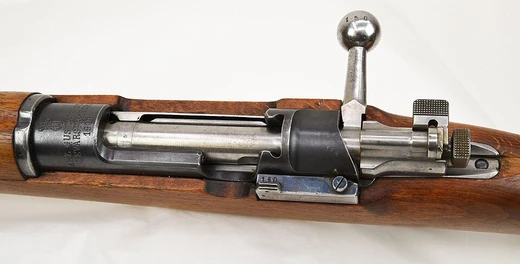
SIG Sauer 205
A precision bolt-action rifle for competition and law enforcement.

The SIG Sauer 205 is a bolt-action rifle formerly produced by SIG Sauer, designed for competition shooting and law enforcement. Its mechanism was developed in the late 1980s as a bid for a common rifle for Scandinavian rifle associations, though the SIG Sauer 200 STR was favored instead. The 205 was later approved for Swiss competition in 1994 and released to Swiss sport shooters in 1995.
Quick Facts
- Is Ranged
- yes
- Origin
- Germany
- Designer
- SIG Sauer
- Manufacturer
- J. P. Sauer & Sohn GmbH
- Used By
- Primarily Swiss sport shooters
- Production Date
- Around 1994 to 2007
- Cartridge
- 5.56×45mm NATO, / 6mm BR, / 6.5×55mm, / 7.5×55mm Swiss, / .308 Winchester, / 7.62×51mm NATO, / .22 LR
- Action
- Bolt-action
- Velocity
- 7.5×55mm Swiss: 11.3 gram bullet at 750 m/s
- Range
- Used in Swiss competitions from 100 to 600 meters
- Weight
- 5400 g
- Length
- 1150 mm (with a 660 mm barrel)
Facts from the source article.
Lore & Background
The SIG Sauer 205 was designed in the late 1980s for a competition where Scandinavian rifle associations sought a replacement for aging rifles. The Swedish Frivilliga Skytterörelsen had used Carl Gustaf CG 63, 73, 74 and 80 target rifles based on the Swedish Mauser. Norwegian Det frivillige Skyttervesen and Danish De Danske Skytteforeninger had used Krag–Jørgensen and rebuilt Mauser K98k actions. The 205 was not selected by the Scandinavian associations, which chose the SIG Sauer 200 STR instead, but was deemed suitable for CISM and ISSF 300 meter disciplines. In 1994, it was approved for Swiss competition in 7.5×55mm Swiss, and became available to Swiss shooters in 1995. The rifle was noted as more expensive than previous Swiss competition rifles. Its 7.5mm caliber variants are rarely seen outside Switzerland due to the uncommon 12.72 mm bolt face diameter.
The receiver is machined from a solid steel block and blued, available in right- or left-hand versions. The safety is on the tang of the stock, allowing disengagement without entering the trigger guard. The action uses a 'fat bolt' with lugs engaging directly into the barrel, rotating 60 degrees. The firing pin is lightweight, producing a 2.4 ms lock time. The two-piece wood stock (walnut, beechwood, or laminated beechwood) eliminates bedding; an aluminum chassis stock was also available. The 205 shares its quick-change barrel system with the SIG Sauer 200 STR and SSG3000, requiring a 5 mm hex key. Barrels were originally produced in .22 LR, 6.5×55mm, .308 Winchester/7.62×51mm NATO, and formerly in 5.56×45mm NATO, 6mm BR, and 7.5×55mm Swiss. A .22 LR conversion kit (bolt, barrel, magazine) was available but is no longer produced. Bolts differ by caliber group: 5.56 bolts have three locking lugs, larger calibers six.
Variants include the Moose Biathlon Rifle (MBR) for Finnish hirvenhiihto competitions, in .308 Winchester with a dark walnut stock, adjustable cheek rest and length of pull, and an integrated UIT rail. The Sport (Standardgewehr) model had a 670 mm match barrel in 7.5×55mm Swiss, laminated beechwood stock, adjustable cheek rest, UIT rail, hand stop, mirage band, and precision iron sights with a diopter rear adjustable from 0.8 to 2.2 mm. The Supertarget and Phantom used an anodized aluminum chassis stock with an adjustable Hämmerli pistol grip; the Supertarget was for ISSF competitions, and the Phantom was a sniper model introduced at the 2005 IWA-show, also marketed in the US as the Sauer ATLR. The Police version had a black laminated wood stock and was marketed as the Sauer S 205 SSG.
Reader's Guide
The SIG Sauer 205 occupies a niche in bolt-action rifle history as a design that, while not adopted by the Scandinavian associations that prompted its creation, found a role in Swiss competition shooting and specialized law enforcement and sporting applications. Its development in the late 1980s reflects the broader transition from military-derived target rifles to purpose-built competition platforms. The 205's quick-change barrel system, shared with the SIG Sauer 200 STR and SSG3000, allowed caliber flexibility and barrel replacement without specialized tools. The rifle's 'fat bolt' and direct barrel-lug engagement contributed to smooth operation and accuracy. Variants such as the Moose Biathlon Rifle for Finnish hirvenhiihto and the Phantom sniper model demonstrate the design's adaptability to different competition rules and tactical roles. The 205's relatively high cost in Switzerland and the rarity of its 7.5mm Swiss caliber outside that country limited its market penetration. Aftermarket barrel support from manufacturers like Blaser, Heym, Lothar Walther, Schultz & Larsen, and Våpensmia extended its service life for enthusiasts. The 205 remains notable for its engineering precision and the diversity of its variants, though production has ceased.
Did You Know?
- The SIG Sauer 205 uses a 'fat bolt' with a 60-degree rotation, and the bolt lugs engage directly into the barrel.
- A .22 LR conversion kit for the 205 was once available but is no longer produced.
- The Phantom variant was introduced at the 2005 IWA-show and marketed in the US as the Sauer ATLR.
- The 205's trigger shares much internal design with the SIG Sauer 200 STR but differs in housing shape and safety placement.
More in Bolt-Action Rifles, Part 3 1-24
Spotted an error? Know more?
Reader corrections go straight into our review queue. Suggest an edit · How this site is sourced