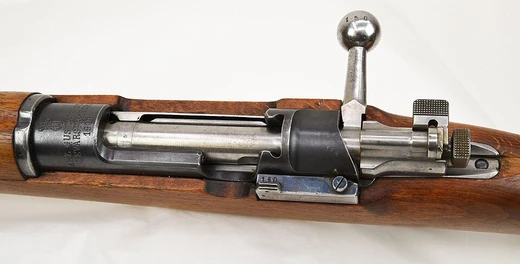
Murata rifle
Japan's first domestically produced service rifle, adopted in 1880.

The Murata rifle, adopted in 1880 as the Meiji Type 13 single-shot rifle, was the first service rifle Japan produced on its own. Its development was a drawn-out process because Japan first had to build the industrial base needed to manufacture it. Before that, the early Imperial Japanese Army relied on imported weapons like the French Chassepot, British Snider-Enfield, and American Spencer repeating rifle, a situation that had persisted since the Boshin War. This came about 300 years after Japan’s first guns, the Tanegashima or "Nanban guns," which were derived from Portuguese matchlock designs.
Combat during the Boshin War showed the need for a standardized design, and the Japanese Army was impressed by the metallic-cartridge system of the French Gras rifle. The Murata was invented by Major Murata Tsuneyoshi, an infantry officer who survived the Boshin War and later traveled to Europe. Adopted in the thirteenth year of Emperor Meiji’s reign, it was designated Model 13 and began production in 1880 as an 11-millimeter, single-shot, bolt-action rifle. Its original 11-millimeter cartridge used a Boxer-type primer, roughly 6 millimeters in size, filled with mercury fulminate.
Superficial changes—like updates to components, bayonet lugs, and minor configurations—led to the Type 18 rifle in 1885. Further modifications that same year, involving both tubular and box magazines, produced the Type 22 rifle, which used a tubular magazine and was reduced to 8mm caliber. The Type 22 was the first Japanese military rifle to use smokeless powder and entered service in 1889.
The Murata was accurate and mechanically reliable, and it worked well in cold weather. However, its steel was relatively soft and of mediocre quality. The bolt assembly had several design flaws that required frequent maintenance, and the rifle has been described unfavorably as a "poor man's Beaumont." Three bayonet models were made: the Type 13 and Type 18 for the single-shot variants, and the Type 22 for the repeaters.
During the First Sino-Japanese War, only two divisions of the Imperial Japanese Army had the Type 22; the rest used older single-shot Muratas. The Type 22 also saw action in the Boxer Rebellion. The army quickly realized that even the improved Type 22 had many technical issues and flaws.
Quick Facts
- Is Ranged
- yes
- Origin
- Empire of Japan
- Design Date
- 1880
- Production Date
- 1880–1905
- Service
- 1880–1919
- Caliber
- 11mm / 8mm
- Cartridge
- 11×60mmR Murata / 8×53mmR Murata
- Feed
- Single-shot / (Type 13, Type 16, Type 18, grenade launcher, and civilian models) / Repeating rifle 8-round tube magazine (Type 22 rifle), 5-round tube magazine (Type 22 carbine)
- Action
- Bolt action
- Velocity
- 435 m/s (1,417 f/s)
- Weight
- 4.09 kg
- Length
- 1,294 mm
Facts from the source article.
Lore & Background
The development of the Murata rifle was lengthy because it required establishing an adequate industrial structure. Before this, the Imperial Japanese Army relied on imports such as the French Chassepot, British Snider-Enfield, and American Spencer repeating rifle. The combat experience of the Boshin War emphasized the need for a standardized design, and the Japanese Army was impressed with the metallic-cartridge design of the French Gras rifle. The design was invented by Major Murata Tsuneyoshi, who had survived the Boshin War and subsequently traveled to Europe. Adopted in Emperor Meiji's thirteenth year of reign, the rifle was designated as the model 13 and went into production as the 11-millimeter Type 13 single-shot, bolt-action rifle in 1880. The original 11-millimeter Murata cartridge used an approximately 6-millimeter Boxer-type primer filled with mercury fulminate.
Superficial improvements led to the Type 18 rifle in 1885, and further modifications involving both tubular and box magazines led to the Type 22 rifle, which used a tubular magazine and was reduced to caliber 8mm. The Type 22 was the first Japanese military rifle to utilize smokeless powder and entered military service in 1889. The Murata rifle was accurate and mechanically reliable, noted for functioning well in cold weather, but suffered from relatively soft steel of mediocre quality. The bolt assembly had a number of design flaws that necessitated frequent maintenance, and it has been unfavorably described as a 'poor man's Beaumont'.
Reader's Guide
The Murata rifle holds significance as Japan's first domestically produced service rifle, representing a crucial step in the nation's military industrialization. During the First Sino-Japanese War, only two divisions were equipped with the Type 22 rifle, while the rest used obsolete single-shot versions. The Imperial Japanese Army quickly recognized that even the improved Type 22 had many technical issues and flaws, leading to its replacement by the Arisaka Type 30 rifle designed in 1898. However, due to insufficient production, many reserve infantry units during the Russo-Japanese War of 1904–1905 continued to be equipped with the Murata Type 22 rifle. Type 18 rifles converted into rifle grenade launchers were used during the Siege of Tsingtao during World War I and the Japanese intervention in Siberia. The rifle also saw use by Filipino revolutionaries, with Andres Bonifacio and Mariano Ponce seeking to acquire Murata rifles via a Japanese silviculturist to equip the Katipunan, though the shipment was destroyed in a typhoon. While never serving in combat during World War 2, many conscripts of the Japanese Volunteer Fighting Corps were equipped with these and other antiquated firearms. The Murata's legacy is that of a transitional weapon that bridged Japan's reliance on foreign arms to indigenous designs, despite its technical shortcomings.
Did You Know?
- The Type 13 designation referred to the adoption date, the year 13 in the Meiji period according to the Japanese calendar.
- A shipment of Murata rifles intended for Filipino revolutionaries was destroyed in a typhoon off the coast of Taiwan.
More in Bolt-Action Rifles, Part 3 1-24
Spotted an error? Know more?
Reader corrections go straight into our review queue. Suggest an edit · How this site is sourced