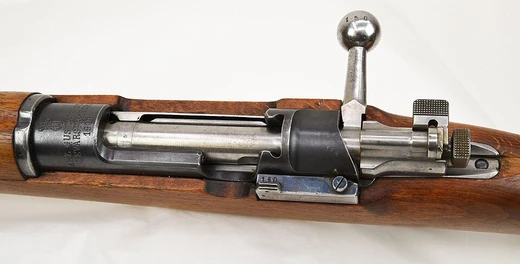
M1870 Italian Vetterli
Italian service rifle converted through multiple wars and calibers.

The M1870 Italian Vetterli was a single-shot bolt-action rifle adopted by the Italian military as its service rifle from 1870 to 1891. It was based on the Swiss Vetterli M1868 design but modified to remove the tubular magazine, firing the 10.4mm Vetterli centrefire cartridge. The rifle is notable for its long service life and numerous conversions, including the M1870/87 Vetterli-Vitali repeating variant and later rechambering to 6.5×52mm Carcano during World War I.
Quick Facts
- Origin
- Switzerland
- Is Ranged
- yes
- Service
- 1871–1950s
- Number
- 1,500,000
- Variants
- M1870/87 and M1870/87/15
- Weight
- M1870/87: 10.19 lb / M1870/87/15: 10.19 lb
- Length
- 52.95 in
- Part Length
- 33.85 in
- Cartridge
- M1870/87: 10.4×47mmR / M1870/87/15: 6.5×52mm Carcano
- Action
- Bolt-action
- Velocity
- M1870/87: 1410 ft/s / M1870/87/15: 2395 ft/s
- Range
- M1870/87: 2000 m / M1870/87/15: 2000 m
Facts from the source article.
Lore & Background
The M1870 Vetterli was developed after the Risorgimento, when the Italian Army trialed bolt-action designs using metallic cartridges. The Swiss Vetterli M1868 was selected, but the Italian government chose a single-shot configuration. Production began in 1871 at Italian state arsenals, with five versions including an infantry rifle, cavalry carbine, short rifle for special troops, and carbines for the Carabinieri and Corazzieri. In 1882, the Italian Navy adopted the tube-magazine Vetterli-Bertoldo. From 1887 to 1896, the army converted M1870s into four-shot repeaters using the Vitali system, adding a box magazine fed by a steel and wood charger. The conversion was applied to long rifles, TS musketoons, and some Carabinieri carbines, but not to cavalry carbines for metropolitan troops. A special run of 500 Vitali-converted cavalry carbines was made for Eritrean native cavalry in 1888, now known as the M1870/88 V.V. Eritrean cav carbine, with only five known examples extant.
Reader's Guide
The M1870 Vetterli's significance lies in its long operational life and extensive conversions that kept it in service for over 70 years. Originally a single-shot black-powder rifle, it was adapted to a repeating magazine system in the 1880s and later rechambered to the 6.5mm Carcano cartridge during World War I, with approximately 700,000 rifles converted via the Salerno barrel-sleeving method. These converted rifles served rear-echelon troops, colonial units, and were supplied to Russia, China, Ethiopia, Finland, Paraguay, and other nations. The rifle saw action in conflicts ranging from the First Italo-Ethiopian War to the Spanish Civil War and World War II, used by regular armies, colonial forces, paramilitaries, and partisans. Its presence in the Larne gun-running operation for the Ulster Volunteers and among Irish Volunteers highlights its role in non-state conflicts. The M1870 Vetterli exemplifies how obsolete military arms can be repurposed across generations and continents.
Did You Know?
- The M1870/87 Vetterli-Vitali conversion added a four-shot box magazine fed by a steel and wood charger with a pull string.
- During World War I, Italy sent 400,000 Vetterli-Vitali rifles to Russia, which later ended up in Republican hands during the Spanish Civil War.
- Only five examples of the M1870/88 V.V. Eritrean cav carbine are known to exist today.
- The M1870/87/15 conversion used the Salerno method of barrel sleeving to rechamber the rifle from 10.4mm to 6.5×52mm Carcano.
More in Bolt-Action Rifles, Part 3 1-24
Spotted an error? Know more?
Reader corrections go straight into our review queue. Suggest an edit · How this site is sourced