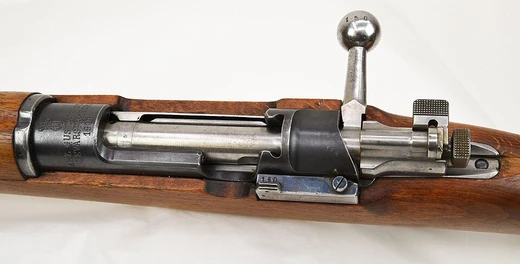
Jarmann M1884
A Norwegian bolt-action repeater that pioneered smokeless ammunition use.

The Jarmann M1884 is a bolt-action repeating rifle from Norway, first designed in 1878 and officially taken into service six years later. Its introduction, along with later updates, shifted the Norwegian Army away from single-shot black-powder firearms toward modern repeaters that used smokeless ammunition. The unusual design came from Norwegian engineer Jacob Smith Jarmann.
The rifle fired a 10.15 mm black-powder cartridge from an eight-round tubular magazine positioned beneath the barrel. Its bolt does not rotate; instead, the bolt handle itself rotates to lock the action. This mechanism is reputed to be smooth, but it is not strong enough for modern ammunition because the only locking point is the rotating handle.
Jacob Smith Jarmann had already built a breech-loading rifle in 1838 that used cardboard cartridges, but the military rejected it on the grounds that a weapon capable of thirteen shots per minute could not be supplied with enough ammunition. In the 1870s, he left the daily management of his workshop to focus on his new bolt-action rifle. His patent listed three novel features: the extractor, which both pulled out spent rounds and limited the bolt’s rearward travel; the rotating bolt handle, which locked the bolt to the receiver when forward; and the way the extractor was attached to the bolt body. The rifle also lacks a separate ejector; instead, the extractor pushes the spent round down onto the elevator, and the friction from that contact ejects it safely.
The design was first tested by a joint Norwegian-Swedish rifle commission. Early results were positive, but the commission wanted a repeating weapon with a magazine. Several prototypes with magazines were built. Ole Herman Johannes Krag, who later designed the Krag–Petersson and Krag–Jørgensen rifles, created two different magazine designs for the Jarmann: one nearly identical to the Krag–Petersson magazine, and another that foreshadowed the Krag–Jørgensen magazine. Jarmann himself made prototypes with tubular magazines under the barrel or detachable magazines mounted sideways above the bolt. The side-mounted version was judged unsuitable for field use, so a tubular magazine was chosen. This magazine resembles the Kropatschek tubular design and may have been inspired by it, or possibly by the Krag–Petersson magazine.
Quick Facts
- Is Ranged
- yes
- Origin
- Norway
- Designer
- Jacob Smith Jarmann
- Design Date
- 1878
- Service
- 1884 to 1900 (reissued to second line units in 1905)
- Cartridge
- 10.15×61mmR
- Action
- Bolt action
- Rate
- Unknown, but as fast as the operator could operate the action
- Velocity
- 485 to 500 m/s (1,191 to 1,640 ft/s)
- Range
- 430 m (with iron sight)
- Max Range
- 2,400 m (10.15 x 61R rimmed)
- Weight
- 4.5 kg (10 lb)
Facts from the source article.
Lore & Background
Jacob Smith Jarmann designed his first breech-loading rifle in 1838, but it was rejected because a rifle capable of 13 shots per minute was deemed impossible to resupply. In the 1870s, he stepped down from his workshop to work on his bolt-action rifle. The design was first tested by a joint Norwegian-Swedish rifle commission, whose favorable tests highlighted the desirability of a repeating weapon. Several magazine-fed prototypes were built, including designs by Ole Herman Johannes Krag, who created two different magazines for the Jarmann. Jarmann himself made prototypes with tubular magazines under the barrel or detachable magazines mounted sideways over the bolt; the latter was considered unusable in the field, and a tubular magazine was selected.
The Jarmann M1884 fired a 10.15 mm black powder cartridge from an 8-round tubular magazine. It has a non-rotating bolt locked by a rotating bolt handle, and a reputedly smooth action. The action is not considered strong enough for modern ammunition because the only locking is provided by the rotating bolt handle. The extractor not only pulls the spent round out but also limits the bolt's rearward motion; there is no separate ejector, as the extractor pushes the spent round onto the elevator, and the resulting friction ejects it. The combination of tubular magazine and centerfire ammunition has been called 'too excitable', especially with pointed bullets, and the weapon's balance changed with every shot—issues common to all tubular-magazine firearms.
Reader's Guide
Despite being a trailblazer with its pioneering design, the Jarmann M1884 cannot be considered successful. The magazine and bolt do not always work well together, possibly because Jarmann was initially unwilling to design a magazine for his single-shot design. Nevertheless, 30,000 were manufactured for the Norwegian armed forces between its adoption in 1884 and the adoption of the Krag–Jørgensen in 1894, with a further 1,500 for the Swedish Navy. In Norwegian service, it replaced the Remington M1867 and the last kammerladers. The military initially considered it a very good weapon, with less than half the spread of the Remington at 600 m (46 cm versus 96 cm). It was later eclipsed by rapid firearms development and phased out within a decade, though second-line units were issued it in 1905 when war with Sweden was considered imminent. After being phased out, a number were rebuilt as harpoon guns. The rifle was remarkably accurate for its time: at 600 m it spread no more than 61 cm with uncoated lead bullets and 46 cm with jacketed bullets, compared favorably to the Remington (96 cm), Gras (89 cm), and Mauser (80 cm).
Did You Know?
- The Jarmann action does not have a separate ejector; the extractor pushes the spent round onto the elevator, and friction ejects it.
- The sights were graduated from 200 m to 1600 m, with an additional volley sight for indirect fire from 1600 m to 2400 m.
- More than 5 million cartridges were manufactured for the M1884, including ball, gallery, blank, dummy, and harpoon rounds.
- After being phased out of the Norwegian Army, a number of Jarmann rifles were rebuilt as harpoon guns.
More in Bolt-Action Rifles, Part 3 1-24
Spotted an error? Know more?
Reader corrections go straight into our review queue. Suggest an edit · How this site is sourced