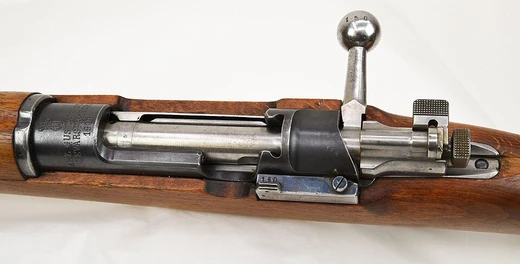
Howa Golden Bear
A Japanese large-caliber hunting rifle adopted by police and exported to America.

The Howa Golden Bear is a bolt-action rifle that was manufactured by Howa Industries in the past. Introduced in 1967, it was the only large-caliber hunting rifle available domestically in Japan at the time. The rifle gained notable recognition after passing all tests at the renowned HP White Laboratory and was sold in the United States under the names Dickson-Howa Golden Bear and, through an OEM arrangement, as the Weatherby Vanguard.
Quick Facts
- Origin
- Japan
- Is Ranged
- yes
- Manufacturer
- Howa Machinery, Ltd.
- Production Date
- 1967-1979
- Variants
- Deluxe, Presentation, Medallion
- Weight
- 3,300g (.30-06), 3,200g (.308Win)
- Length
- 1,160mm (.30-06), 1,075mm (.308Win)
- Part Length
- 616mm (.30-06), 565mm (.308Win)
- Cartridge
- .30-06, .308 Winchester, others
- Caliber
- 7.62mm
- Action
- Bolt-action, Mauser type
- Velocity
- Depends on caliber
Facts from the source article.
Lore & Background
The Howa Golden Bear was developed after Howa Industries released the M300 hunting rifle in 1960. Seeking to meet demand for a large-caliber bolt-action rifle in Japan, the designers used the Finnish SAKO L61R 'Finnbear' as the basis. The rifle was introduced in 1967 at the US Open rifle exhibition in Chicago, USA. Approximately 3000 Golden Bear rifles were sold to the United States and passed every test at the HP White Laboratory, a renowned firearms testing facility. This success helped Howa gain popularity and acceptability in the American market. The Golden Bear was sold in three export grades: deluxe, presentation, and medallion. In Japan, only the deluxe model was sold. In the United States, the rifles were sold by Dickson Roses company as the 'Dickson-Howa Golden Bear', and Weatherby also sold them under the name Weatherby Vanguard through an OEM arrangement. In 1979, an updated design, the M1500, was introduced, and the older Golden Bear model was discontinued in the same year. Despite being designed for hunting, the Golden Bear was adopted by elements within Japanese law enforcement. Following the Kin Kiro incident in 1968, the National Police Agency deployed Golden Bear rifles to prefectural police as equipment for taking down criminals and rescuing hostages. All police Golden Bear rifles came with a scope. During the Setouchi Seajacking incident in 1970, an Osaka Prefectural Police Special Gun Corps sniper used a Golden Bear rifle to take down a criminal, allowing other officers to rescue hostages. The rifle is also said to have been used by the Tokyo Metropolitan Police Department's Special Squadron (now the SAT).
Reader's Guide
The Howa Golden Bear holds significance as a Japanese-manufactured large-caliber bolt-action rifle that successfully entered the American market and also served in domestic law enforcement. Its development addressed a gap in Japan for large-caliber hunting rifles, and its design was based on the Finnish SAKO L61R 'Finnbear'. The rifle's passage of all tests at the HP White Laboratory helped establish Howa's reputation in the United States, leading to sales of approximately 3000 units and partnerships with Dickson Roses and Weatherby. The Golden Bear's legacy includes its adoption by Japanese police after the Kin Kiro incident, where it was used as a precision tool for hostage rescue and criminal takedowns. Its use in the Setouchi Seajacking incident demonstrated its effectiveness in a real-world crisis. The rifle was chambered in .30-06 Springfield for police use and fitted with a Bushnell 3-9x scope. The Golden Bear was discontinued in 1979 with the introduction of the M1500, but its role in both civilian and law enforcement contexts marks it as a notable firearm in Japanese and American shooting history.
Did You Know?
- All police Golden Bear rifles came with a scope, and the police chambering was .30-06 Springfield.
- The Golden Bear was sold in the US by Dickson Roses as the 'Dickson-Howa Golden Bear' and by Weatherby as the Weatherby Vanguard.
More in Bolt-Action Rifles, Part 3 1-24
Spotted an error? Know more?
Reader corrections go straight into our review queue. Suggest an edit · How this site is sourced