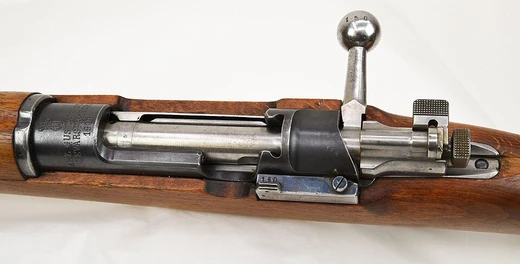
Carcano
Italian bolt-action rifle used in both World Wars and the Kennedy assassination.

The Carcano is a series of Italian bolt-action, en-bloc clip-fed repeating military rifles and carbines, officially designated as the Fucile Modello 1891 (Model 1891 Rifle). Introduced in 1891 and chambered for the rimless 6.5×52mm Carcano round, it was developed by chief technician Salvatore Carcano at the Turin Army Arsenal in 1890. The rifle is notable for its use by Italian troops in both World Wars and for being the weapon used by Lee Harvey Oswald to assassinate United States President John F. Kennedy on November 22, 1963.
Quick Facts
- Origin
- Kingdom of Italy
- Is Ranged
- yes
- Service
- 1894–1981 (Italy) / 1894–present (others)
- Designer
- Salvatore Carcano
- Design Date
- 1890
- Production Date
- 1892–1945
- Number
- 5,000,000–6,000,000 of all variants
- Spec Label
- Fucile mod. 91
- Mass
- 8.6 lb
- Part Length
- 30.7 in
Facts from the source article.
Lore & Background
The Carcano replaced the Vetterli-Vitali rifles and carbines in 10.35×47mmR after the Italian government formed a commission in late 1888 to choose a new infantry rifle. After testing over 50 designs, the commission recommended Carcano's design on March 5, 1892, with formal approval on March 29. The first rifles were issued in the spring of 1894. The rifle is often called 'Mannlicher-Carcano' in American parlance, though the 'Mannlicher' title refers only to the en-bloc loading clip system, not the action itself, which was a modified Gewehr 88 action. Italian soldiers simply called it 'il novantuno' (the ninety-one).
The Carcano family included both rifle (fucile) and shorter-barreled carbine (moschetto) forms. Early models featured progressive rifling (gain twist), which increased stability and accuracy while decreasing rifling erosion. This feature was dropped in the Mod. 41 rifle. The bolt was simpler than the Gewehr 88 and included a safety plate between the rear of the bolt piece and the cocking piece. The design remained practically unchanged for over 60 years, with only slight modifications.
During World War I, scoped M1891s were used as sniper rifles, and some Alpini soldiers preferred the carbine variant. A variety of scopes were used, including a French-made APX derivative known as Amigues and a 4× power scope called 'Scheibler' manufactured by Filotecnica-Salmoiraghi. After the war, the Italian Army converted old M1891 rifles to carbine length as the M1891/24 for colonial operations.
Reader's Guide
The Carcano's significance lies in its long service life and widespread use. It was used by Italian troops during both World War I and World War II, and also by Finland, the German Volkssturm, and the Imperial Japanese Navy (which used the Type I rifle variant) during WWII. Post-war, it saw use with regular and irregular forces in Africa, Asia, and the Middle East. Despite often being described as inaccurate and inferior—especially by Kennedy assassination conspiracy theorists—the rifle is described as accurate and capable. Military historian Ian V. Hogg described it as 'a serviceable enough weapon and on a par with its contemporaries.' FBI firearms expert Robert A. Frazier, who test-fired Oswald's Carcano, testified it was an accurate weapon. E. C. Ezell stated that despite rumors of it being unsafe to fire, 'it is as safe as any other military rifle' provided the gun is in good condition and proper ammunition is used. The rifle's most infamous moment came on November 22, 1963, when a Carcano Mod.91/38 was used by Lee Harvey Oswald to assassinate President John F. Kennedy in Dallas, Texas.
More in Bolt-Action Rifles, Part 3 1-24
Spotted an error? Know more?
Reader corrections go straight into our review queue. Suggest an edit · How this site is sourced