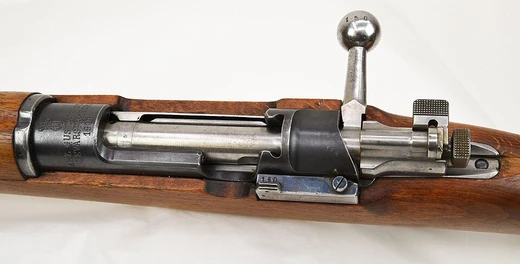
Arisaka
Japanese bolt-action service rifle family, 1897–1945.

The Arisaka is a family of Japanese military bolt-action service rifles produced and used from approximately 1897, when it replaced the Murata rifle, until the end of World War II in 1945. The design developed under the supervision of Colonel Arisaka Nariakira and resembled the German Rifle Test Commission 8mm Model 1888 bolt-action rifle. Notable for its strength, the Arisaka was found in destructive stress-tests to be stronger than the American M1903 Springfield, British Lee–Enfield, and German Mauser rifles.
Quick Facts
- Is Ranged
- yes
- Origin
- Empire of Japan
- Designer
- Arisaka Nariakira / Kijirō Nambu
- Design Date
- 1897
- Service
- 1897–1961
- Variants
- Type 30 / Type 30 carbine / Type 35 / Type 38 / Type 38 carbine / Type 38 sniper rifle / Type 44 carbine / Type 97 sniper rifle / Type 99 / Type 99 sniper rifle / TERA
- Cartridge
- 6.5×50mmSR Type 30 / 6.5×50mmSR Type 38 / 7.7×58mm Type 92 / 7.7×58mm Type 97 / 7.7×58mm Type 99
- Action
- Bolt-action
- Feed
- 5-round internal magazine / (reloaded via stripper clip)
- Sights
- Rear: ladder, tangent (Type 35) / Front: fixed blade / Sniper variants: factory-zeroed scope
Facts from the source article.
Lore & Background
The Arisaka rifle family was developed under the supervision of Colonel Arisaka Nariakira, who was promoted to lieutenant general in 1906 and received the title of baron in 1907. The design may have been influenced by the German Rifle Test Commission 8mm Model 1888. Over several wars, the rifle underwent multiple production runs, transitioning from the 6.5mm Type 38 cartridge to the larger 7.7mm Type 99. A paratrooper variant that could be broken into two parts was also introduced. Post-war testing revealed the bolts and receivers were made of carbon steel similar to SAE No. 1085. The Arisaka was one of the few firearms of its era to use polygonal rifling rather than lands and grooves.
Early Type 99 rifles sometimes featured a folding wire monopod for prone firing and rear sights with folding horizontal extensions for aiming at aircraft. Near the end of World War II, ersatz models were manufactured with cost-cutting measures, including a smaller cylindrical bolt, omission of the hand-guard, and crude fixed sights. The imperial ownership seal—a 16-petal chrysanthemum—was often defaced on surviving examples, as required by Military Defense Decree 1147 issued in April 1914 for rifles leaving imperial service. Many rifles were thrown into Tokyo Harbor after the surrender, and ammunition became rare, though China continued manufacturing 6.5×50mmSR and 7.7×58mm for captured rifles.
Reader's Guide
The Arisaka rifle served everywhere in the Imperial Japanese Army and Navy. Before World War II, it saw service with the Royal Navy, Imperial Russian Army, Finland, and Albania. The Czech Legions fighting in the Russian Civil War were almost entirely armed with Type 30 and Type 38 Arisakas. Various countries, including China, Thailand, and Cambodia, used captured rifles during and after the war. After the Japanese surrender in the northern-hemisphere summer of 1945, manufacture stopped abruptly and the rifles quickly became obsolete. Many thousands of Type 99s and other variants were brought to the United States as war trophies. Some captured Sino-Arisakas were later exported to the U.S., including Type 38 and Type 44 carbines re-barrelled for 7.62×39mm, and some Type 38 and Type 99 rifles captured by Kuomintang forces were converted to 7.92×57mm Mauser. A small run of Type 38 rifles was manufactured for export to Mexico in 1910 with the Mexican coat-of-arms, but few arrived before the Mexican Revolution; the bulk remained in Japan until World War I, when they were sold to Imperial Russia.
Did You Know?
- Destructive stress-tests showed Arisaka rifles to be stronger than the M1903 Springfield, Lee–Enfield, and German Mauser.
- The imperial chrysanthemum seal was often ground off or defaced on rifles leaving imperial service per a 1914 decree.
More in Bolt-Action Rifles, Part 3 1-24
Spotted an error? Know more?
Reader corrections go straight into our review queue. Suggest an edit · How this site is sourced