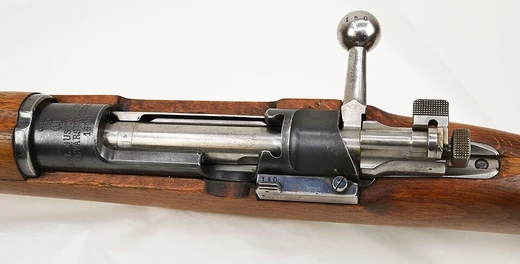
Sako TRG
Finnish bolt-action sniper rifle line from SAKO.

The Sako TRG—standing for "Precision Rifle G-series"—is a line of bolt-action sniper rifles made by the Finnish firearms company SAKO in Riihimäki. It replaced the SAKO TR-6 target rifle, and the "G" in its name stands for the number 7, since G is the seventh letter of the alphabet.
The TRG-21 and TRG-22 (A1) fire standard .308 Winchester (7.62×51mm NATO) cartridges, while the TRG-41 and TRG-42 (A1) handle the larger and more powerful .300 Winchester Magnum (7.62×67mm) and .338 Lapua Magnum (8.6×70mm) rounds. These rifles come with stocks in olive drab green, desert tan/coyote brown, dark earth, or black, and a folding stock option is available. The TRG-62 A1, the largest model in the line, fires the even more powerful .375 CheyTac (9.5×77mm) cartridge.
The rifles typically have detachable muzzle brakes that vent sideways to reduce recoil, jump, and flash. They are usually fitted with Zeiss or Schmidt & Bender PM II telescopic sights, either fixed-power or variable-magnification, the latter offering flexibility for different ranges and a wider field of view.
In October 2011, Sako introduced the TRG M10 Sniper Weapon System, a user-configurable, multi-caliber modular design that does not share its receiver or other technical features with the single-caliber TRG line.
The TRG-21 originated from the successful Sako TR-6 target rifle and development work (1984–1986) on the rarely produced Valmet Sniper M86, made by the former Finnish state firearms company Valmet, which merged with Sako. Weighing 4.7 kg, the TRG-21 was designed after a thorough study of sniper requirements.
In 1989, Sako introduced the TRG-21 in .308 Winchester. With this bolt-action, Sako moved away from the modified two-lug Mauser bolt-actions it had favored, adopting a symmetrical three-lug bolt with a 19 mm diameter and a 75 mm² locking surface. The TRG-21 action accepts cartridges up to 75 mm long. This design evolved into the Sako 75 and Sako 85 hunting rifles. Later, a scaled-up magnum action, 20 mm longer, produced the TRG-41 for the .338 Lapua Magnum cartridge.
A hunting-oriented variant, the TRG-S M995 (and M995 Magnum), appeared in 1992.
Quick Facts
- Service
- 2000–present
- Wars
- War in Afghanistan (2001–2021) / Iraq War · Russian Invasion of Ukraine
- Length
- 1000 mm (TRG-22 510 mm barrel) / 1150 mm (TRG-22) / 1020 mm (TRG-42 folded stock 510 mm barrel) / 1200 mm (TRG-42)
- Action
- Bolt-action
- Origin
- Finland
- Is Ranged
- yes
- Design Date
- 1989 (TRG-21 / TRG-41) / 1999 (TRG-22 / TRG-42) / 2011 (TRG M10) / 2024 (TRG-62 A1)
- Manufacturer
- Sako
- Production Date
- 1989–1999 (TRG-21 / TRG-41) / 1999–present (TRG-22 / TRG-42) / 2011–present (TRG M10) / 2024–present (TRG-62 A1)
- Part Length
- 510 mm (TRG-22 and TRG-42 folded stock) / 660 mm (TRG-22) / 690 mm (TRG-42)) / 762 mm (TRG-62 A1)
- Range
- 800 m (TRG-22 .308 Winchester) / 1100 m (TRG-42 .300 Winchester Magnum) / 1500 m (TRG-42 .338 Lapua Magnum) / 2000 m (TRG-62 A1 .375 CheyTac)
- Feed
- 5-round detachable box magazine (.338 Lapua Magnum) / 7-round detachable box magazine (.300 Winchester Magnum and .375 CheyTac) / 10-round detachable box magazine (.308 Winchester)
Facts from the source article.
Lore & Background
The TRG-21 obtained its origins from the successful Sako TR-6 target rifle and 1984–1986 development work for the hardly produced Valmet Sniper M86 rifle by the former Finnish state firearms company Valmet, which merged with Sako. In 1989 Sako introduced the TRG-21 precision rifle chambered in .308 Winchester, moving away from modified two-lug Mauser bolt-actions to a symmetrical three-lug bolt. A scaled-up magnum action emerged as the TRG-41 for the .338 Lapua Magnum cartridge. In 1992, a hunting-oriented variant, the TRG-S M995 and TRG-S M995 Magnum, was introduced, using the same magnum action but with an open top receiver and integral Sako-type wedged dovetail rail. The TRG-S M995 was produced until 2003 in multiple chamberings. A carbine variant with a 520 mm barrel was produced, though US imports featured a 495 mm barrel chambered in .375 H&H Magnum only. Sako planned a short-action TRG-S M975 but abandoned it after a handful of prototypes.
Reader's Guide
The TRG system's purposive design features, reliability in adverse conditions, and consistent accuracy performance have made it a notable platform in military and law enforcement service, as well as in civilian long-range competition. The rifle is commonly seen in long-range competition where it has done very well. The TRG-22/42 system, introduced in 1999, upgraded the design for military use, with improvements to the muzzle brake and bipod. In 2013, further upgrades included improved recoil pads, a new bolt release, a fully adjustable two-stage trigger, and an ambidextrous safety lever. The 2018 introduction of the TRG-22 A1 and TRG-42 A1 models brought a chassis-style stock with M-LOK rail interface and a built-in 30-MOA Picatinny rail. The TRG-62 A1, added in 2024, extended the effective range to 2000 m using the .375 CheyTac cartridge. Sako never forgot the target rifle origins, offering accessories for match-grade peep sights and target aperture sights, allowing the TRG to be used in 300 m UIT standard rifle competition and CISM competition.
Did You Know?
- The letter G in TRG represents the number 7, as G is the seventh letter of the alphabet, referencing the TR-6 target rifle.
- The TRG-21 action was designed for a maximum cartridge length of 75 mm, while the TRG-62 A1 action handles cartridges up to 113.40 mm long.
- In 2011, an American Sako vendor commissioned a limited production run of TRG-22 rifles chambered in .260 Remington.
- The TRG-62 A1 is marketed for 'military and law enforcement only' and a future variant chambered in .408 CheyTac is under development.
More in Bolt-Action Rifles, Part 2 1-24
Spotted an error? Know more?
Reader corrections go straight into our review queue. Suggest an edit · How this site is sourced