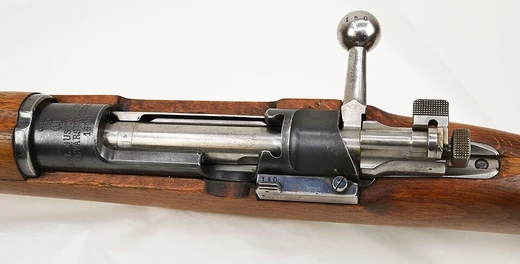
Norinco JW-103
A Chinese bolt-action hunting rifle with an adjustable trigger.

The Norinco JW-103 'Bush Ranger' is a centrefire bolt-action hunting rifle made by China North Industries Corporation (Norinco) for export. It belongs to Norinco's 'Jian Wei' series of sporting rifles, a line that started in 1955. Development of the JW-103 began in 1993, targeting the foreign hunting market. The design was finalized in June 1995, and mass production started later that year. The rifle is based on the Norinco JW-9/15 series, which is itself a simplified Chinese copy of the Czech .22 LR Brno Model 2 (later the CZ 452).
The receiver is made from milled and forged steel, and the barrel has a heavy blued finish. It fires the Russian-designed 7.62×39mm cartridge from a detachable, single-column, 5-round box magazine. The receiver is drilled and tapped for Weaver scope ring bases, allowing various scopes to be mounted. Unlike the JW-15, the JW-103 adds a three-way, user-adjustable trigger—a feature usually found on higher-end rifles. The trigger force, take-up, and break (sear contact patch area) are all adjustable using two threaded nuts and a set screw. The JW-103 has no iron sights; the JW-105 variant has front and rear sights, with the rear sight mounted on the barrel. These rifles are commercially available in countries including Australia, Canada, France, Germany, and New Zealand, sometimes sold under the "Bisley Small Arms" brand instead of Norinco.
Contrary to a common belief, the JW-103 and JW-105 do not use the Mauser-style front-locking action found on the earlier JW-101. Instead, their bolt design was scaled up from the rimfire JW-15, adding a pair of rear-locking lugs connected to the bolt handle.
The sole variant is the Norinco JW-105, also called the 'Bush Ranger', chambered for the .223 Remington cartridge. It is slightly longer and heavier than the JW-103 and features open-style iron sights, but is otherwise identical. Development of the JW-105 began in 1999 to appeal to shooters who prefer the more common .223 Remington over the 7.62×39mm round. Its design was approved in March 2001, with mass production starting immediately. The JW-103 and JW-105 are often advertised as lightweight, reliable hunting rifles at a lower price than similar models.
Quick Facts
- Origin
- China
- Is Ranged
- yes
- Designer
- China North Industries Corporation
- Design Date
- 1993-1995
- Manufacturer
- Zhongzhou Machine Works
- Production Date
- 1995 - Present
- Number
- 8000+ JW-103 / 1000+ JW-105
- Variants
- Norinco JW-105
- Weight
- 2.8 kg (JW-103) / 3 kg (JW-105)
- Length
- 1040 mm (JW-103) / 1045 mm (JW-105)
- Part Length
- 534 mm (JW-103) / 535 mm (JW-105)
- Cartridge
- 7.62×39mm (JW-103) / .223 Remington (JW-105)
Facts from the source article.
Lore & Background
The Norinco JW-103 was developed beginning in 1993 to create a rifle for the lucrative foreign hunting market. Its design was finalized in June 1995, with mass production underway by the end of that year. The rifle's design is based on the Norinco JW-9/15 series, which is a simplified Chinese copy of the Czech .22 LR Brno Model 2 (later CZ 452) rifle. The receiver is made from both milled and forged steel, while the barrel has a heavy blued finish. The JW-103 feeds from a detachable, single-column 5-round box magazine and is drilled and tapped for Weaver scope ring bases, allowing various scopes to be mounted.
Contrary to common beliefs, the JW-103 does not employ a Mauser-style front-locking action like the earlier JW-101 rifle. Instead, the bolt design was scaled up from the rimfire JW-15, adding a pair of rear-locking lugs connected to the bolt handle. The JW-103 has no sights, while its variant, the JW-105, features open-style iron sights. The JW-103 and JW-105 are commercially available in many countries including Australia, Canada, France, Germany and New Zealand, sometimes branded as 'Bisley Small Arms' instead of Norinco.
Reader's Guide
The Norinco JW-103 represents an effort by a Chinese state-owned manufacturer to enter the international hunting rifle market with a cost-effective design. Its significance lies in its adaptation of a rimfire action to a centrefire cartridge, scaling up the bolt from the JW-15 while adding rear-locking lugs. The inclusion of a three-way adjustable trigger—allowing adjustment of trigger force, take-up, and break via two threaded nuts and a set screw—was a feature typically found on more expensive rifles, giving the JW-103 a competitive edge in its price class. The rifle's legacy is tied to its availability in multiple Western markets, often under the Bisley Small Arms brand, and its pairing with the common 7.62×39mm cartridge. The later JW-105 variant, chambered in .223 Remington, expanded the series' appeal. The JW-103/105 series is unrelated to the earlier Norinco JW-101, a copy of the Zastava M48 that never entered mass production. The JW-103 is often advertised as a lightweight, reliable hunting rifle at a lower price than similar models.
Did You Know?
- The JW-103 is sometimes branded as 'Bisley Small Arms' instead of Norinco in countries such as Australia, Canada, France, Germany and New Zealand.
- The sole variant, the JW-105, is chambered for .223 Remington and features open-style iron sights.
Design Lineage & Manufacturing Origins
The Norinco JW-103 'Bush Ranger' traces its roots to a long-standing sporting rifle program. It belongs to the Jian Wei series—a name translating roughly to 'Health Guard'—which Norinco has produced since 1955. The specific JW-103 project kicked off in 1993 with a clear commercial objective: building a centrefire bolt-action rifle aimed squarely at the profitable overseas hunting trade. Engineers finalized the design in June 1995, and full-scale manufacturing was underway before that year closed. The mechanical foundation draws from the JW-9/15 family, which itself represents a simplified Chinese interpretation of the Czech Brno Model 2, later rebranded as the CZ 452. Production falls under Zhongzhou Machine Works, a Norinco subsidiary that carries the historical name State Factory No. 396. The receiver combines milled and forged steel for structural rigidity, while the barrel receives a heavy blued finish. Cartridge feeding is handled by a detachable, single-column five-round box magazine, and the action is chambered for the Russian-designed 7.62×39mm round. The top of the receiver is drilled and tapped to accept weaver-pattern scope ring bases, making optical mounting straightforward for hunters.
Trigger Engineering & Bolt Mechanics
One of the JW-103's most talked-about features is its three-way, user-adjustable trigger—a capability typically reserved for premium-tier hunting rifles. Shooters can fine-tune the trigger pull weight, the take-up distance before the break, and the sear contact patch area, all managed through two threaded nuts and a set screw. This level of adjustability gives the rifle a remarkably customizable shooting experience for its price bracket. The bolt action deserves particular attention because it is frequently misidentified. Despite sharing the 7.62×39mm chambering with the earlier JW-101, the JW-103 does not use a Mauser-style front-locking bolt. Instead, its locking mechanism was scaled up from the rimfire JW-15 platform and employs a pair of rear-locking lugs that connect directly to the bolt handle. This distinction matters to collectors and engineers who compare the two rifles. Additionally, the JW-103 ships without any iron sights, relying entirely on the weaver-base scope mounting for aiming, whereas its sibling JW-105 includes open iron sights with the rear sight mounted on the barrel.
Global Market Presence & Branding
From the outset, the JW-103 was conceived as an export product targeting what Norinco described as the lucrative foreign hunting market. That strategy has borne fruit across multiple continents. The rifle is commercially available in countries including Australia, Canada, France, Germany, and New Zealand, giving it a genuinely international footprint for a Chinese-manufactured sporting arm. Interestingly, in some of these markets the rifle does not carry the Norinco name at all. Instead, it is sold under the 'Bisley Small Arms' brand, a commercial rebranding that likely helps it compete alongside European and North American hunting rifles without the unfamiliarity that a Chinese manufacturer's name might carry in certain buyer demographics. The marketing pitch consistently emphasizes three selling points: lightweight construction, dependable reliability in the field, and a price tag noticeably below that of comparable bolt-action hunting rifles from established Western manufacturers. The use of the widely available 7.62×39mm cartridge—originally a Russian design—further broadens the rifle's appeal, as ammunition for this round is inexpensive and plentiful in many of the countries where the JW-103 is sold.
The JW-105 Variant & Series Boundaries
The JW-105 stands as the sole sibling in the JW-103 family, sharing the 'Bush Ranger' nickname but chambered for the .223 Remington cartridge rather than 7.62×39mm. Development of the .223 variant began in 1999, driven by the recognition that a significant portion of overseas hunters preferred the more ubiquitous .223 round. The design received approval in March 2001, and mass production commenced immediately thereafter. Physically, the JW-105 is slightly longer and heavier than its 7.62×39mm counterpart, and it adds open-style iron sights—front and rear, with the rear sight mounted on the barrel—while remaining otherwise mechanically identical. It is important to draw a clear line between the JW-103/105 pair and the Norinco JW-101. Although the JW-101 also fires 7.62×39mm, it was a copy of the Yugoslav Zastava M48, featured a four-round fixed magazine, Kar98k-style furniture, and never reached mass production. The JW-103 and JW-105 are entirely separate designs with no mechanical lineage to the JW-101, a distinction that sometimes causes confusion among collectors browsing Norinco's extensive catalogue.
More in Bolt-Action Rifles, Part 2 1-24
Spotted an error? Know more?
Reader corrections go straight into our review queue. Suggest an edit · How this site is sourced