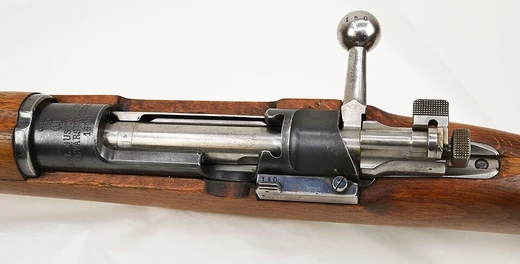
Sako 75
Finnish premium hunting rifle with three locking lugs and detachable magazine.

The Sako 75 is a bolt-action rifle from Finnish manufacturer Sako, produced from 1996 until 2006, when it was succeeded by the Sako 85, and finally discontinued in 2007. It was introduced to mark Sako’s 75th anniversary in 1996. While its external appearance closely resembled earlier Sako models, the internal design was new: it featured three symmetrical locking lugs, a manual ejector, and a detachable magazine—only the earlier L46 model had offered a detachable magazine before.
Positioned as Sako’s premium hunting rifle, the 75 came in numerous configurations and chamberings. Models included the Hunter, Hunter Stainless, Hunter left-hand, Laminated Stainless, Deluxe, Synthetic Stainless, Finnlight, Varmint, and Varmint Laminated Stainless.
The trigger pull weight is adjustable between 1 and 2 kg. The action can be cycled while the safety is engaged. The scope sight on the receiver bridge uses a proprietary tapered dovetail rail that is narrow at the rear and wide at the front. Proprietary scope rings are available, as are aftermarket Picatinny rail adapters. The entire bolt, including its handle, is milled from a single piece of cast steel. The Sako 75 uses a push feed mechanism, whereas its successor, the Sako 85, uses controlled feeding; the two models also have different magazine types.
Quick Facts
- Origin
- Finland
- Is Ranged
- yes
- Manufacturer
- Sako
- Production Date
- 1996–2006
- Cartridge
- .222 Rem to .500 Jeffery
- Action
- Bolt action
- Feed
- Push feed
- Sights
- Proprietary tapered dovetail rail for attaching optical sights
Facts from the source article.
Lore & Background
The Sako 75 was externally very similar to earlier Sako models, but its construction was different, having 3 symmetrical locking lugs, a manual ejector, and a detachable magazine. Hitherto, only one Sako rifle, the L46, had a detachable magazine. The action can be cycled with the safety applied. The scope sight in the receiver bridge is a proprietary tapered dovetail rail with variable width (narrow at the rear, wide at the front). Proprietary scope rings are available, and aftermarket picatinny rail adapters are also available. The entirety of the bolt, including its handle, is milled from a single piece of cast steel.
The Sako 75 has a push feed mechanism, compared to its successor Sako 85 which has controlled feeding. The M75 and M85 also have different types of magazines. The receiver was delivered in 6 different lengths depending on the cartridge group, graded with roman numerals from I to V: I (Short) for .222 Rem and .223 Rem; II (PPC) for .22 PPC USA and 6 mm PPC USA; III (Medium) for .22-250, .243 Win, .260 Rem, 7 mm-08 Rem, and .308 Win; SM (Short magnum) for .270 WSM and .300 WSM; IV (Long) for .25-06, 6.5×55 mm, .270 Win, 7×64 mm, .30-06, 9.3×62 mm, and 9.3×66 mm; V (Magnum) for 7 mm Rem Mag, .300 Win Mag, .375 H&H, and .416 Rem Mag.
Reader's Guide
The Sako 75 represents a significant evolution in Sako's rifle design, introducing a three-lug bolt and detachable magazine to the company's premium hunting lineup. Its push feed mechanism distinguishes it from the later controlled-feed Sako 85, and the rifle was offered in an extensive array of configurations and chamberings, including Hunter, Hunter Stainless, Hunter left hand, Laminated stainless, Deluxe, Synthetic stainless, Finnlight, Varmint, and Varmint Laminated Stainless models. The adjustable trigger (1–2 kg) and the ability to cycle the action with the safety applied were practical features for hunters. The proprietary tapered dovetail rail for scope mounting, along with aftermarket picatinny adapters, allowed flexibility in optics. The rifle's receiver lengths, graded I through V plus SM, covered cartridges from .222 Rem to .416 Rem Mag, making it adaptable to a wide range of game. The Sako 75 was produced from 1996 until its replacement by the Sako 85 in 2006, with final discontinuation in 2007, marking a decade of service as Sako's flagship hunting rifle.
Did You Know?
- The Sako 75 was named after the 75 year anniversary of Sako in 1996.
- It was the second Sako rifle to have a detachable magazine, after the L46.
- The receiver was offered in six different lengths graded with roman numerals I to V plus SM.
Design Philosophy & the Three-Lug Revolution
The Sako TRG line traces its roots to the TR-6 target rifle and development work carried out for the Valmet Sniper M86 in the mid-1980s. When Sako introduced the TRG-21 in 1989, it marked a deliberate departure from the company's earlier reliance on modified two-lug Mauser bolt actions. The new design featured a symmetrical three-lug bolt with a 19 mm diameter and a 75 mm² locking surface, engineered specifically after a thorough study of sniper requirements. The "G" in the name is a clever nod to its lineage, representing the number seven (the seventh letter of the alphabet) as a successor to the TR-6. This three-lug architecture proved so successful that it evolved into Sako's Sako 75 and Sako 85 hunting rifles. The TRG-21 weighed 4.7 kg and was chambered in .308 Winchester, with a maximum cartridge length of 75 mm. A scaled-up magnum action with a 20 mm longer bolt followed as the TRG-41, designed to exploit the .338 Lapua Magnum cartridge.
Military Refinement & Iterative Upgrades
To better suit military operators, Sako overhauled the TRG-21/41 platform in the late 1990s, producing the TRG-22/42 system in 1999. Improvements extended to accessories as well: the bipod was redesigned so the rifle could swivel or "hang" near its bore axis, providing greater stability when paired with large, heavy optics. A voluntary factory recall in June 2007 addressed a potential issue where a portion of the firing pin could travel rearward when a defective cartridge was fired, affecting rifles made between October 1999 and October 2002. In 2013, customer feedback drove another wave of upgrades: improved recoil pads, a newly constructed bolt release, a fully adjustable two-stage trigger with an ambidextrous safety lever, an aluminium-milled trigger guard for more positive magazine seating, and ruggedised bolt handle attachment. For .338 Lapua Magnum TRG-42 models, a new bolt with double plunger ejectors was introduced to handle the larger, heavier cases more reliably. All 2013 upgrades remained backwards compatible with earlier TRG rifles.
Calibre Spectrum & the Modular M10
The TRG family spans an impressive range of calibres. The TRG-21 and TRG-22 (A1) fire .308 Winchester (7.62×51mm NATO), while the TRG-41 and TRG-42 (A1) handle the more powerful .300 Winchester Magnum (7.62×67mm) and .338 Lapua Magnum (8.6×70mm). In 2011, Sako added the TRG-62 A1 as the third and largest iteration, chambered for the .375 CheyTac (9.5×77mm) cartridge. Beyond the single-calibre TRG line, Sako introduced the TRG M10 Sniper Weapon System in October 2011. Unlike its siblings, the M10 was conceived as a user-configurable, multi-calibre modular platform responding to evolving market demands, and it does not share its receiver or other technical features with the rest of the TRG family. This dual approach—dedicated single-calibre precision rifles alongside a flexible modular system—allowed Sako to address both traditional and emerging tactical requirements simultaneously.
Optics, Recoil Management & Practical Ergonomics
TRG rifles are typically fitted with detachable muzzle brakes that vent gas sideways, reducing recoil, muzzle jump, and flash. For optics, Sako generally pairs the TRG with Zeiss or Schmidt & Bender PM II telescopic sights, available in fixed or variable magnification. Variable-power scopes give operators flexibility when engaging targets at differing ranges or when a wide field of view is needed. Stock options include olive drab green, desert tan/coyote brown, dark earth, or black, with a folding stock variant also available. The 2018 A1 models brought a significant ergonomic leap: an aluminium middle chassis frame, a side-folding quick-adjustable buttstock, and a fore-end featuring the M-LOK rail interface, which allows direct accessory attachment to hollow slot mounting points. Chassis frames come in Tungsten Gray, Olive Drab Green, Graphite Black, and Coyote finishes. Earlier hunting-oriented variants like the TRG-S M995 (produced until 2003) offered an open-top receiver with a wedged dovetail rail and were available in eight standard and fourteen magnum chamberings.
More in Bolt-Action Rifles, Part 2 1-24
Spotted an error? Know more?
Reader corrections go straight into our review queue. Suggest an edit · How this site is sourced