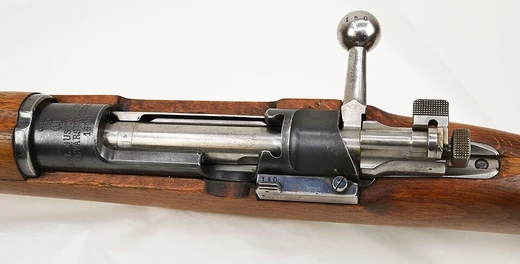
Ross rifle
A straight-pull rifle that saw controversy in Canadian service.

Unknown author Unknown author or not provided · Public domain
The Ross rifle is a straight-pull bolt-action rifle that used the .303 British cartridge and was made in Canada between 1903 and 1918. Its straight-pull design meant the bolt handle only needed to be pushed or pulled, rather than lifted and turned like on a Mauser or Lee-Enfield, which in theory could give a faster rate of fire and was simpler for soldiers to learn. The bolt could also be taken apart without tools, though this sometimes led to unauthorized disassembly.
The Mark II, or model 1905, was very successful in target shooting before World War I. However, the later Mark III (model 1910) had problems in trench warfare. Its chamber had tight tolerances, it lacked primary extraction, and it was long. These issues were made worse by the poor-quality ammunition often issued. The rifle also had a tendency for the bayonet to fall off when fired. Another serious flaw was that the bolt could be reassembled incorrectly after cleaning, so it would not lock but still fire, sending the bolt back into the shooter’s face.
The Ross Rifle Company also made sporting rifles, most notably chambered in .280 Ross, introduced in 1907. That cartridge was the first recorded to reach over 3,000 feet per second muzzle velocity and gained a strong international reputation among target shooters and hunters.
During the Second Boer War, Canada wanted to produce the Lee-Enfield SMLE under license, but the United Kingdom refused. Sir Charles Ross then offered to build a factory in Canada to make his own straight-pull rifle. The Liberal government of Sir Wilfrid Laurier accepted, and Ross got his first contract in 1903 for 12,000 Mark I rifles. Ross’s design was generally inspired by the straight-pull Austrian Mannlicher M1895, and his earliest rifles borrowed several mechanical details from it.
The first 1,000 rifles went to the Royal North-West Mounted Police for testing. Routine inspection found 113 defects serious enough for rejection, including a poorly designed bolt lock that let the bolt fall out and springs as soft as copper. In 1906, the RNWMP went back to their Winchesters and Lee-Metfords. The rifle was then modified into the Mark II (model 1905). In 1907, the Mark II was adapted for the higher-pressure .280 Ross, becoming the Mark II**. The model 1910 was a new design meant to fix the 1905’s problems, and no major parts are interchangeable between the two.
Quick Facts
- Is Ranged
- yes
- Origin
- Canada
- Designer
- Charles Ross
- Design Date
- 1903
- Production Date
- 1903–1918
- Service
- 1905–1918 / 1939–1945
- Wars
- World War I / Irish War of Independence / Spanish Civil War / World War II / 1947–1949 Palestine war
- Caliber
- .303 in (7.70 mm)
- Cartridge
- .303 British (7.7×56mmR)
- Part Length
- 711 mm (Mk 1 and Mk IIs) / 774 mm Mk II and Mk III)
- Feed
- 5-round stripper clip/charger
- Action
- Straight-pull bolt action
Facts from the source article.
Lore & Background
The Ross rifle was designed by Sir Charles Ross, who offered to finance a factory in Canada to produce his straight-pull design after the United Kingdom refused to license the Lee–Enfield SMLE for Canadian production. The design was inspired by the Austrian Mannlicher M1895, and early Ross rifles borrowed mechanical details from it. The straight-pull mechanism uses a bolt sleeve with spiral grooves that rotate the bolt head as the handle is pushed or pulled, unlocking or locking the action in a single motion.
The Mark I Ross was first tested by the Royal North-West Mounted Police, who found 113 defects in the first 1,000 rifles, including a poorly designed bolt lock and soft springs. The rifle was modified into the Mark II (Model 1905), which became highly successful in target shooting before World War I. A variant, the Mark II**, was modified in 1907 to handle the higher-pressure .280 Ross cartridge, which was the first cartridge to achieve over 3000 ft/s muzzle velocity. The Mark III (Model 1910) was a new design intended to correct earlier shortcomings, but its close chamber tolerances, lack of primary extraction, and length made it unsuitable for trench warfare, especially with poor-quality British ammunition.
Reader's Guide
The Ross rifle's significance lies in its role as Canada's standard infantry weapon during the early years of World War I and the controversy that surrounded its performance. The Mark III (1910) suffered from jamming when British-made ammunition was used, and the bolt could be reassembled incorrectly, causing it to fail to lock and potentially injure the operator. The bayonet also tended to become dislodged when firing. These problems led units such as Princess Patricia's Canadian Light Infantry to replace the Ross with the Lee-Enfield, and by the time of the Somme battles in July 1916, all Ross rifles in Canadian divisions were replaced by the Pattern 1914 Enfield.
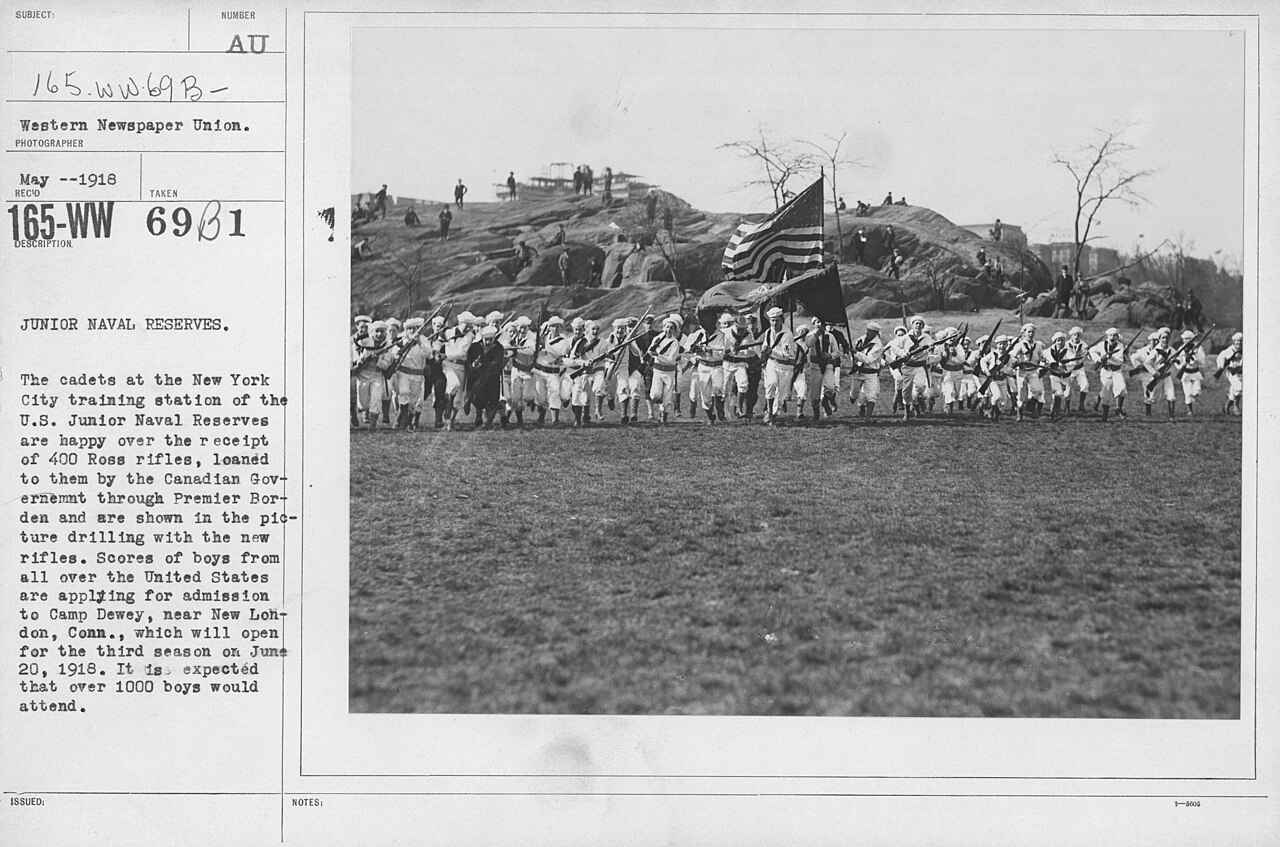
The rifle's chief sponsor, Canadian Minister of Militia and Defence Sam Hughes, defended it despite professional criticism, leading to political conflict. After Hughes resigned in November 1916, Ross rifles were used for training in Canada, the UK, and the United States. Some were converted into the Huot automatic rifle, which was effective but never adopted. The Ross rifle's legacy is one of a design that was accurate at long range but fatally flawed for the conditions of trench warfare.
Did You Know?
- The Ross rifle was inspired by the straight-pull Austrian Mannlicher M1895.
- The .280 Ross cartridge was the first to achieve over 3000 ft/s muzzle velocity.
- The bolt of the Ross rifle could be taken apart without special tools, encouraging unauthorized disassembly.
- Approximately 342,040 Ross service rifles were purchased by the British.
Origins and the Straight-Pull Mechanism
The Ross rifle's birth was rooted in a diplomatic standoff. When the United Kingdom declined to grant Canada a license to manufacture the Lee-Enfield SMLE in the aftermath of the Second Boer War, Sir Charles Ross stepped in with a bold proposal: he would personally fund a Canadian factory to build his own straight-pull bolt-action rifle for military service. The Liberal government under Sir Wilfrid Laurier accepted the offer, and in 1903 Ross received his initial contract for twelve thousand Mark I rifles. The design drew clear mechanical inspiration from the Austrian Mannlicher M1895, still a relatively recent introduction in the 1890s. The straight-pull system works through a hollow bolt sleeve fitted with internal spiral teeth that mesh with matching projections on the bolt head. Moving the lever forward or backward rotates the bolt head roughly ninety degrees, locking or unlocking it in a single fluid motion. This eliminated the separate raising, pulling, and lowering steps required by conventional actions like the Mauser or Lee-Enfield, promising a faster cycle and simpler training. The bolt could also be field-stripped without special tools, a feature that, while practical, encouraged soldiers to take the mechanism apart on their own initiative.
Target Shooting Glory and the .280 Ross
From its earliest days, the Ross Rifle Company saw beyond military contracts and began producing sporting rifles for the civilian market. The Mark II, also known as the Model 1905, earned a strong reputation in competitive target shooting circles before the outbreak of the First World War. Its tight chamber tolerances, which would later prove problematic in the mud of the trenches, were precisely what made it a precision instrument on the range. In 1907 the company introduced the .280 Ross cartridge, a round that made history as the first to exceed three thousand feet per second (914 meters per second) at the muzzle. This milestone gave the cartridge an outsized international following among both target shooters and hunters. The Mark II was subsequently modified into the Mk II** variant specifically to withstand the higher pressures generated by the .280 Ross load. The cartridge's reputation for velocity and accuracy spread well beyond Canada, cementing the Ross name in the global shooting community and establishing a legacy in the sporting world that persisted long after the military rifle itself fell out of favor.
Failure in the Trenches at Ypres
The Ross rifle's tight tolerances, lack of a primary extraction mechanism, and overall length made it poorly suited to trench conditions, a problem worsened by the often poor quality of issued ammunition. When the Model 10 reached France with the First Canadian Contingent in February 1915, its flaws were laid bare before the Second Battle of Ypres in April. Princess Patricia's Canadian Light Infantry was the first unit to voice objections, replacing the Ross with Lee-Enfields and persuading the 3rd Division to do the same. British-made ammunition, produced to looser tolerances than Canadian rounds, triggered frequent jams. The bolt's outer face could strike the bolt stop and deform the thread shape, and a bolt reassembled incorrectly might still fire but fail to lock, sending it back into the shooter's face. The bayonet also had a tendency to pop off during recoil. At Ypres, Canadian soldiers grabbed Lee-Enfields from fallen British troops. Lieutenant Chris Scriven remarked it sometimes took five men to keep one Ross firing, while Major T.V. Scudamore, captured after being wounded, called the rifle "contemptible" and described the terror of facing a German charge with a weapon that would not fire.
Political Storm and the Hughes Controversy
The Ross rifle's failures at the front quickly escalated into a political firestorm in Ottawa. Sam Hughes, the Canadian Minister of Militia and Defence and the rifle's chief political sponsor, refused to accept the professional assessment of Sir Edwin Alderson, the British officer commanding the First Canadian Division. Rather than concede the weapon's shortcomings, Hughes accused Alderson of ignorance and circulated a critical letter to numerous officers in the corps, effectively undermining Alderson's authority. Hughes also alleged that Canadian officers had been induced to file adverse reports about the rifle. When the Ottawa Citizen published negative accounts of the weapon's performance, Hughes's earlier claims before the House of Commons that the rifle's faults were overstated became increasingly difficult to sustain. The controversy transcended military matters, becoming a flashpoint in relations between Canada and Britain. Even as the British government pushed for standardization across the Empire on the Lee-Enfield, Canada stubbornly clung to the Ross. The political entanglement ensured that the rifle's retirement was not simply a technical decision but a deeply personal and national embarrassment for its patron.
Gallery
More in Bolt-Action Rifles, Part 2 1-24
Spotted an error? Know more?
Reader corrections go straight into our review queue. Suggest an edit · How this site is sourced