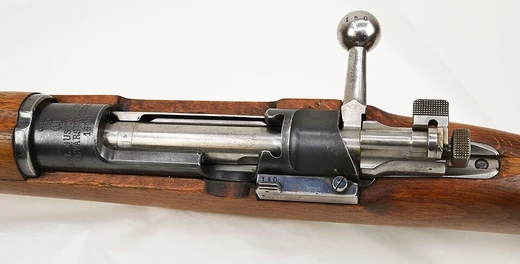
Colt Canada C19
Licence-built Tikka T3 CTR modified for Canadian Rangers.

The Colt Canada C19 is a bolt-action rifle produced under licence by Colt Canada, based on the Finnish-designed Tikka T3 CTR. It was developed to replace the longer and heavier Lee-Enfield No. 4 Mk.1 .303" rifles that had been in service with the Canadian Rangers since the unit's formation in 1947. The C19 is notable for being the result of a Canadian military procurement program that required a new bolt-action rifle with iron sights and a detachable 10-round box magazine, produced by a Canadian manufacturer and not totally identical to commercial rifles.
Quick Facts
- Origin
- Canada
- Is Ranged
- yes
- Service
- 2018
- Designer
- SAKO
- Manufacturer
- Colt Canada
- Unit Cost
- 4,824
- Production Date
- 2016–2018
- Number
- 6,800
- Weight
- 4.0 kg
- Length
- 102.0 cm
- Part Length
- 51.0 cm
- Cartridge
- 7.62×51mm NATO / .308 Winchester
Facts from the source article.
Lore & Background
The C19 was selected as the winner of a Canadian military procurement program after testing submissions from different rifle manufacturers. According to SAKO, production commenced in mid-2016, with rifle trials into 2017, and the full complement of 6,800 rifles was expected to be delivered by the end of 2019. The rifles are mainly used for self-defence against large North American carnivores, including polar bears, and for personal survival, as regional surveillance missions are often conducted for extended periods in remote areas, requiring the Rangers to hunt for food.
In May 2025, it was reported that the rifles could not withstand use in extreme arctic conditions, as evidenced by cracking in the wooden stocks due to moisture absorption. The lamination on the C19 wood stocks was peeling off, and the red wood dye from the stocks was leaching and staining the hands of users. Rangers were directed to treat the stocks with tung oil to seal the wood and protect against moisture. It was estimated that replacing the stocks would cost $10 million and take three years to complete. In July 2025, it was reported that a contract would be awarded that year for a three-year process from 2026 with new wood stocks matching the original red/grey laminate colour scheme. The Canadian Forces also ordered synthetic stocks for other C19 rifles for use by regular force military members on firing ranges, at airfields, and on the Royal Canadian Navy’s Arctic and Offshore Patrol Ships.
To meet requirements, the C19 features a larger bolt handle and enlarged trigger guard for gloved hands, protected front and rear iron sights, a laminated stock in a unique red colour with a Ranger badge, a two-stage trigger with a three-position safety, and a NATO Accessory Rail on the receiver top. The free-floating, hammer-forged threaded barrel, receiver, bolt, bolt handle, and other critical components are made of stainless steel. The buttstock is manufactured from plywood laminates, which are stronger and resist warping better than conventional one-piece patterns, do not require lengthy maturing, and are cheaper. The buttstock can be lengthened by adding spacers. The 10-round double-stack detachable box magazines have a rubber protector added at the bottoms.
Reader's Guide
The Colt Canada C19 represents a significant shift in the equipment of the Canadian Rangers, replacing the venerable Lee-Enfield No. 4 Mk.1 rifles that had been in use since World War II. Its design, based on the Tikka T3 CTR, incorporates modifications specifically for arctic and remote operations, such as a larger bolt handle and trigger guard for gloved hands, and protected iron sights. The rifle is chambered for both in-service 7.62×51mm NATO ammunition and commercially available .308 Winchester, allowing Rangers to use their issued rifles for private hunting. The C180 hunting ammunition, assembled by General Dynamics Ordnance and Tactical Systems in Quebec, pairs Nosler Accubond 180 gr hunting bullets with Canadian Forces' match brass cartridge cases, and is legally compliant for use as a last resort protection against polar bears on Svalbard.
The C19's legacy is marked by the stock issues reported in 2025, which led to a costly replacement program. The rifle's iron sights, with a rear rotary drum protected by sturdy ears and a semi-hooded front post, are designed for field conditions rather than maximal precision. The Canadian Armed Forces have not issued a requirement for optical weapon sights, leaving the choice to individual Rangers. The commercial Tikka T3x Arctic, introduced in 2017, is the civilian version, lacking the Ranger crest and featuring a more orange colour, with differences in bolt shroud, cocking piece, and sling mounting. The C19's role in self-defence and survival in extreme environments underscores its importance to the Canadian Rangers' mission.
Did You Know?
- In May 2025, it was reported that the C19's wooden stocks cracked due to moisture absorption, and the red dye leached onto users' hands.
- The C19 is capable of chambering both 7.62×51mm NATO ammunition and commercially available .308 Winchester ammunition.
- The commercial Tikka T3x Arctic, introduced in 2017, lacks the Canadian Rangers crest and has a more orange colour than the service rifle.
Roots in Wartime Vigilance
The modern Canadian Rangers trace their lineage to a wartime volunteer corps born from fear. In March 1942, as the spectre of a Japanese landing on the Pacific coast loomed, the Pacific Coast Militia Rangers were mustered to patrol British Columbia's and Yukon's shorelines. At their peak, roughly fifteen thousand volunteers organized into 138 companies across three patrol zones—Vancouver Island, the lower Fraser Valley, and the Bridge River region—kept watch with whatever rifles they could find. Senior officers such as Lieutenant-Colonel Cyrus Wesley Peck VC, Lieutenant-Colonel A.L. Coote, and Major H. Ashby led the effort. After Japan's surrender, the PCMR was stood down on September 30, 1945. Two years later, on May 23, 1947, the Canadian Rangers were formally created as a sub-component of the Army Reserve, tasked with maintaining a limited military footprint in corners of the country where garrisoning a conventional battalion would be neither practical nor affordable. Today approximately five thousand part-time members carry that mandate forward.
Five Patrol Groups, One Mosaic
The five thousand Rangers are distributed across five Canadian Ranger patrol groups, each commanded by a lieutenant-colonel and assigned to a Canadian division, with the sole exception of 1 CRPG, which falls under Joint Task Force North. The geographic spread is vast: 1 CRPG covers Yukon, the Northwest Territories, Nunavut, and British Columbia; 2 CRPG is confined to Quebec; 3 CRPG operates in Ontario from its Borden headquarters; 4 CRPG spans four western provinces from Victoria; and 5 CRPG serves Newfoundland and Labrador. Because each group's area of responsibility differs so dramatically in size and terrain, their internal structures vary. 3 CRPG, managing a single province, runs a central headquarters with full-time staff and a scattering of patrols across the north. 4 CRPG, covering four provinces, layers traditional companies between the headquarters and individual patrols. Full-time Army staff—mostly Class-B Reserve personnel, though 1 CRPG relies predominantly on Regular Force members—administer these patrols. Each patrol averages around thirty members, the rough equivalent of a platoon, and is commanded by a sergeant with a master corporal as second-in-command, while ten-man sections are led by master corporals assisted by corporals.
Always Watching, Rarely Standing Down
Rangers operate in the most remote, sparsely settled stretches of the country—northern reaches and coastal communities where no conventional garrison would ever be posted. Their core tasks include surveillance, sovereignty patrols known as SOVPATS, and inspections of the North Warning System infrastructure. When other Army elements deploy into their area, Rangers step in as guides, scouts, and subject-matter experts, particularly in wilderness survival. Despite the always-on character of their role, formal training is limited to twelve days per year, though additional sessions are often offered and attendance remains voluntary. Compensation follows a tiered system: during routine operations and training, Rangers are paid at Class-A or Class-B Reserve rates based on rank. However, when called to search-and-rescue missions or domestic emergencies such as flood and wildfire response, they receive Class-C pay, which matches full Regular Force rates and benefits. This structure acknowledges that while the role is part-time in name, the vigilance is continuous.
Gear, Guns, and the Art of Self-Sufficiency
Each Ranger receives a standard-issue kit: a red sweatshirt bearing the Ranger emblem, CADPAT trousers, combat boots, a baseball cap, a safety vest, a rifle, and navigation aids. Beyond that, the philosophy is self-reliance. Patrols are stocked with basic camp stores—tents, stoves, lanterns, axes—but individuals are expected to bring and maintain their own transport and tools. The military reimburses the use of personal equipment at nationally set rates, covering everything from snowmobiles (military-designated as light over-snow vehicles) and all-terrain vehicles to watercraft, trailers, pack horses, sled dog teams, radios, chainsaws, and generators. On the weapons front, the Lee-Enfield No 4 in .303 British has been the standard rifle since 1947, with each user allotted two hundred rounds annually. That tradition echoes the PCMR era, when volunteers patrolled with personal rifles and shotguns, and purchasing agents turned to American lever-actions like the Winchester 1894 and Marlin 36 in .30-30 calibre as a stop-gap while Canadian Enfield production was reserved for overseas campaigns.
More in Bolt-Action Rifles, Part 2 1-24
Spotted an error? Know more?
Reader corrections go straight into our review queue. Suggest an edit · How this site is sourced