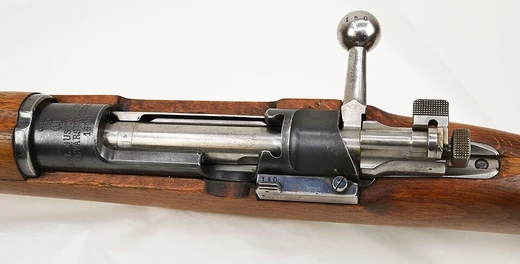
ZVI Falcon
Czech 12.7 mm bullpup anti-materiel rifle for long-range targets.

Sumeet Moghe · CC BY-SA 4.0
The ZVI Falcon is a Czech anti-materiel rifle chambered in 12.7 mm. It is a bolt-action bullpup design produced by Zbrojovka Vsetín Inc., now known as ZVI Inc. The weapon is built for ground troops and special forces engaging targets at distances up to 1600 meters, including armored fighting vehicles and other technical equipment.
The rifle uses a Mauser-style locking system with a two-lug bolt and feeds from a fixed two-round box magazine. It includes a magazine cut-off, which means that when engaged, each shot requires manually loading a fresh cartridge into the chamber. A collapsible bipod and a carrying handle are mounted near the midpoint of the barrel. A muzzle brake reduces recoil by 75 percent according to the manufacturer. Although a bayonet mount was planned, it was not included on production models.
The Falcon has a sight rail for mounting a Meopta ZD 10×50 telescopic sight for daytime use or a Meopta ZN 6× passive night vision sight for nighttime operations. A protective cover is available for the scope, and backup iron sights are provided for emergency use if the scope is damaged. For transport, the rifle can be stored in a carrying case, and a special backpack is available for airborne forces.
The Falcon saw service in the War in Afghanistan. It is also used by the Armed Forces of Ukraine during the Russian invasion of Ukraine. A total of 19 rifles were gifted from the Czech Republic as part of a military aid package following the 2022 invasion.
Quick Facts
- Origin
- Czech Republic
- Is Ranged
- yes
- Service
- 1998–present
- Manufacturer
- ZVI Inc. (formerly Zbrojovka Vsetín Inc.)
- Variants
- OP96 / OP99
- Spec Label
- OP99
- Weight
- 12.2 kg (single-shot) / 12.9 kg (with magazine)
- Length
- 1260 mm
- Part Length
- 839 mm
- Cartridge
- .50 BMG (OP99) / 12.7×108mm (OP96)
- Action
- Mauser bolt action
- Velocity
- 825 –
Facts from the source article.
Lore & Background
The ZVI Falcon is a bullpup bolt-action rifle with a Mauser locking system and fixed 2-round box magazine. It features a magazine cut-off, necessitating a new cartridge must be manually loaded into the chamber after each shot when it is engaged. The bolt has two locking lugs. Mounted about halfway along the Falcon are a collapsible bipod and a carrying handle. It also features a muzzle brake to dampen recoil; ZVI states that the muzzle brake reduces recoil by 75 percent. A bayonet mount was planned, but was not included on production versions. The Falcon features a sight rail to mount the Meopta ZD 10×50 telescopic sight for daylight engagements and the Meopta ZN 6× passive night vision sight for nighttime use. A protective cover is available to protect the scope from damage. The rifle also has backup iron sights for emergency use if the scope is damaged. The Falcon can be stowed in a carrying case for transport, and a special backpack is available for use by airborne forces.
Reader's Guide
The ZVI Falcon was used in the War in Afghanistan. It is also used by Armed Forces of Ukraine during Russian invasion of Ukraine. 19 were gifted from Czech Republic, sent as part of a military package in response to the 2022 Russian invasion of Ukraine. The rifle's bullpup configuration and 12.7 mm caliber provide a compact yet powerful anti-materiel capability for engaging distant targets up to 1600 m. Its Mauser locking system and fixed 2-round magazine, along with the magazine cut-off feature, define its operational manual-loading cycle. The inclusion of both day and night optical sights, backup iron sights, and a carrying case or backpack for airborne forces underscores its intended use by special operations and ground troops in diverse combat environments.
Did You Know?
- The ZVI Falcon uses a Mauser locking system with two locking lugs.
- Its muzzle brake is stated by ZVI to reduce recoil by 75 percent.
- A bayonet mount was planned but not included on production versions.
- 19 Falcons were gifted from the Czech Republic to Ukraine as part of a military package.
Engineering a Precision Platform
The ZVI Falcon represents a distinctly Czech approach to anti-materiel rifle design, developed by Zbrojovka Vsetín Inc. (which later rebranded as ZVI Inc.). At its core, the weapon is a 12.7 mm bolt-action rifle built around a bullpup configuration, with the action and magazine positioned behind the trigger group to shorten the overall profile. The locking mechanism draws on the proven Mauser system, employing two locking lugs on the bolt to secure the chamber under the pressures of the heavy cartridge. A fixed two-round box magazine feeds the chamber, and an optional magazine cut-off feature forces the operator to manually seat each subsequent round—a deliberate design choice that prioritizes deliberate, single-shot engagement over rapid follow-up fire. About midway along the receiver, a collapsible bipod and a carrying handle are mounted, giving the shooter both stability and portability. The most striking recoil-management element is the muzzle brake, which ZVI claims cuts felt recoil by as much as 75 percent, making sustained accuracy at extended ranges far more practical. A bayonet mount was considered during development but ultimately excluded from production models.
Optics, Transport, and Field Readiness
The Falcon's sighting system is built around a dedicated rail that accepts two distinct Meopta scopes tailored to different operational conditions. For daylight engagements, the Meopta ZD 10×50 telescopic sight provides the magnification needed to identify and engage distant targets, while the Meopta ZN 6× passive night vision sight extends the rifle's utility into low-light and nighttime operations. A protective cover is available to shield the scope from field damage, and a set of backup iron sights is incorporated as a fallback should the primary optic be compromised. Beyond the optical package, ZVI has thought through the logistics of moving the weapon. The Falcon can be stowed in a purpose-built carrying case for standard transport, and a special backpack configuration exists specifically for airborne forces who need to deploy the rifle by parachute. These transport solutions reflect the rifle's intended role with ground troops and special operations units who may need to carry the weapon across varied terrain and in austere environments. The overall design philosophy balances precision shooting capability with practical field considerations, ensuring the weapon remains functional and transportable in the conditions where anti-materiel fire is most likely to be required.
Combat Proven: Afghanistan to Ukraine
The ZVI Falcon was designed with a specific operational envelope in mind: engaging distant targets at ranges extending to 1,600 metres (approximately 1,700 yards). Its intended targets are not personnel but rather armoured fighting vehicles and other technical equipment—assets that pose a significant threat to infantry and special forces operating in the field. The rifle's combat record spans two major conflicts. It saw service during the War in Afghanistan, where anti-materiel capability was a critical requirement for forces confronting improvised and conventional threats at range. More recently, the Falcon has been employed by the Armed Forces of Ukraine in the context of the Russian invasion. In both theatres, the weapon's combination of heavy-calibre firepower, manageable recoil, and precision optics made it a practical choice for operators tasked with neutralizing hardened or armoured targets that smaller-calibre weapons could not effectively engage. The fact that the rifle has been deployed in geographically and tactically distinct environments underscores its versatility and the confidence operators place in its reliability under sustained combat conditions.
A Small but Strategic Footprint
Despite its relatively niche role, the ZVI Falcon has found a place in the arsenals of several nations across Central and Eastern Europe. The Czech Republic, as the manufacturer's home country, naturally fields the rifle, and it has also been adopted by Slovakia, Georgia, and North Macedonia. The most geopolitically significant deployment came in 2022, when the Czech Republic gifted nineteen Falcon rifles to Ukraine as part of a military aid package delivered in response to Russia's full-scale invasion. This transfer highlighted the weapon's immediate tactical value to a nation facing armoured and technical threats on its own soil, and it also underscored the broader pattern of Czech military hardware flowing to Ukraine during the conflict. The user list, while modest in number, reflects a consistent demand from smaller and mid-sized armed forces that need a capable anti-materiel platform without the logistical burden of heavier systems. The Falcon's presence in these diverse arsenals speaks to its reputation as a reliable, purpose-built tool for a specific and critical combat role.
Gallery




More in Bolt-Action Rifles, Part 2 1-24
Spotted an error? Know more?
Reader corrections go straight into our review queue. Suggest an edit · How this site is sourced