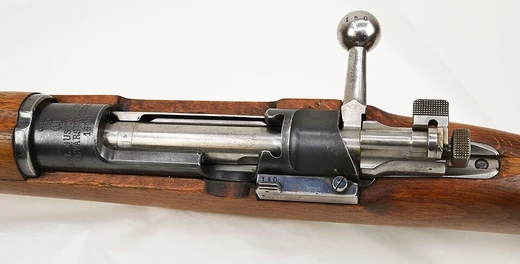
Cooey 60
A Canadian bolt-action .22 repeater with a tubular magazine.

The Cooey Model 60 is a bolt-action repeating rifle chambered for .22 short, .22 long, and .22 LR rimfire cartridges. It appeared in 1939–1940 and was manufactured by H.W. Cooey Machine & Arms Company in Cobourg, Ontario, Canada, until 1979. The Model 60 is notable for its tubular magazine, which holds 10+1 (.22 LR) to 15+1 (.22 short) cartridges, and for being the repeating counterpart to Cooey's single-shot models.
Quick Facts
- Origin
- Canada
- Designer
- H.W. Cooey Machine & Arms Company
- Production Date
- 1939-1967
- Variants
- Winchester Model 600
- Cartridge
- .22LR, .22 Long, .22 Short
Facts from the source article.
Lore & Background
The Cooey Model 60 shares various design characteristics with Cooey's previous rifles. Its bolt assembly is similar to the Model 38 and Model 75, but has been adapted to fully cock itself when the shooter cycles the action. In contrast, single-shot Cooey rifles leave the bolt in a half-cock state after cycling, requiring the user to manually pull the striker to its rest point before firing, a design that makes those rifles exceptionally safe and almost impossible to fire accidentally. The Model 60 would sometimes feature 'Ranger' stamped into the receiver preceding the model number, a marketing word used by Cooey and various department stores that sold the rifle.
In 1967, following the Olin Corporation purchase of H.W. Cooey Machine & Arms, the 'Model 60' moniker was replaced by the 'Model 600' branding. The Winchester Model 600 was functionally identical to the Model 60, with minor changes: the trigger guard was made of polymer, the knurled thumbscrew joining the receiver and stock was replaced with a Phillips pan head screw, and the fore end of the stock was notably longer. Some Model 600 Cooey rifles were produced with a rabbit engraved into the stock, a configuration informally known as the 'Jackrabbit Special'.
Reader's Guide
The Cooey Model 60 represents a significant step in the evolution of Cooey's bolt-action rimfire rifles, transitioning from single-shot designs to a repeating platform while retaining core mechanical similarities. Its tubular magazine, offering capacities from 10 to 15 rounds depending on cartridge length, made it a practical choice for plinking and small-game hunting. The rifle's production span from 1939–1940 to 1979, all at the Cobourg, Ontario factory, underscores its long-standing popularity in Canada. The later rebranding as the Winchester Model 600 after the Olin Corporation acquisition, with minor updates such as a polymer trigger guard and a longer fore end, kept the design relevant into the late 20th century. The informal 'Jackrabbit Special' variant, with its rabbit engraving, adds a collectible dimension. The Model 60's legacy is tied to its reliability and the broader Cooey lineage, which influenced later Winchester-branded rimfire rifles.
Did You Know?
- The Model 60 appeared in 1939–1940 and was manufactured until 1979.
- Some Model 60 rifles have 'Ranger' stamped into the receiver as a marketing prefix.
- The later Winchester Model 600 replaced the knurled thumbscrew with a Phillips pan head screw.
More in Bolt-Action Rifles, Part 2 1-24
Spotted an error? Know more?
Reader corrections go straight into our review queue. Suggest an edit · How this site is sourced